
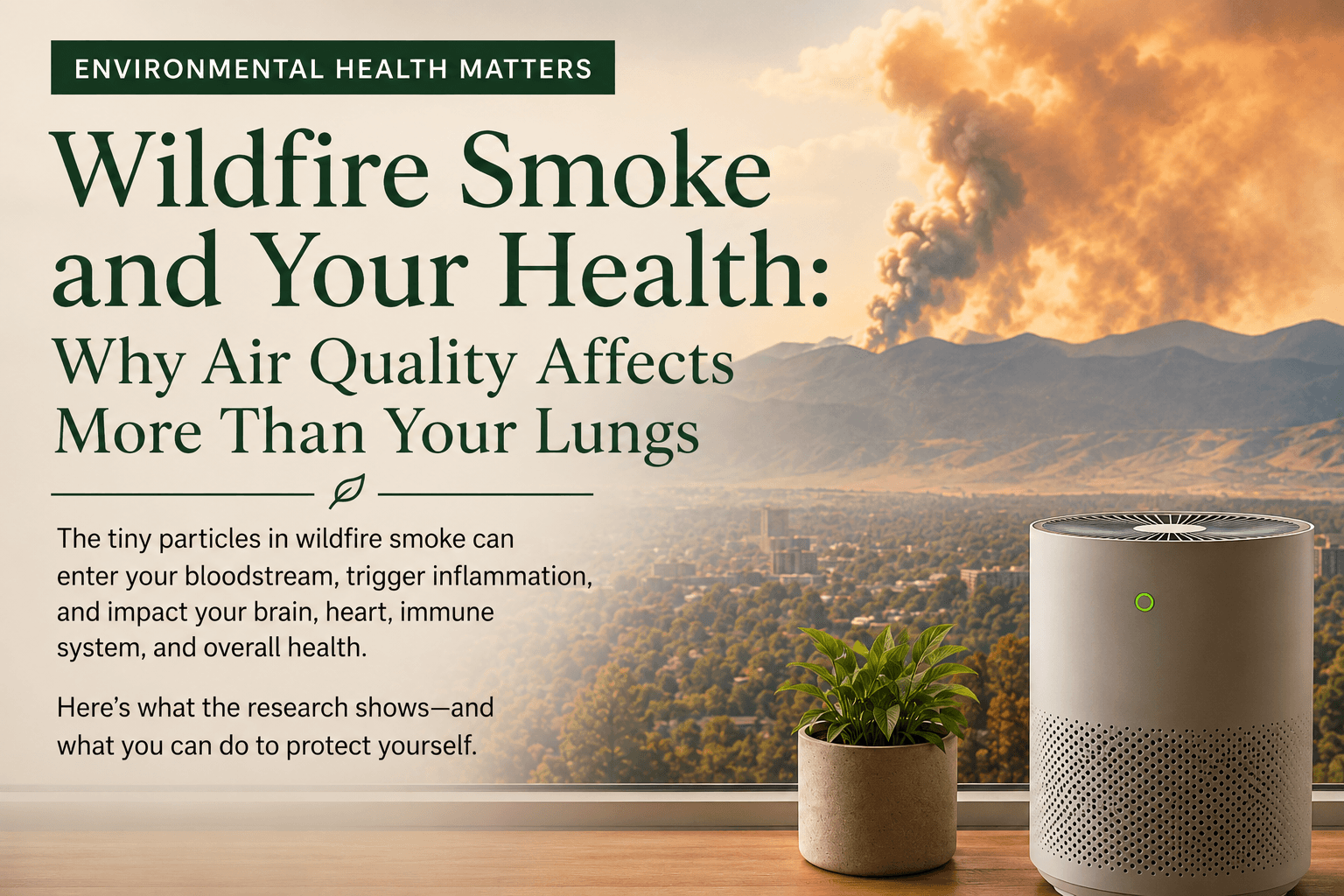
Wildfire Smoke and Your Health: How Air Pollution Impacts Inflammation, Brain Function, and Long-Term Wellness
 Kelsey Asplin, ND
in Environmental Health, immune health, naturopathic medicine, real talk
June 10, 2026
Kelsey Asplin, ND
in Environmental Health, immune health, naturopathic medicine, real talk
June 10, 2026
Wildfire Smoke Has Become a Colorado Health Issue
One of the reasons so many people choose to live in Colorado is because we value being outdoors.
We hike. We bike. We paddle board. We snowboard. We camp. We horseback ride. We spend as much time outside as possible because that’s one of the things that makes Colorado such an incredible place to live.
Unfortunately, wildfire smoke is a part of that reality as well.
What used to feel like an occasional inconvenience has become a recurring seasonal health challenge. Even when the fires aren’t burning in our immediate area, smoke can travel hundreds or even thousands of miles, impacting air quality throughout the Front Range and across the state.
Most people think about wildfire smoke as a respiratory issue.
If you’ve ever experienced a smoky day, you’ve probably noticed some of the classic symptoms:
- irritated eyes
- coughing
- sore throat
- increased congestion
- shortness of breath
But as I started diving deeper into the research, I realized that the story is much bigger than that.
Wildfire smoke doesn’t just affect your lungs. It affects your entire body. And for many people, it may be contributing to symptoms that don’t immediately seem related to air quality at all.
Why Wildfire Smoke Is Different Than Ordinary Smoke
When we talk about wildfire smoke, we’re not just talking about burning trees.
Wildfire smoke is a complex mixture of particulate matter, volatile organic compounds (VOCs), carbon monoxide, heavy metals, and combustion byproducts generated from everything the fire consumes.1
That may include:
- vegetation
- building materials
- plastics
- household chemicals
- vehicles
- treated wood
- industrial materials
The component that concerns researchers most is something called PM2.5.
PM2.5 refers to particulate matter measuring less than 2.5 microns in diameter. To put that into perspective, a human hair is roughly 70 microns wide. That means these particles are approximately 30 times smaller than the width of a human hair.
Because of their size, they bypass many of the body’s normal defense mechanisms. Instead of getting trapped in the nose or upper respiratory tract, they travel deep into the lungs where they can interact directly with delicate lung tissue. Even more concerning, some of these particles can cross into circulation and travel throughout the body.2
This is where the conversation shifts from respiratory health to whole-body health.
Why You Might Feel “Off” During Wildfire Season
One of the things I hear from patients every summer is:
“I don’t know what’s wrong. I just don’t feel like myself.”
They’re more tired. Their sleep is worse. Their brain feels foggy. They are more irritable. Their autoimmune symptoms flare. Their headaches become more frequent. Their motivation drops.
Many assume they’re stressed, overworked, dehydrated, or simply getting older. And sometimes those things are true. But wildfire smoke may be contributing more than we realize.
Research has shown that PM2.5 exposure increases inflammatory signaling throughout the body.3 Once these particles enter circulation, they can contribute to oxidative stress, activate inflammatory cytokines, and influence immune system activity.4
This means your body isn’t just responding locally in the lungs. It’s responding systemically. In functional medicine and naturopathic medicine, we often talk about “total body burden.” Wildfire smoke is one more input that the body has to process.
And when someone is already dealing with hormone imbalances, chronic stress, autoimmune disease, metabolic dysfunction, mold exposure, or digestive issues, that additional burden can sometimes be enough to tip the scales and make symptoms noticeably worse.
The Research That Made Me Pay Attention
I’ll be honest.
When I first started looking into wildfire smoke, I viewed it primarily as a respiratory concern. Then I started reading the neurological research. And that completely changed how I think about air quality. Researchers have increasingly identified associations between long-term exposure to PM2.5 and changes in brain health.5
Several studies have found links between air pollution exposure, neuroinflammation, cognitive decline, and increased accumulation of beta-amyloid in the brain.6 Beta-amyloid plaques are one of the hallmark pathological findings associated with Alzheimer’s disease.
One of the researchers whose work has helped bring attention to this connection is Dr. Lilian Calderón-Garcidueñas, who has spent decades studying the neurological effects of air pollution.7 Her research has demonstrated that chronic exposure to particulate air pollution is associated with inflammatory changes in the brain and increased markers linked to neurodegenerative disease.
To be very clear, this does not mean that experiencing a smoky week causes Alzheimer’s disease. That would be an inaccurate interpretation of the research. What it does suggest is that chronic exposure to fine particulate matter may contribute to processes involved in neuroinflammation and long-term brain health.
For me, this was one of those moments where a piece of research changes how you think about a topic.
Wildfire smoke stopped being just a respiratory issue.
It became a brain health issue.
A cardiovascular issue.
An immune system issue.
A whole-body issue.
And that has important implications for how we approach prevention and support.
Beyond the Lungs: The Cardiovascular and Metabolic Effects of Wildfire Smoke
One of the reasons researchers have become so concerned about PM2.5 is that these particles do not stay confined to the respiratory tract.
Once particulate matter enters circulation, it can interact with blood vessels, immune cells, and tissues throughout the body. Research has linked PM2.5 exposure to endothelial dysfunction, increased oxidative stress, elevated inflammatory cytokines, and changes in blood vessel function.8
In plain English? Wildfire smoke can make the body behave as though it’s under attack. This is one reason why studies have consistently found increases in cardiovascular events during periods of poor air quality. Hospital admissions for heart attacks, strokes, arrhythmias, and other cardiovascular conditions often rise during wildfire smoke events.9
For those of us who work with patients dealing with insulin resistance, metabolic syndrome, chronic inflammation, or autoimmune disease, this is particularly important. Inflammation rarely stays in one lane. It tends to ripple outward. The body doesn’t separate inflammation into neat categories like “lung inflammation” or “brain inflammation.” Inflammatory signaling affects multiple systems simultaneously. This is one reason why, during periods of smoke exposure, people may experience:
- increased fatigue
- worsened blood sugar control
- heightened pain sensitivity
- headaches
- mood changes
- increased autoimmune symptoms
Sometimes patients tell me they feel crazy because they can almost predict when air quality worsens before they even check the Air Quality Index. The reality is that many of them are noticing real physiological changes.
The Hidden Exposure Most People Miss
One of the biggest misconceptions about wildfire smoke is that staying indoors completely protects you. I wish that were true. Unfortunately, wildfire smoke is incredibly good at finding its way into our homes.
When my husband and I were traveling in Portugal with some friends during our honey-babymoon, we landed in the city of Porto to find brown skies and campfire smells everywhere. Several wildfires had broken out in a crescent that surrounded the city and blew all the smoke towards across Porto to the Atlantci. By the next morning, it was raining ash and all of our tours were cancelled. Masks were sold out everywhere. By day three, we were catching a train to Lisbon because the Air Quality Index literally displayed a gas mask icon. The apartment we were staying in was collecting ash inside the bathrooms and bedrooms – there was no escaping it. Those particles permeate. And not feeling like we could breathe, along with all the women being pregnant, gave us good cause to get out.
Those tiny PM2.5 particles can infiltrate through:
- doors
- windows
- ventilation systems
- building materials
- attic spaces
- crawl spaces
This means indoor air quality often deteriorates alongside outdoor air quality. In some homes, indoor levels may remain elevated for days after outdoor air quality improves.
This is one of the reasons I have become increasingly passionate about helping patients understand air filtration. Not because air purifiers are trendy. Not because they are the answer to everything. But because reducing exposure is often more effective than trying to compensate for exposure after it occurs.
If I had to choose between someone taking a handful of supplements while breathing poor-quality air versus improving the quality of the air they’re breathing, I would certainly prioritize the air first. The best supplement protocol in the world cannot completely overcome ongoing environmental exposure.
Who Tends to Be Most Sensitive?
Some people seem to tolerate smoke exposure relatively well. Others feel terrible after just a day or two. Why? The answer is multifactorial.
Individuals with asthma, COPD, cardiovascular disease, autoimmune conditions, chronic fatigue, mold illness, mast cell activation, and chronic inflammatory conditions often appear to be more sensitive.10 Children and older adults are also at increased risk. Pregnancy presents another unique situation because inflammatory and oxidative stress exposures may affect both mother and baby (hence why we left our destination city).
Then there are the patients who don’t fit neatly into any of those categories. The patients who simply tell me:
“I feel awful when the smoke rolls in.”
Many of those individuals likely have varying degrees of susceptibility related to genetics, detoxification pathways, antioxidant capacity, immune regulation, and overall body burden. This is why two people can live in the same environment and have completely different experiences.
Supporting the Body During Wildfire Season
One of my favorite things about naturopathic medicine is that we don’t have to choose between prevention and support. We can do both. The first goal is always reducing exposure. The second goal is helping the body respond more effectively when exposure occurs.
NAC and Glutathione
If you’ve spent any time around functional medicine, you’ve probably heard about NAC. There is a good reason for that. N-acetylcysteine (NAC) serves as a precursor to glutathione, one of the body’s most important endogenous antioxidants.11 Glutathione plays a central role in managing oxidative stress and supporting detoxification processes. Wildfire smoke exposure increases oxidative stress. Supporting glutathione production is one way we can help improve resilience during periods of increased environmental burden.
NAC also has a long history of use in respiratory health and has been studied for its ability to help support bronchodilation, healthy mucus production and antioxidant activity within the lungs.12 For many patients, wildfire season becomes one of the times of year when NAC moves higher on my list of considerations.
Omega-3 Fatty Acids: EPA and DHA Are Not the Same
One of the most common mistakes I see is people thinking all fish oil works the same way. It doesn’t. EPA and DHA each play distinct roles.
EPA tends to be more strongly associated with inflammatory signaling and cytokine modulation.13 When I think about helping calm an inflammatory response, EPA is often the omega-3 that comes to mind first.
DHA, on the other hand, serves as a major structural component of neuronal membranes and plays a critical role in maintaining healthy brain tissue.14 When I think about long-term neurological health, cognitive resilience, and supporting the brain during periods of increased inflammatory stress, DHA becomes incredibly important.
This is one reason I often recommend formulas that provide meaningful amounts of both EPA and DHA rather than focusing exclusively on one. The combination allows us to support both inflammatory balance and brain health simultaneously. But, the ratio of the two omegas may vary from patient to patient, and from season to season, depending on your unique needs.
Antioxidants: The Unsung Heroes
Wildfire smoke generates a significant amount of oxidative stress. Think of oxidative stress as biological wear and tear occurring faster than the body can repair it. Antioxidants help buffer that process. Some of the nutrients I commonly think about during wildfire season include:
- Vitamin C, which supports immune function and antioxidant recycling.
- Vitamin E, which helps protect cellular membranes.
- Quercetin, which has both antioxidant and mast-cell stabilizing properties.
- Curcumin, which supports healthy inflammatory signaling.
- Resveratrol, which has been studied for both antioxidant and neuroprotective effects.
The goal isn’t to throw every antioxidant imaginable at the problem. The goal is to strategically support resilience.
Medicinal Mushrooms
This is another area where I think the conversation gets interesting. Several medicinal mushrooms offer unique benefits that align surprisingly well with the challenges posed by wildfire smoke.
Lion’s Mane is best known for its effects on cognitive health and nerve growth factor support. Given the growing discussion around air pollution and brain health, Lion’s Mane often becomes part of the conversation.
Reishi is one of my favorites for immune modulation and stress resilience. It tends to support balance rather than simply stimulating immune activity. It is particularly useful for brain specific allergy protection and reducing neuroinflammation.
Cordyceps has traditionally been used to support respiratory function, energy production, and oxygen utilization. Considering that wildfire smoke directly impacts respiratory health, Cordyceps can be a valuable tool for certain patients.
No single mushroom is a magic solution. But they can be part of a thoughtful strategy aimed at improving resilience during periods of environmental stress.
What We Are Doing at Denver Naturopathic Clinic
For those of you who know our predecessors, Dr. Jacob Schor and Dr. Rena Bloom, you may remember hearing that large air filter unit humming over in the corner of the lobby. We have maintained that unit over the years and have been consistently thankful for it during wildfire season, but also when our neighbors wore a little too much cologne, made a little too strong of coffee, or smoked a little too much inside their office (yes – you read that right).
Over the past several years, environmental medicine has become a larger and larger part of our clinical conversations.
We’re seeing increasing numbers of patients whose symptoms are influenced by:
- wildfire smoke
- mold exposure
- water-damaged buildings
- chemical exposures
- indoor air quality
Sometimes these environmental factors are the primary issue. More often, they’re one piece of a larger puzzle. But they are often an important piece. This is one reason we’ve chosen to partner with trusted air filtration companies, not only in our office and our homes, but also for our patients.
Not because air filters are exciting. Let’s be honest. Nobody wakes up excited to buy an air purifier and many people probably lose hours to researching them (Hi!).
But because reducing exposure often provides more value than trying to compensate for exposure after the fact. If we can lower the amount of particulate matter entering the body every day, we reduce the burden the body has to manage. That matters.
Final Thoughts
One of the biggest lessons I’ve learned from diving into the wildfire smoke literature is that air quality deserves far more attention than it receives. This is not just a respiratory issue.
It is an inflammatory issue.
A cardiovascular issue.
A neurological issue.
An immune system issue.
And increasingly, it appears to be a long-term brain health issue as well.
The good news is that we are not powerless. We can improve our indoor air. We can reduce exposure. We can support the body’s antioxidant systems. We can strengthen resilience through nutrition, targeted supplementation, and lifestyle strategies. And perhaps most importantly, we can stop dismissing the very real effects that environmental exposures can have on how we feel.
If you’ve ever noticed that you feel more fatigued, more inflamed, more foggy, or simply less like yourself during wildfire season, you’re probably not imagining it. Your body may be responding exactly the way biology predicts it would.
And once we understand that, we can start doing something about it.
References
- Reid CE, Brauer M, Johnston FH, Jerrett M, Balmes JR, Elliott CT. Critical review of health impacts of wildfire smoke exposure. Environmental Health Perspectives. 2016.
- Schraufnagel DE, Balmes JR, Cowl CT, et al. Air pollution and noncommunicable diseases. Chest. 2019.
- Manisalidis I, Stavropoulou E, Stavropoulos A, Bezirtzoglou E. Environmental and health impacts of air pollution. Frontiers in Public Health. 2020.
- Brook RD, Rajagopalan S, Pope CA III, et al. Particulate matter air pollution and cardiovascular disease. Circulation. 2010.
- Calderón-Garcidueñas L, Solt AC, Henriquez-Roldán C, et al. Long-term air pollution exposure is associated with neuroinflammation and Alzheimer’s-type pathology. Toxicologic Pathology. 2008.
- Peters R, Ee N, Peters J, Booth A, Mudway I, Anstey KJ. Air pollution and dementia: systematic review and meta-analysis. BMJ Open. 2019.
- Calderón-Garcidueñas L, Villarreal-Ríos R. Living close to heavy traffic roads, air pollution, and dementia. Journal of Alzheimer’s Disease. 2017.
- Rajagopalan S, Al-Kindi SG, Brook RD. Air pollution and cardiovascular disease. Journal of the American College of Cardiology. 2018.
- Wettstein ZS, Hoshiko S, Fahimi J, et al. Cardiovascular and cerebrovascular emergency department visits associated with wildfire smoke exposure. Environmental Research. 2018.
- U.S. Environmental Protection Agency. Wildfire Smoke: A Guide for Public Health Officials. Updated guidance.
- Rushworth GF, Megson IL. Existing and potential therapeutic uses for N-acetylcysteine. Pharmacology & Therapeutics. 2014.
- Millea PJ. N-acetylcysteine: multiple clinical applications. American Family Physician. 2009.
- Calder PC. Omega-3 fatty acids and inflammatory processes. Nutrients. 2010.
- Dyall SC. Long-chain omega-3 fatty acids and brain function. Proceedings of the Nutrition Society. 2015.