
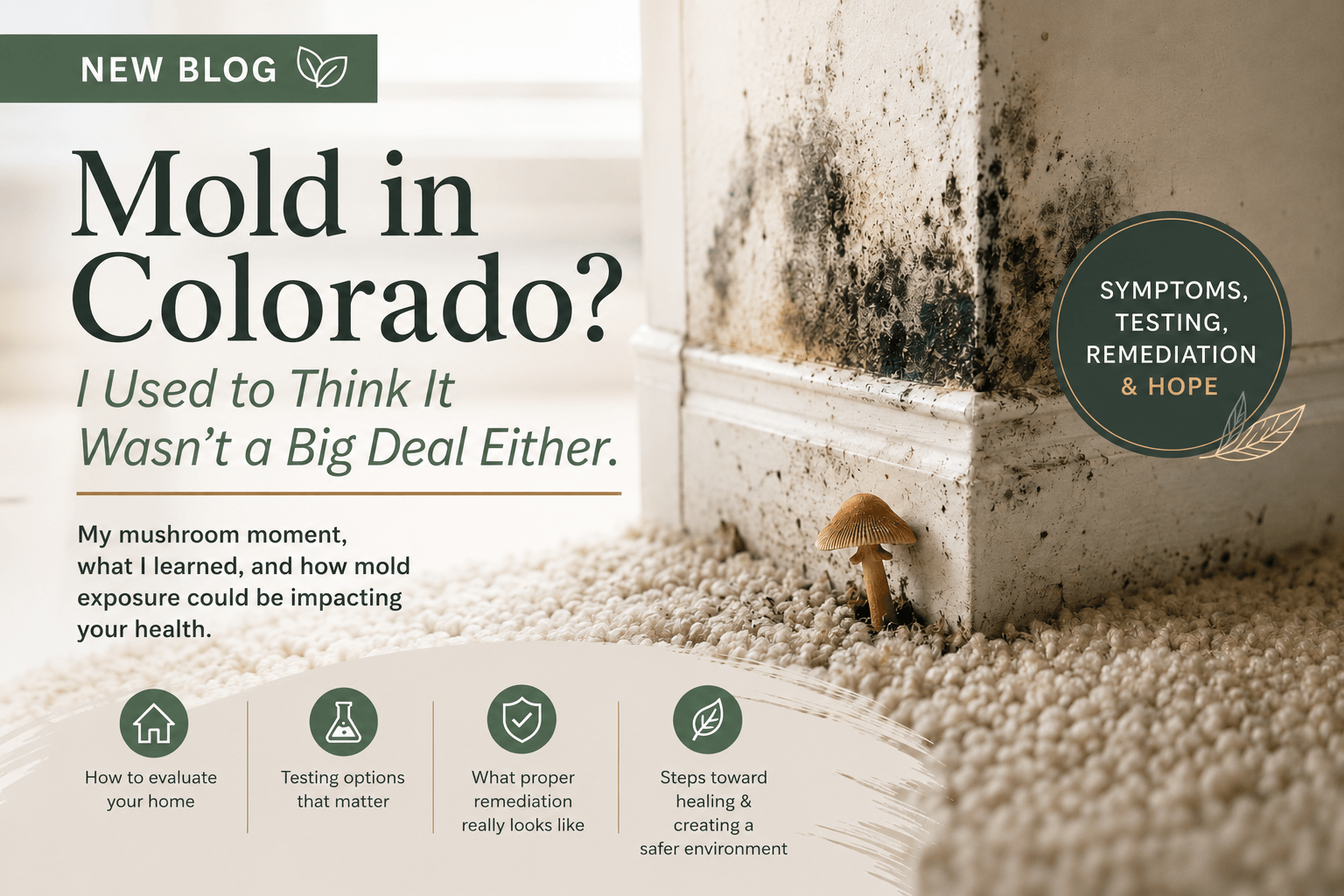
Mold in Colorado? I Used to Think It Wasn’t a Big Deal Either.
 Kelsey Asplin, ND
in brain health, detox, Environmental Health, gut health, immune health, mens health, thyroid health, womens health
June 16, 2026
Kelsey Asplin, ND
in brain health, detox, Environmental Health, gut health, immune health, mens health, thyroid health, womens health
June 16, 2026
The Night I Found a Mushroom Growing Through My Carpet
There are certain moments in life that permanently change the way you think about something.
For me, one of those moments happened in a condo I owned here in Colorado.
I had always thought mold was mostly a problem in humid climates. Florida? Sure. Louisiana? Absolutely. Somewhere tropical with constant moisture? That made sense.
Colorado? Not really.
We live in a dry climate. We have sunshine. We don’t exactly have a reputation for mold problems.
Then one evening, I noticed something unusual near a baseboard.
At first glance, it looked like a small piece of debris sticking up through the carpet.
When I got closer, I realized it was a mushroom.
An actual mushroom.
Growing through my carpet.
Inside my home.
As strange as that sounds, that mushroom ended up being one of the most important discoveries I’ve ever made.
Because mushrooms don’t appear without a reason.
That little mushroom was simply the visible part of a much larger problem hiding behind the walls.
What We Eventually Discovered
What followed was a lengthy investigation that revealed a construction defect that had likely been present for years.
A moisture barrier had never been properly installed between the exterior rock façade of the building and the interior wall assembly. Every time it rained or snowed, water would make its way behind the stone, become trapped, and slowly saturate the materials hidden behind the drywall.
From the outside, everything looked completely normal. There were no giant water stains. No obvious flooding. No dramatic signs that something was wrong. Meanwhile, inside the wall cavity, moisture had been accumulating for years. Mold had quietly established itself. The mushroom was simply the first clue that the problem had reached a point where it could no longer stay hidden.
The discovery eventually displaced us from our home for more than six months while the investigation, remediation, reconstruction, and contents restoration process unfolded. And let me tell you, there is nothing quite like packing up your entire life because of mold.
I often joke that it’s remarkable my relationship survived that period. At the time, James and I were still relatively early in our relationship. Mold remediation, insurance claims, construction delays, temporary housing, and replacing much of your belongings is a crash course in stress management.
The experience was exhausting. But it also taught me lessons that have fundamentally changed how I evaluate patients today.
The Symptoms Didn’t Scream “Mold”
One of the reasons mold is so often missed is because the symptoms rarely point directly to mold. People expect mold illness to look like respiratory illness. They expect coughing, sneezing, congestion, maybe asthma. Sometimes those symptoms occur. But often the presentation is much broader.
During that period, we experienced many of the symptoms I now hear from patients every week.
- Brain fog.
- Fatigue.
- Anxiety.
- Sleep disruption.
- Frequent sinus infections.
- Digestive complaints.
- Mood changes.
- General inflammation.
- A feeling that something simply wasn’t right.
Looking back, what fascinates me most is how easy it was to explain away each symptom individually. I mean, maybe we were stressed. Maybe we weren’t sleeping enough. Maybe work was overwhelming. Maybe it was hormones. Maybe it was allergies. Maybe it was something we ate (because isn’t it always…).
The challenge with mold is that it rarely presents as one giant obvious symptom. Instead, it often appears as dozens of seemingly unrelated symptoms that gradually accumulate over time. This is one reason mold frequently becomes a diagnosis of exclusion. People spend months or years looking for answers before anyone considers the environment itself.
Why Mold Is More Common Than Most Colorado Residents Realize
One of the biggest misconceptions I encounter in practice is the belief that mold isn’t a major concern in Colorado because we’re a dry state. The reality is that mold doesn’t require humidity. It requires moisture. Something like a plumbing leak, roof leak, a poorly sealed window, condensation, a refrigerator water line, an HVAC issue, dishwasher leak, a foundation problem…Any of these situations can create the conditions necessary for mold growth.
In fact, studies suggest that approximately half of all buildings in North America have experienced some degree of water damage, and water-damaged buildings are strongly associated with indoor microbial growth.¹
Colorado is not exempt from that reality. If anything, our climate can sometimes create a false sense of security that delays discovery. I’ve also become increasingly concerned about newer construction. Many people assume that new homes can’t have mold problems. Unfortunately, that’s not always true. Building materials are often exposed to rain and snow during construction. If materials become wet and are enclosed before fully drying, microbial growth can begin before the homeowner ever moves in. I’ve seen mold issues in homes that were less than two years old. Age is not protection. Moisture management is.
Why Mold Affects People So Differently
One of the things that makes mold so confusing is that two people can live in the exact same home and have completely different experiences. One person feels terrible. The other feels perfectly fine. I’ve seen this repeatedly in practice, and it’s often one of the reasons mold gets dismissed so quickly. Someone will tell me:
“My spouse feels fine.”
“My kids don’t seem affected.”
“My coworkers aren’t having any issues.”
And therefore, the assumption becomes that mold can’t be the problem. But biology doesn’t work that way. We know from both research and clinical experience that people respond differently to environmental exposures based on a variety of factors. Genetics play a role. Detoxification capacity plays a role. Immune system regulation plays a role. Inflammatory burden plays a role. Hormonal status plays a role. Even previous environmental exposures may influence how someone responds.
Think of it like sun exposure. Two people can spend the same afternoon at the pool. One develops a severe sunburn while the other barely changes color. The exposure was identical. The response was not.
Mold works similarly. The question isn’t simply: “Is mold present?”
The question is: “How is this particular person’s body responding to that exposure?”
And that is where things become much more nuanced.
The Connection Between Mold, Inflammation, and Chronic Symptoms
One of the reasons mold has become such an important topic in functional medicine is that it often creates a state of chronic immune activation. The body recognizes mold spores, mold fragments, microbial volatile organic compounds, and in some cases mycotoxins as environmental threats. When exposure becomes ongoing, the immune system may remain activated for prolonged periods of time. This can contribute to inflammatory signaling throughout the body.
The result is that symptoms often appear in places people don’t expect.
- The brain.
- The gut.
- The skin.
- The hormones.
- The immune system.
- The nervous system.
This is why mold rarely presents as a simple respiratory issue. In fact, some of the most common symptoms we see clinically include:
- brain fog
- fatigue
- anxiety
- depression
- headaches
- poor sleep
- sinus congestion
- digestive complaints
- food sensitivities
- skin flares
- hormone disruption
- difficulty recovering from exercise
- and worsening autoimmune symptoms.
One of the biggest clues I often look for is symptom clustering. Any one of these symptoms could have dozens of explanations. But when someone presents with multiple symptoms across multiple systems and the timing aligns with a known or suspected exposure, mold moves much higher on my list of possibilities.
Chronic Inflammatory Response Syndrome (CIRS)
If you’ve spent any time researching mold illness, you’ve probably come across the term CIRS. CIRS stands for Chronic Inflammatory Response Syndrome. The concept was largely developed through the work of Dr. Ritchie Shoemaker, who observed that some individuals appeared to develop a persistent inflammatory response following exposure to water-damaged buildings and other biotoxin exposures.² The idea behind CIRS is that certain individuals may have difficulty effectively clearing biotoxins from the body. As a result, inflammatory pathways remain activated long after the initial exposure begins.
The symptoms associated with CIRS can be surprisingly broad. People may experience:
- fatigue
- brain fog
- poor concentration
- headaches
- temperature regulation issues
- sleep disruption
- joint pain
- muscle aches
- growing pains
- hormone changes
- digestive symptoms
- mood changes
- and unusual sensitivity to light, sound, chemicals, or odors.
One of the reasons CIRS remains somewhat controversial is that it doesn’t fit neatly into conventional medical frameworks. At the same time, many clinicians working with environmentally complex patients observe patterns that are difficult to ignore. Whether someone meets strict criteria for CIRS or not, what matters most clinically is understanding that environmental exposures can create systemic effects that extend far beyond the lungs.
Mold and Hormone Health
One of the things I find particularly interesting is how often mold shows up in patients who initially come to us for hormone concerns. A patient may schedule an appointment because of:
- PMS
- perimenopause
- low energy
- irregular cycles
- fertility concerns
- thyroid symptoms
- or unexplained weight changes.
On the surface, these issues may not appear related to mold at all. But when we dig deeper, we sometimes uncover an environmental story running quietly in the background. Chronic inflammation can influence hormone signaling. Stress responses can alter cortisol regulation. Sleep disruption affects reproductive hormones. Immune activation can place additional strain on the body.
The result is that mold exposure may indirectly contribute to symptoms that seem primarily hormonal. This does not mean mold is always the cause. But it does mean that environmental health deserves a seat at the table when we’re trying to understand why someone doesn’t feel well.
Mold, Fertility, and the Growing Environmental Health Conversation
Another area receiving increasing attention is the relationship between environmental exposures and fertility. While the research is still evolving, we know that inflammation, oxidative stress, endocrine disruption, and immune dysfunction can all influence reproductive health. These same mechanisms frequently appear in discussions surrounding mold exposure. I think this is an area we’ll continue learning much more about over the coming decade. For now, what I tell patients is simple:
When someone is struggling with unexplained fertility challenges, recurrent symptoms, or chronic inflammatory issues, it is reasonable to consider whether environmental factors may be contributing to the overall picture. Not because mold is always the answer. But because it is sometimes the answer. And if it is being missed, progress can remain frustratingly slow.
How Do We Actually Test for Mold?
This is usually the point where patients ask the question I wish had a simple answer:
“Can I just get tested for mold?”
Unfortunately, mold testing is rarely that straightforward. One of the biggest misconceptions about mold illness is the belief that there is a single test that can definitively tell us whether mold is the problem. There isn’t. At least not currently. Instead, mold evaluation often looks more like detective work. We gather clues from multiple sources and determine whether they point toward a common explanation. This can feel frustrating because most people want certainty. They want a lab result that says, “Yes, mold is the problem,” or, “No, mold isn’t the problem.”
But environmental medicine rarely operates in black and white. Instead, we look for patterns. Patterns in symptoms. Patterns in exposure history. Patterns in laboratory findings. Patterns in the home environment. And when those patterns begin aligning, the picture often becomes much clearer.
The First Step: Your Story
Before we ever talk about testing, I usually start with a much simpler question.
What is the story?
When did this start?
Did any major life changes happen around or shortly before that time (like moving into a new house, starting Has there been water damage?
Do symptoms improve when you travel?
Do symptoms worsen when you return home?
Have you lived in older buildings?
Have there been roof leaks, plumbing issues, flooding, condensation, musty odors, or visible mold?
Has anyone else in the household experienced symptoms?
The answers to these questions often tell me far more than any single laboratory test. One of the reasons my own mold experience was eventually identified is because the environmental story became impossible to ignore. There was a mushroom growing through my carpet. Most people don’t get such an obvious clue. Which is why taking a careful environmental history becomes so important.
Urine Mycotoxin Testing
One of the most commonly requested (and controversial) tests is urine mycotoxin testing. This type of testing measures the presence of certain mycotoxins being excreted through the urine. Mycotoxins are toxic compounds produced by some species of mold that are water soluble. In theory, finding elevated levels in the urine may suggest higher than average exposure. In practice, interpretation becomes more complicated.
One challenge is that urinary mycotoxin testing does not necessarily tell us where the exposure came from. It cannot tell us whether the mold is in your current home, a previous home, your workplace, or another environment. It also cannot reliably tell us whether the exposure is current or historical. And perhaps most importantly, not everyone excretes toxins the same way. Some individuals appear to excrete more readily than others.
Despite these limitations, urine mycotoxin testing can still provide useful information when interpreted alongside symptoms, history, and other findings. Like most mold testing, it is most valuable as one piece of the puzzle rather than a standalone answer.
Bloodwork and Inflammatory Markers
Another approach involves evaluating inflammatory and immune markers that may become dysregulated in response to chronic environmental exposure. Depending on the clinical situation, this may include markers such as:
- TGF-beta1
- C4a
- MMP-9
- VEGF
- MSH
- ADH and osmolality
- Various inflammatory and immune markers
These markers are often discussed within the context of CIRS and biotoxin illness. One of the challenges is that many of these markers are not specific to mold. They can be influenced by other inflammatory processes as well. This means that elevated markers do not prove mold exposure. However, when combined with symptoms, exposure history, and other findings, they may help us better understand what the immune system is doing.
MARCoNS Testing
Another tool sometimes used in complex mold cases is testing for MARCoNS. MARCoNS stands for Multiple Antibiotic Resistant Coagulase Negative Staphylococci. This testing is typically performed using a nasal swab.
The theory is that chronic biotoxin exposure may create an environment where these bacteria can persist within the nasal passages and contribute to ongoing inflammatory signaling.³ Like many aspects of mold medicine, opinions differ regarding how much weight should be given to MARCoNS testing.
Some clinicians use it frequently. Others rarely use it.
In my experience, it can occasionally provide useful information, but it should be viewed within the broader clinical picture rather than as a primary diagnostic tool.
Visual Contrast Sensitivity (VCS) Testing
One of the more unusual screening tools is Visual Contrast Sensitivity testing. This assessment evaluates a person’s ability to distinguish between subtle differences in contrast. Research has suggested that certain inflammatory and biotoxin-related conditions may affect visual contrast sensitivity.⁴
The test itself is relatively inexpensive and noninvasive. However, like many mold-related tests, it is not diagnostic on its own. Think of it as another clue. A clue that may support a larger pattern, but not a final answer.
Home Testing: Where Things Get Interesting
Personally, I think one of the most important questions isn’t, “Is mold showing up in my body?” It’s, “Is mold present in my environment?” Because if exposure continues, healing becomes much more difficult.
This is where home testing enters the conversation. And this is also where things can become expensive, confusing, and occasionally controversial.
ERMI Testing
ERMI stands for Environmental Relative Moldiness Index. This test analyzes dust samples collected from the home and uses DNA-based technology to evaluate mold species present within the environment.⁵ ERMI can provide a broader picture of historical mold burden because dust tends to accumulate over time. One advantage is that it may identify mold issues that air sampling misses. One limitation is that it does not necessarily tell us where the mold is located.
A high ERMI score tells us there is a mold burden. It doesn’t automatically tell us where the problem exists or how significant current exposure may be.
Air Sampling
Air sampling remains one of the most commonly performed environmental assessments. During air sampling, air is collected from various locations and analyzed for mold spores. It’s common that samples from outside are compared to inside the concerning space to see if inside levels exceed those found outside.
The challenge is that air sampling represents a snapshot in time. If mold is hidden behind a wall and not actively releasing spores into the sampled air, results may appear relatively normal despite a significant problem being present.
I’ve seen homes with obvious mold issues produce surprisingly unremarkable air sampling results. I’ve also seen elevated air samples in homes where the source was relatively minor. This is why air sampling is often most useful when combined with other forms of assessment.
What About Mold Dogs?
Believe it or not, mold detection dogs are a real thing. And yes, some of them are remarkably impressive. (Aren’t dogs the best!?)
Specially trained dogs can sometimes identify hidden mold locations that are difficult to find through visual inspection alone. While this may sound unusual, it can occasionally be helpful in complex situations where traditional inspections have failed to identify the source.
Would I use a mold dog as my first-line strategy? Probably not (because I’d be too worred about the dog’s health)
Would I completely dismiss them? Also no. There are situations where they can provide valuable information.
One of the Most Important Ethical Considerations
This is something I feel strongly about. Whenever possible, I generally prefer that the company performing the mold inspection is not the same company offering to perform the remediation.
Why? Because there is an inherent conflict of interest. If a company benefits financially from finding mold, there is a risk that recommendations become influenced by that financial relationship.
Most ethical companies that test for mold will not offer remediation services but may have ones they refer to. Separating inspection from remediation creates a cleaner process and helps ensure recommendations remain objective.
Think of it this way. You probably wouldn’t want your mechanic getting paid based on how many repairs they can convince you to authorize. The same principle applies here.
Independent assessment often leads to greater confidence in the findings.
What Proper Remediation Actually Looks Like
One of the biggest myths I encounter is the idea that mold remediation simply means replacing drywall or spraying something with antimicrobial paint. Unfortunately, it is rarely that simple. Proper remediation involves identifying and correcting the moisture source first. Without addressing the moisture problem, the mold problem will almost always return.
Once the source has been corrected, contaminated materials often need to be removed under carefully controlled conditions. Professional remediation typically includes containment barriers, negative air pressure systems, HEPA filtration, and strict cleaning protocols designed to prevent cross-contamination throughout the home.⁶
This matters because mold isn’t just growing where you can see it.Spores, fragments, and dust can become airborne and settle throughout the environment. In our situation, many porous items could not be reliably cleaned.
- Mattresses.
- Bedding.
- Furniture.
- Certain fabrics.
- Other belongings.
It was one of the most difficult parts of the process and was a practice in letting go. And it gave me a much greater appreciation for how disruptive mold remediation can be for families.
How We Approach Mold Cases at Denver Naturopathic Clinic
One of the reasons mold cases can feel overwhelming is because there is rarely a perfect roadmap. Testing is imperfect. Remediation can be expensive. Symptoms can be confusing. And information online is often contradictory.
Our goal is not to convince every patient they have mold. Our goal is to determine whether mold may be a meaningful contributor to the symptoms they’re experiencing. Sometimes the answer is yes. Sometimes the answer is no. And sometimes the answer is “maybe, but we need more information.”
The key is approaching the situation thoughtfully, systematically, and without jumping to conclusions. Because while mold may not be the answer for everyone, it can be a significant barrier to healing for the people it affects. And when that’s the case, identifying it can change everything.
The Good News: Mold Is a Problem We Can Do Something About
If you’ve made it this far into the article, you might be thinking, “This sounds overwhelming.” And honestly, sometimes it is. Mold exposure can be disruptive. Really disruptive And finding reliable information is often harder than it should be.
But here’s the good news. Unlike many health challenges, mold is often a problem we can identify and actively address. I’ve watched patients spend years chasing symptoms before finally uncovering an environmental contributor that had been quietly influencing their health all along. Once the exposure was identified and properly addressed, many of those patients were finally able to make progress in areas that had previously felt stuck.
Their energy improved. Their sleep improved.Their brain fog lifted. Their resilience returned.
Not overnight. Not because there was a magic supplement. But because their body was no longer fighting the same battle every single day. One of the biggest lessons my own mold experience taught me is that healing isn’t always about finding the next thing to add. Sometimes it’s about identifying what needs to be removed.
Start With What You Can Control
If there is one takeaway I hope you leave with, it’s this:
Don’t let perfection become the enemy of progress.
You don’t need to panic. You don’t need to tear your house apart tomorrow. And you certainly don’t need to assume that every symptom is caused by mold. But if mold exposure is a possibility, it’s worth paying attention to.
Start by gathering information. Understand your environment. Investigate water damage when it occurs. Ask questions – lot’s of them. Work with qualified professionals (like our doctors!). And focus on reducing unnecessary exposure where possible.
One of the easiest places to start is the air you breathe every day.
This is one reason we partner with trusted air filtration companies to help patients access high-quality systems capable of filtering mold spores, mycotoxins, wildfire smoke particles, and other ultra-fine contaminants.
Air filtration is not a cure. But reducing exposure can be an important part of creating an environment that supports healing.
Final Thoughts
One of the reasons environmental medicine has become such an important part of our work at Denver Naturopathic Clinic is because we continue to see how profoundly the environment can influence health. Sometimes the missing piece isn’t another diet or another supplement. Sometimes it’s the home you’re living in and the air you’re breathing. Maybe it’s the exposure your body is quietly responding to every single day.
And while mold may be hidden, its effects don’t have to remain a mystery. The more we understand the relationship between our environment and our health, the better equipped we are to make decisions that support long-term wellness.
Because health isn’t just about what’s happening inside your body.
It’s also about the environment surrounding it.
References
References
- Institute of Medicine (US) Committee on Damp Indoor Spaces and Health. (2004). Damp indoor spaces and health. Washington, DC: National Academies Press.
- Shoemaker, R. C., & House, D. E. (2006). A time-series study of sick building syndrome: Chronic, biotoxin-associated illness from exposure to water-damaged buildings. Neurotoxicology and Teratology, 28(5), 573–588.
- World Health Organization. (2009). WHO guidelines for indoor air quality: Dampness and mould. Copenhagen, Denmark: WHO Regional Office for Europe.
- Mendell, M. J., Mirer, A. G., Cheung, K., Tong, M., & Douwes, J. (2011). Respiratory and allergic health effects of dampness, mold, and dampness-related agents: A review of the epidemiologic evidence. Environmental Health Perspectives, 119(6), 748–756.
- Fisk, W. J., Lei-Gomez, Q., & Mendell, M. J. (2007). Meta-analyses of the associations of respiratory health effects with dampness and mold in homes. Indoor Air, 17(4), 284–296.
- Hope, J. (2013). A review of the mechanism of injury and treatment approaches for illness resulting from exposure to water-damaged buildings, mold, and mycotoxins. Scientific World Journal, 2013, 767482.
- Brewer, J. H., Thrasher, J. D., Hooper, D., Straus, D. C., & Madison, R. A. (2013). Detection of mycotoxins in patients with chronic fatigue syndrome. Toxins, 5(4), 605–617.
- Gray, M. R., Thrasher, J. D., Crago, R., Madison, R. A., Arnold, L., Campbell, A. W., & Vojdani, A. (2003). Mixed mold mycotoxicosis: Immunological changes in humans following exposure in water-damaged buildings. Archives of Environmental Health, 58(7), 410–420.
- United States Environmental Protection Agency. (2024). Mold and indoor air quality. Retrieved from https://www.epa.gov/mold
- United States Environmental Protection Agency. (2024). A brief guide to mold, moisture and your home. Retrieved from https://www.epa.gov/mold
- American Conference of Governmental Industrial Hygienists (ACGIH). (2022). Recognition, evaluation, and control of indoor mold (2nd ed.).
- International Society for Environmentally Acquired Illness (ISEAI). (2024). Clinical practice guidelines for diagnosis and treatment of environmentally acquired illness.
- Environmental Relative Moldiness Index (ERMI). United States Environmental Protection Agency. Retrieved from https://www.epa.gov/indoor-air-quality-iaq/environmental-relative-moldiness-index-ermi
- Shoemaker, R. C., Hudnell, H. K., House, D. E., Schmid, J., & Aziz, N. (2006). Sick building syndrome in water-damaged buildings associated with chronic inflammatory response syndrome: A review of the evidence. Neurotoxicology and Teratology, 28(5), 573–588.