
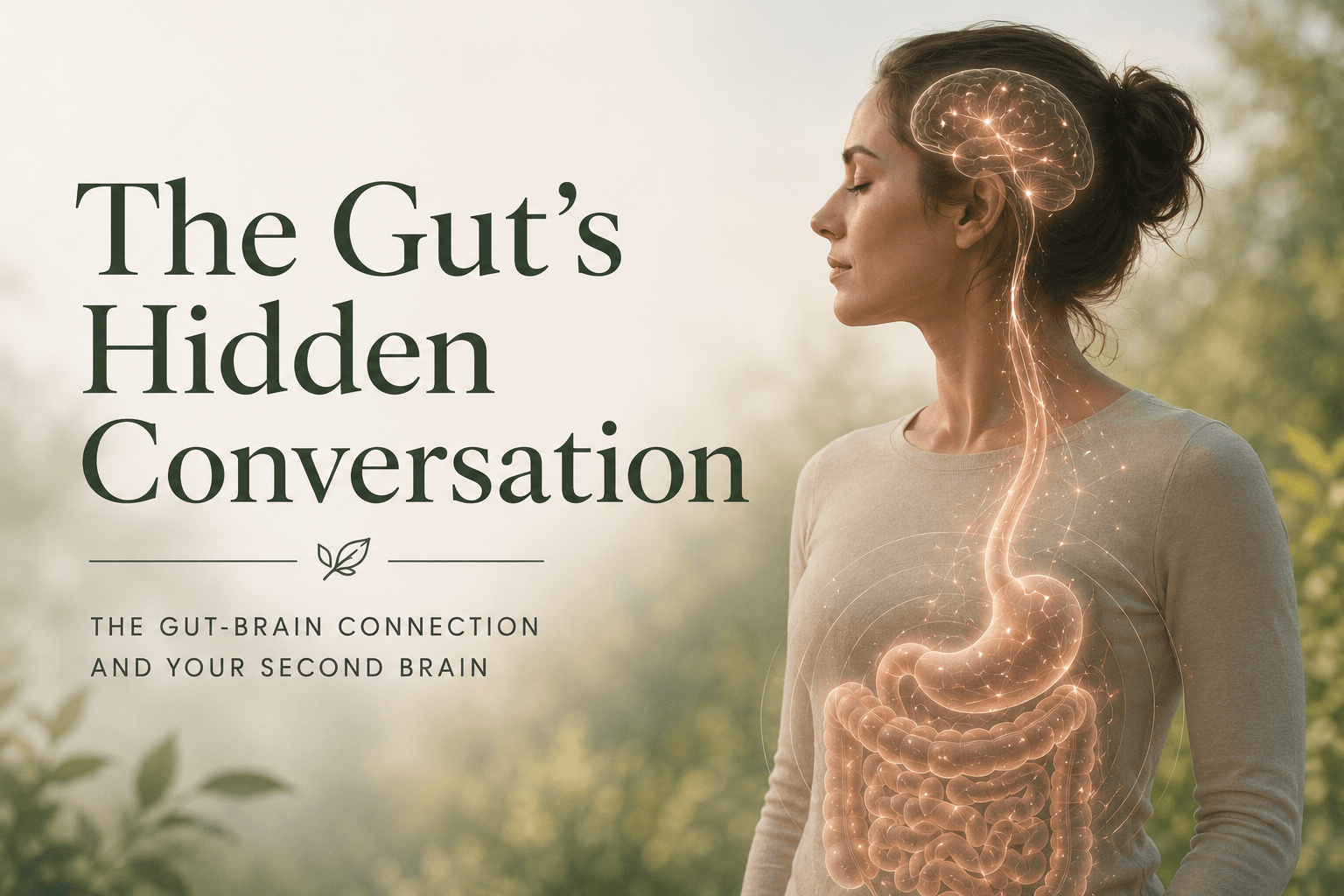
The Gut’s Hidden Conversation: Why It’s Called the Body’s “Second Brain”

Have you ever been so nervous before giving a presentation that your stomach seemed to tie itself into knots? Or noticed that during a particularly stressful week, you suddenly weren’t hungry? Maybe you’ve experienced the opposite. Some people reach for comfort foods when life becomes overwhelming, while others feel nauseated at the thought of eating. Many people develop abdominal pain, diarrhea, constipation, or bloating during periods of emotional stress, only to watch those symptoms improve once life settles down again.
Most of us have experienced some version of this. What’s remarkable is how rarely we stop to ask why. Why would an emotion that begins in the brain produce sensations in the digestive tract? Why should worrying about tomorrow’s meeting change how your stomach feels today?
For many years, these experiences were often dismissed with phrases like, “It’s just stress,” or, “It’s all in your head.” Today, we know something much more interesting. Your brain and your digestive system are in constant conversation. Those butterflies in your stomach are not imaginary. They’re physiology. Understanding that conversation changes the way we think about digestion, stress, and the remarkable ways our bodies maintain balance.
A Conversation Happening Every Second
One of the biggest misconceptions about the human body is that each organ works independently. We often imagine the brain doing brain things; the stomach digesting food, the immune system fighting germs, hormones floating around in the bloodstream. In reality, the body functions much more like a living ecosystem than a collection of separate parts. Every system has its own role, but no system works in isolation.
The nervous system, immune system, hormones, microbiome, and digestive tract are constantly exchanging information, adapting to changing conditions, and influencing one another in real time. The digestive tract may be one of the best examples of this principle. Long before food reaches your stomach, your brain has already begun preparing the digestive system for the meal ahead.
The sight of your favorite restaurant, the smell of fresh bread. Even the thought of food can stimulate saliva production, increase stomach acid secretion, prepare digestive enzymes for release, and begin coordinating muscular contractions that will eventually move food through the gastrointestinal tract. Without conscious effort, your nervous system has already started digesting dinner before you’ve taken your first bite. That’s communication.
The Gut Has Its Own Nervous System
Many people are surprised to learn that the digestive tract contains its own extensive network of neurons known as the enteric nervous system, or ENS.
Embedded throughout the walls of the gastrointestinal tract are hundreds of millions of nerve cells organized into interconnected networks that extend from the esophagus to the rectum. In fact, the enteric nervous system contains more neurons than the spinal cord and is one of the most complex neural networks outside the brain itself.¹ Scientists sometimes refer to it as the body’s “second brain.”
That phrase captures people’s attention, but it can also create misconceptions. Your gut isn’t solving math problems. It isn’t storing memories. It isn’t making conscious decisions. What it is doing is remarkably sophisticated.
The enteric nervous system is capable of coordinating many digestive functions independently. It regulates muscular contractions, monitors stretching within the intestinal wall, influences blood flow, coordinates digestive secretions, communicates with hormone-producing cells, exchanges information with immune tissues, and integrates signals from the microbiome.
Imagine trying to coordinate a city with hundreds of miles of roads, thousands of traffic lights, millions of vehicles, changing weather conditions, construction zones, emergency responders, and public transportation.
Now imagine doing it twenty-four hours a day without anyone noticing. That begins to approximate what the enteric nervous system accomplishes every day.
Digestion Is a Choreographed Performance
When people think about digestion, they often picture food simply falling through the stomach and intestines under the influence of gravity. In reality, digestion resembles an elaborate choreography.
The muscles of the digestive tract contract in carefully coordinated waves known as peristalsis, moving food from one region to the next at precisely the right pace. The stomach grinds and mixes food while releasing acid and enzymes. The small intestine receives carefully timed secretions from the pancreas and gallbladder. Nutrients are absorbed as food moves slowly across millions of tiny villi lining the intestinal wall. The colon reclaims water while allowing beneficial bacteria time to ferment dietary fibers.
Every step depends on timing. Release digestive enzymes too early, and they accomplish little. Move food too quickly, and nutrients may not be adequately absorbed. Move food too slowly, and fermentation patterns change, symptoms may develop, and the environment within the digestive tract begins to shift.
Healthy digestion isn’t simply about having enough stomach acid or taking the right probiotic. It depends on coordination. That’s one of the reasons the nervous system plays such a central role.
Motility: The Rhythm of the Gut
One of the most overlooked aspects of digestive health is something called motility. Motility refers to the coordinated movement of material through the gastrointestinal tract. That definition sounds deceptively simple. In reality, motility is one of the most important jobs performed by the enteric nervous system.
Imagine driving across the country. If traffic moved at highway speeds everywhere, navigating city streets would be impossible. If every road reduced to ten miles per hour, the journey would take weeks.
Healthy transportation depends on the right speed in the right location. The digestive tract operates much the same way. Food should remain in the stomach long enough for acid and enzymes to begin breaking down proteins. The small intestine requires sufficient contact time for nutrient absorption. The colon benefits from allowing bacteria adequate time to ferment dietary fibers into beneficial compounds.
Every section has its own rhythm. When those rhythms become disrupted, symptoms often follow. Some people develop constipation. Others experience diarrhea. Some notice reflux. Others develop bloating or abdominal discomfort.
Importantly, these symptoms don’t automatically tell us why motility has changed. Many different physiologic processes can influence movement through the digestive tract. That’s one reason understanding physiology matters. Symptoms are clues. They are rarely the entire story.
The Longest Conversation in the Body
Although the enteric nervous system is capable of functioning independently, it is in constant communication with the central nervous system. One of the major communication pathways is the vagus nerve. The vagus nerve connects the brain with multiple organs throughout the body, including much of the digestive tract.
For years, many people assumed the brain primarily sent instructions downward. Modern research tells a more interesting story. Roughly 80 percent of the nerve fibers within the vagus nerve carry information from the body back to the brain, not the other way around.²
In other words, your digestive tract is constantly providing updates. Food has arrived. The stomach is stretching. Nutrients are being absorbed. Microbial metabolites are being produced. The immune system has detected new information. The intestinal environment is changing. Your brain listens to all of it.
Rather than issuing orders from above, the brain and gut engage in an ongoing dialogue, adjusting continuously as conditions change. It’s less like a commander directing troops and more like two close colleagues solving problems together. Once you begin seeing the body this way, many experiences that once seemed mysterious suddenly become much easier to understand.
More Than a Highway Between Two Organs
When we hear the phrase gut-brain axis, it’s easy to picture a single pathway connecting two separate structures. In reality, the conversation between the gut and the brain is far more sophisticated than that. The nervous system is certainly part of the story, but it isn’t the only messenger.
Hormones participate in the conversation. The immune system participates. The microbiome contributes signaling molecules. Cells lining the intestine release chemical messengers. Even the nutrients we absorb influence communication throughout the body.
Rather than imagining a single telephone line connecting the gut and brain, it’s more accurate to picture an entire communication network with multiple channels operating simultaneously. That’s one of the reasons physiology is so fascinating. The body rarely relies on just one way of accomplishing something important. It builds redundancy. Communication happens through many overlapping systems working together.
The Language of the Gut
Every moment of every day, your digestive tract is gathering information. How much food has arrived? What type of nutrients are present? How quickly is the stomach emptying? How much stretching is occurring within the intestinal wall? What are the microbial communities producing? Are immune cells detecting anything unusual?
Each of those questions generates information. That information doesn’t simply remain within the intestine. It is transmitted throughout the body, helping coordinate digestion, appetite, metabolism, immune activity, and many other physiologic processes.
One of the beautiful aspects of human physiology is that communication is rarely dramatic. Most of it is quiet. Continuous. Adaptive. The body isn’t constantly sounding alarms. Instead, healthy physiology depends on countless subtle adjustments occurring every second without us ever noticing.
Why Stress Changes Digestion
One of the easiest places to see this communication in action is during periods of stress. Imagine you’re driving to an important interview. Perhaps you’re excited. Perhaps you’re nervous. Your brain begins interpreting the situation before you’ve even arrived. Almost immediately, signals begin traveling throughout the body. Your heart rate increases. Breathing changes. Stress hormones begin to rise. Blood flow is redistributed.
At the same time, your digestive system starts adapting. Some people lose their appetite entirely. Others develop nausea. Some notice cramping or diarrhea. Others feel like their stomach has simply stopped moving. These aren’t separate events. They’re coordinated physiologic responses.
From an evolutionary perspective, this makes sense. If our ancestors were escaping immediate danger, digesting a large meal wasn’t the body’s highest priority. Resources shifted toward systems needed for survival. Most of the time, those changes were temporary. Once the danger passed, digestion resumed its normal rhythm.
Modern life creates a different challenge. Our bodies often respond to work deadlines, financial concerns, family responsibilities, and constant digital stimulation using many of the same physiologic pathways that once helped us survive immediate threats.
That doesn’t mean stress explains every digestive symptom. It certainly doesn’t. But it does remind us that supporting digestive health sometimes involves caring for the nervous system as well.
The Serotonin Story
One statistic appears in almost every discussion about the gut-brain axis. Approximately 90 to 95 percent of the body’s serotonin is produced within the digestive tract.
That’s true. But the way this fact is often presented can be misleading. Many people assume that because serotonin is associated with mood, the serotonin produced in the gut must simply travel to the brain to make us happier.
Physiology is more nuanced than that. Most serotonin produced in the gastrointestinal tract remains there, where it plays essential local roles. It helps regulate intestinal movement. It influences secretion. It participates in communication between nerve cells within the enteric nervous system. It contributes to maintaining normal digestive function. The serotonin used within the brain is produced separately by neurons inside the central nervous system because serotonin itself does not freely cross the blood-brain barrier.
Does that mean the gut has no influence on mood? Not at all. It simply means the relationship is more sophisticated than many headlines suggest. The gut influences the brain through numerous pathways, including neural communication, immune signaling, hormones, microbial metabolites, sleep, inflammation, and nutrient availability. aAs is so often the case in medicine, the truth is both more complicated and more interesting than a simple statistic.
The Microbiome Joins the Conversation
As our understanding of the microbiome has expanded over the past two decades, researchers have begun appreciating just how active these microbial communities really are. The bacteria living within us are not silent passengers.
As they break down dietary fibers and other compounds, they produce a wide variety of metabolites. Some nourish the cells lining the colon. Some interact with immune cells. Others influence hormone production or participate in signaling pathways that researchers are still working to understand.
This doesn’t mean the microbiome controls every aspect of our health. Nor does it mean that changing one bacterial species will solve every medical problem. Rather, it reminds us that the digestive tract is home to an incredibly dynamic ecosystem whose activities extend well beyond digestion.
One of my favorite ways to think about the microbiome is as another participant in the conversation. The gut isn’t communicating with the brain alone. The microbiome has a voice as well.
Everything Is Connected, But Not Everything Is Caused by the Gut
One of the challenges of writing about gut health today is avoiding two extremes. On one end of the spectrum, some people dismiss the gut as nothing more than a digestive organ. On the other, it’s easy to encounter claims that virtually every disease begins in the gut. Neither perspective reflects the complexity of human physiology.
The gut is extraordinarily important. It influences immunity, metabolism, nutrient absorption, hormone regulation, and nervous system communication. But influence is not the same as sole cause. The body functions as an integrated network. Rarely does one organ operate in isolation. Rarely does one organ explain every symptom.
As clinicians, one of our responsibilities is resisting the temptation to oversimplify. Patients deserve explanations that reflect both what we know and what we are still learning. I find that approach far more hopeful. It means we don’t need to search for one magical answer. Instead, we can appreciate how multiple systems work together to create health.
Seeing the Body as a Whole
One of the greatest gifts of studying physiology is that it changes the questions we ask. Instead of asking,
“Which organ is causing this symptom?”
we begin asking,
“How are these systems communicating?”
Instead of wondering,
“What single thing is wrong?”
we ask,
“What patterns are emerging?”
Those questions often lead to better conversations between patients and practitioners. They encourage curiosity instead of fear. They invite investigation instead of assumption. Most importantly, they remind us that the body is remarkably intelligent.
Health isn’t created by one perfect hormone, one perfect bacterium, or one perfect laboratory result. It emerges from countless systems communicating effectively with one another. The gut is simply one of the busiest places where those conversations occur.
What This Looks Like in Clinical Practice
One of the privileges of practicing medicine is that every day offers another reminder of just how interconnected the human body truly is. Rarely does someone walk into my office with a problem that fits neatly into one organ system.
A patient may come seeking help for fatigue but also mention chronic constipation almost as an afterthought. Another may schedule an appointment for migraines while casually describing years of bloating that they assumed was simply “normal.” Someone struggling with persistent reflux may also describe poor sleep, elevated stress, or changes in appetite.
Does that automatically mean all of these symptoms are caused by the gut? No. But it does remind us that symptoms often occur within patterns rather than isolation. One of the most valuable things physiology teaches us is to become curious about those patterns. Rather than asking, “Which symptom should we treat first?” we begin asking, “How are these systems interacting?”
Sometimes the digestive system becomes an important part of that answer. Sometimes another system deserves our attention first. The goal is never to force every patient into the same explanation. The goal is to understand the individual sitting in front of us.
Why Physiology Comes Before Protocols
One of the reasons I spend so much time teaching physiology is because I believe understanding creates better decisions. It’s easy to become overwhelmed by the endless stream of health advice available online. One article tells you to eliminate certain foods. Another recommends a particular probiotic. Someone else insists everyone should take digestive enzymes or practice intermittent fasting.
While each of those strategies may have a role in the right clinical situation, none of them makes much sense without first understanding the physiology they’re intended to support. Take probiotics as an example. People often ask me, “What’s the best probiotic?”
The honest answer is that it depends. Different strains perform different functions. Different patients have different health histories. Different clinical goals require different approaches.
The same principle applies to nearly every aspect of medicine. The body is not a collection of isolated protocols. It’s an integrated system. The better we understand how that system works, the better equipped we are to make thoughtful decisions together.
That’s one of the reasons I believe education is such an important part of healthcare. Patients shouldn’t simply leave an appointment knowing what to do. They should understand why.
Looking Beyond the Latest Headlines
Few areas of medicine have generated as much public interest in recent years as the gut-brain axis. Nearly every week seems to bring another headline linking the microbiome to mood, memory, neurodegenerative disease, athletic performance, or longevity. This research is exciting. It is expanding our understanding of human physiology in ways that would have seemed almost unimaginable a generation ago.
At the same time, it’s important to approach new discoveries with both curiosity and humility. Many of these relationships are complex. Some have been demonstrated clearly in animal models but are still being explored in humans. Others show strong associations without proving direct cause and effect.
Science often moves forward by asking better questions rather than offering immediate answers. I find that encouraging. It means our understanding continues to evolve.
As clinicians, our responsibility is to remain open to new evidence while resisting the temptation to promise more certainty than the research currently supports. That balance allows us to practice evidence-informed medicine while remaining curious about what future discoveries may teach us.
One of the Most Remarkable Conversations in the Human Body
When we pause to appreciate it, the relationship between the gut and the brain is extraordinary. As you eat breakfast, your digestive tract is already adjusting its movements. Specialized cells are releasing signaling molecules. The microbiome is metabolizing dietary fibers. The immune system is quietly gathering information. Nerves are carrying updates toward the brain. The brain is sending signals back to coordinate digestion.
None of this requires conscious thought. There are no alarms. No flashing lights. No notifications asking you to approve the next step. Instead, millions of cells communicate continuously, adapting to changing circumstances while maintaining remarkable stability. Most days, we never notice.
And perhaps that’s one of the greatest achievements of healthy physiology. Its success often lies in its quietness.
A Different Way to Think About Gut Health
Over the past two weeks, we’ve explored two ideas that I hope will stay with you. First, your digestive tract is where your body meets the outside world. Second, it is one of the body’s largest communication networks. Together, these ideas create a very different picture of gut health than the one many of us grew up with.
The gut isn’t simply a place where food is digested. It is an active participant in helping the body adapt to an ever-changing environment. It gathers information. It communicates. It coordinates. It learns. It responds.
When we understand those roles, discussions about nutrition, stress, digestion, immunity, and even the microbiome become much more meaningful because we appreciate the larger system they’re supporting. That shift in perspective is one of my favorite parts of practicing medicine.
When patients understand why the body works the way it does, they often become more confident, less fearful, and more engaged in their own health. Knowledge doesn’t eliminate uncertainty. But it does replace confusion with understanding.
Looking Ahead
Next week, we’ll continue building on this foundation by exploring what happens when this beautifully coordinated system begins to lose its rhythm. We’ll discuss stomach acid, digestive enzymes, bile, motility, and the microbiome, not as isolated topics, but as different parts of the same ecosystem.
We’ll also look at why two people with nearly identical symptoms can have very different underlying physiologic processes, and why thoughtful evaluation often matters more than assumptions.
As we move through this series, I hope one message continues to stand out above all the others. The body is not fragile. It is remarkably intelligent. Every day it gathers information, communicates across organ systems, adapts to changing circumstances, and works continuously to maintain balance.
Our role, whether as clinicians or patients, is not to force the body into perfect health. It is to better understand how it was designed to function so we can create the conditions that allow that remarkable design to do what it does best.
References
Breit, S., Kupferberg, A., Rogler, G., & Hasler, G. (2018). Vagus nerve as modulator of the brain-gut axis in psychiatric and inflammatory disorders. Frontiers in Psychiatry, 9, 44.
Carabotti, M., Scirocco, A., Maselli, M. A., & Severi, C. (2015). The gut-brain axis: Interactions between enteric microbiota, central and enteric nervous systems. Annals of Gastroenterology, 28(2), 203-209.
Cryan, J. F., O’Riordan, K. J., Cowan, C. S. M., Sandhu, K. V., Bastiaanssen, T. F. S., Boehme, M., Codagnone, M. G., Cussotto, S., Fulling, C., Golubeva, A. V., Guzzetta, K. E., Jaggar, M., Long-Smith, C. M., Lyte, J. M., Martin, J. A., Molinero-Perez, A., Moloney, G. M., Morelli, E., Morillas, E., … Dinan, T. G. (2019). The microbiota-gut-brain axis. Physiological Reviews, 99(4), 1877-2013.
Furness, J. B. (2012). The Enteric Nervous System. Wiley-Blackwell.
Gershon, M. D. (1998). The Second Brain. HarperCollins.
Gershon, M. D., & Tack, J. (2007). The serotonin signaling system: From basic understanding to drug development for functional GI disorders. Gastroenterology, 132(1), 397-414.
Mayer, E. A. (2016). The Mind-Gut Connection. Harper Wave.
Spiller, R., & Major, G. (2016). IBS and IBD: Separate entities or on a spectrum? Nature Reviews Gastroenterology & Hepatology, 13(11), 613-621.