
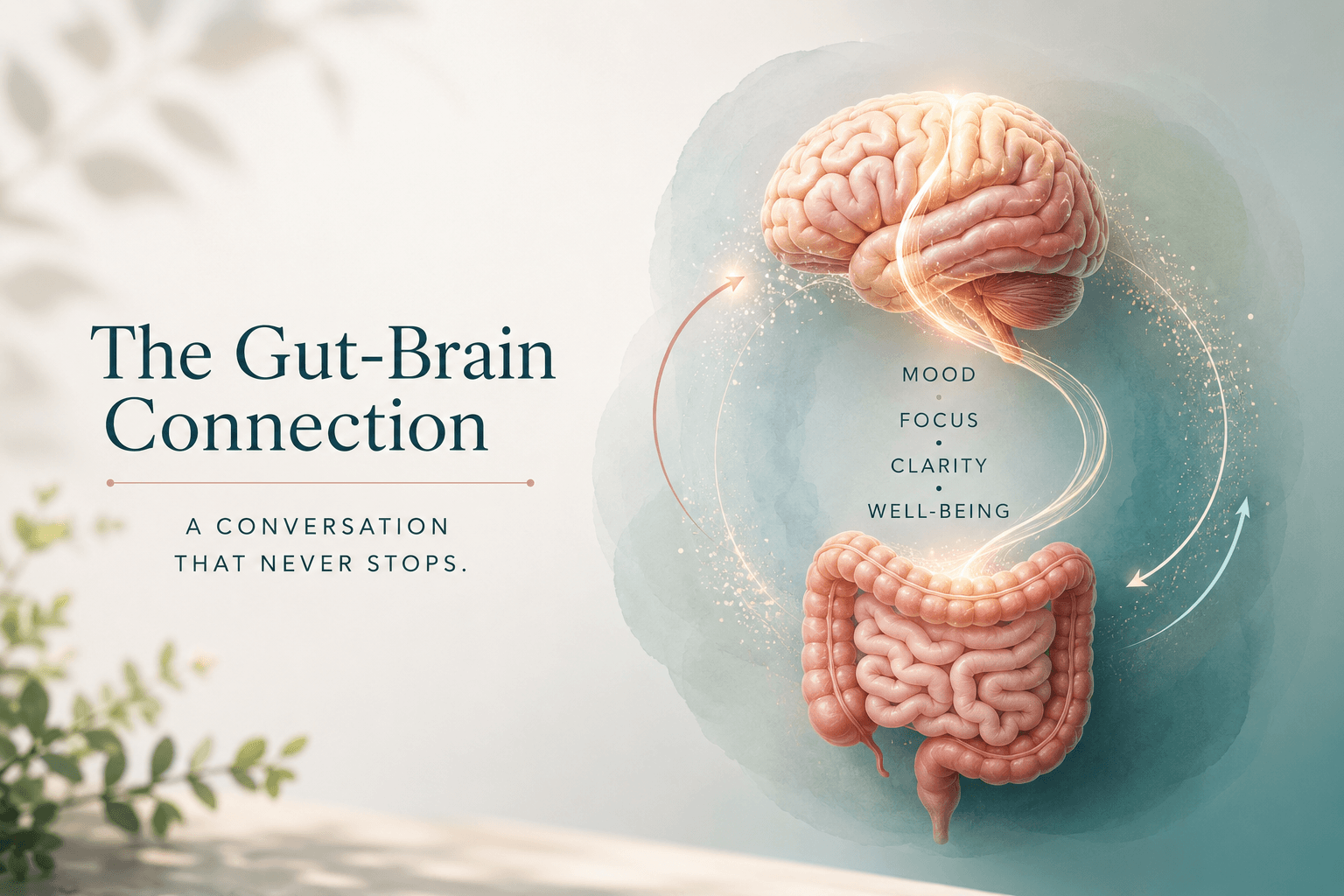
The Conversation You Never Knew Was Happening: How Your Gut and Brain Shape One Another

If you followed along with us through August, you probably noticed that I kept bringing up the brain, even though we were supposedly talking about the gut. At the time, I may have seemed a little distracted, like someone who keeps wandering off topic halfway through a story. I promise there was a reason for it. The deeper we ventured into the digestive system, the more obvious it became that every road seemed to lead back to the brain. This month, we’re simply taking the other half of that journey.
I think one of the biggest misconceptions about the brain is that we picture it as the CEO of the body, sitting comfortably in a corner office, issuing commands to everyone else. It’s a convenient image, but it leaves out something I find much more interesting. The brain spends an enormous amount of its time listening. Every second of every day it is collecting information from your digestive tract, your immune system, your hormones, your muscles, your blood vessels, your lungs, and thousands of tiny sensory receptors scattered throughout your body. It is constantly asking questions. Are we safe? Do we have enough energy? Is there inflammation? Is there infection? Are we nourished? Should we be alert, or is it finally safe to relax?
When people tell me they struggle with brain fog, anxiety, poor focus, or low mood, my mind rarely jumps to the brain alone. Instead, I find myself wondering about the conversations happening behind the scenes. What messages has the brain been receiving? How long has it been hearing them? And perhaps most importantly, why?
Those questions have changed the way I think about health over the years. They have also changed the way I practice medicine.
The Most Expensive Organ You Own
Your brain represents only about two percent of your body weight, yet at rest it consumes roughly twenty percent of your body’s energy.¹ That statistic has fascinated me since I first learned it because it immediately explains why the brain is so sensitive to changes elsewhere in the body. It is an incredibly sophisticated organ, but it is also surprisingly demanding. It needs a continuous supply of oxygen, glucose, amino acids, healthy fats, vitamins, minerals, blood flow, and remarkably precise communication with the rest of your body. It never really clocks out. Even while you’re asleep, it is organizing memories, regulating hormones, repairing tissues, and deciding which experiences are worth keeping and which can be quietly filed away.
Imagine trying to run the busiest airport in the world during a rolling power outage. Flights may still take off. Luggage may eventually arrive. Air traffic controllers may somehow keep everything moving. But it requires far more effort, there is much less room for error, and before long everyone starts feeling the strain. The brain is remarkably resilient, yet it also depends on a healthy internal environment to perform all of the tasks we ask of it every day.
This is one of the reasons I become cautious when conversations about brain health are reduced to a single nutrient, one neurotransmitter, or the latest supplement trending on social media. Human biology is rarely that tidy. A brain that isn’t functioning optimally may be responding to poor sleep, chronic inflammation, unstable blood sugar, nutrient deficiencies, thyroid dysfunction, persistent stress, changes in the gut microbiome, or dozens of other influences that have quietly accumulated over time. Sometimes several of those factors are happening simultaneously, each nudging the system just enough that, eventually, someone begins saying, “I just don’t feel like myself anymore.”
That sentence is one I hear often in clinic.
It’s also one of the reasons I love practicing naturopathic medicine. Our goal is rarely to silence symptoms without asking where they came from. Curiosity has always been one of our greatest clinical tools. When we become genuinely curious about why the body is behaving the way it is, we often uncover opportunities for healing that might otherwise remain hidden.
A Conversation Happening Around the Clock
One of my favorite things about physiology is that the body doesn’t rely on just one communication system. If it did, we’d all be in trouble the first time one pathway encountered a little traffic.
Instead, our bodies have built-in redundancy. Nerves send messages in milliseconds. Hormones travel through the bloodstream. Immune cells carry information about injury or infection. Even the trillions of microbes living inside the digestive tract participate by producing compounds that our own cells can recognize and respond to. The result is an astonishing communication network that allows organs separated by several feet of anatomy to behave as though they’re sitting across the same table having a conversation.²
The gut and brain are perhaps the best example of this partnership.
You have probably heard the phrase “the gut-brain axis” before. It sounds technical, but it’s really just the name we give to this ongoing exchange of information between the digestive system and the central nervous system. That communication happens through several different pathways simultaneously. The vagus nerve carries signals directly between the gut and the brain. The immune system relays information about inflammation. Hormones respond to meals, stress, and circadian rhythms. The microbiome produces metabolites that influence both local gut function and distant organs, including the brain.³
I think that’s part of what makes this field so exciting. There isn’t just one conversation happening. There are thousands, all overlapping, responding, adapting, and changing from one moment to the next.
As clinicians, we’re still learning exactly how all of these conversations influence one another. The research has expanded dramatically over the past two decades, and every year seems to uncover another layer of complexity. The exciting part is not that we’ve finally figured everything out. It’s that we’ve begun asking better questions, and those questions are helping us understand why nutrition, movement, sleep, stress, relationships, medications, infections, and the health of the gut can all influence something as seemingly unrelated as how clearly we think or how resilient we feel.
The Vagus Nerve Gets a Lot of Attention… But It Isn’t Working Alone
If you’ve spent any time reading about the gut-brain connection, you’ve almost certainly come across the vagus nerve. It has become something of a celebrity in the health world over the past few years, and for good reason. It is the longest cranial nerve in the body, extending from the brain down through the neck and into the chest and abdomen, where it helps coordinate everything from heart rate and breathing to digestion and immune function. A large proportion of its fibers actually carry information toward the brain, quietly updating it about what’s happening throughout the body every moment of the day.⁴
I think the vagus nerve is fascinating, but I also think it sometimes gets promoted as though it’s the entire story. In reality, it’s one member of a much larger team.
Imagine you’re planning a family reunion. Some relatives text. Others call. Someone inevitably starts a group email that only half the family reads, and there’s always one aunt who somehow hears everything before anyone else does, and someone who is completely lost until the day of. Information still gets where it needs to go, just through different channels.
Your body communicates in much the same way.
The vagus nerve provides one incredibly important route, particularly for fast neural communication between the gut and brain, but it works alongside hormones, immune messengers, microbial metabolites, nutrient signals, and countless other pathways that are all sharing information at the same time.⁵ This is one of the reasons biology is so endlessly humbling. Every time we think we’ve identified the main character, another important supporting cast quietly steps onto the stage.
One of the most exciting discoveries over the past several years has been learning that certain cells lining the intestine don’t simply absorb nutrients. They also act as highly specialized sensors. As food moves through the digestive tract, these cells detect fats, proteins, carbohydrates, fiber, and even some of the compounds produced by your microbiome. In response, they release hormones that influence hunger, fullness, blood sugar regulation, digestion, and even activity within the brain itself. Some are capable of communicating with nearby nerve endings remarkably quickly, blurring the lines between what we traditionally thought of as the nervous system and the digestive system.⁵
That means your breakfast is doing far more than providing calories. Before you’ve even finished your coffee, your digestive tract has already begun reporting back to your brain about what arrived, how much energy is available, what nutrients are present, and how the rest of the body should prepare.
I don’t know about you, but I think that’s pretty incredible.
Your Microbiome Is Part of the Conversation Too
Last month we spent quite a bit of time getting acquainted with the microbiome, and hopefully by now you’ve started thinking about those trillions of microbes a little differently. They aren’t passive passengers simply hitching a ride through the digestive tract. They’re active participants in your physiology, carrying out jobs that our own cells either cannot do at all or cannot do nearly as efficiently.
One of those jobs is manufacturing molecules that become part of the body’s communication network.
When gut bacteria ferment dietary fiber, for example, they produce compounds called short-chain fatty acids. These molecules help nourish the cells lining the colon, support the integrity of the intestinal barrier, influence immune activity, and participate in signaling pathways that reach well beyond the digestive tract. Other microbes produce metabolites from amino acids or bile acids that interact with receptors throughout the body. Researchers are still uncovering many of these relationships, which makes this one of the most rapidly evolving areas of medicine today.⁵⁻⁶
This is also where I think it’s important to acknowledge something we don’t always do well in healthcare.
Sometimes we become so excited about new discoveries that we oversimplify them. You may have heard statements like, “Ninety-five percent of serotonin is made in the gut,” – heck, I know I’ve said this a few hundred times. And while that statistic is generally accurate, it often leaves people with the impression that gut serotonin is somehow traveling directly to the brain to determine whether we feel happy or sad. The reality is much more nuanced. Most serotonin produced in the gut stays in the gut, where it plays important roles in digestion, motility, and local signaling. The connection between the microbiome and brain function is real, but it involves an intricate web of immune pathways, microbial metabolites, hormones, neural communication, and changes in the internal environment, many of which researchers are still working to understand.⁶
Personally, I find that more exciting than a simple explanation.
The human body has never been particularly interested in taking shortcuts.
It has evolved layers upon layers of communication, feedback loops, and built-in checks and balances that allow it to adapt continuously to an ever-changing world. That complexity can feel overwhelming at first, but I actually think it’s encouraging. It means there are often many opportunities to influence health in a positive direction. A better night’s sleep, steadier blood sugar, regular movement, nourishing food, healthier relationships, treatment of an underlying infection, restoring nutrient deficiencies, improving digestive function, or reducing chronic inflammation may all change the messages the brain is receiving because every one of those things changes the environment in which the brain is trying to do its work.
And if there’s one theme I hope carries through this entire month, it’s that brain health doesn’t begin when something goes wrong inside the brain. It begins much earlier, in the countless ordinary choices and biological processes that quietly shape the conversations happening throughout the rest of the body every single day.
The Brain Talks Back
Up to this point we’ve mostly looked at information flowing from the gut to the brain, but as with any good conversation, listening is only half of the story.
The brain is constantly responding.
Every thought you have, every deadline you race to meet, every exciting surprise, every difficult season, every night you stay up too late scrolling “for just five (90) more minutes” all become information that the brain sends back to the rest of the body. Some of those messages are helpful and adaptive. Others are designed to help us survive periods of challenge. The fascinating part is that the digestive system is one of the first places those messages often arrive.
Have you ever lost your appetite before giving a presentation? Or noticed your stomach doing somersaults before an important conversation? Maybe you’ve been through a particularly stressful month and suddenly found yourself dealing with reflux, constipation, diarrhea, bloating, or abdominal discomfort despite eating the same foods you’ve always eaten.
Most of us have experienced some version of that.
It’s such a common experience that we have built it right into our language. We talk about having “gut feelings.” We describe situations as “gut-wrenching.” We say we “can’t stomach” something. We tell children they have butterflies in their stomach before a big event. Long before we understood the physiology, we recognized that our emotions and our digestive system seemed to speak the same language.
We now know there is good biological reason for those observations. And often, if you stop long enough to actually hear what you’re saying, you’ll gain some insight into what’s going on physiologically too.
When the brain perceives stress, it doesn’t just change our thoughts. It begins coordinating an incredibly sophisticated response involving the nervous system, hormones, immune function, circulation, and digestion. Blood flow shifts. Digestive secretions change. Motility may speed up or slow down. The permeability of the intestinal barrier can be influenced. The composition and activity of the microbiome may change over time as well.⁷
In other words, the conversation between the gut and brain is constantly moving in both directions. Your digestive system informs your brain about what’s happening inside the body, and your brain adjusts digestive function based on what it believes is happening in the world around you. It’s an elegant feedback system that has helped humans survive for thousands of years.
The challenge, of course, is that our biology hasn’t entirely caught up with modern life.
Your brain responds to a charging dinosaur and a relentlessly full inbox using many of the same physiological pathways. It doesn’t necessarily distinguish between physical danger and psychological stress with the precision we sometimes imagine. It simply gathers information, makes its best prediction about what’s needed, and coordinates a response.
I find that perspective strangely reassuring. Our bodies are not overreacting out of spite. They’re responding to the information they’ve been given.
Every Choice Becomes Information
One of the themes you’ll hear me come back to throughout this series is that your body is always collecting data.
That’s one of my favorite ways to think about physiology because it shifts the conversation away from blame and toward stewardship. Your body isn’t keeping score or handing out gold stars for eating kale. It’s constantly observing its environment and making adjustments based on the information available.
A meal rich in fiber sends one set of signals. A night of restorative sleep sends another. Regular exercise communicates something different than prolonged inactivity. Meaningful relationships, time outdoors, stable blood sugar, adequate protein, nutrient sufficiency, inflammation, medications, alcohol, infections, grief, laughter, chronic stress, and recovery all become pieces of information that the brain incorporates into its ongoing decision making.
Individually, many of those inputs seem small. Collectively, they create the environment in which the brain is expected to perform one of the most complex jobs in biology.
I think that’s an encouraging way to look at health because it reminds us that meaningful change rarely depends on finding one perfect intervention. More often, it’s the accumulation of many small conversations, repeated day after day, that gradually changes the story.
As we move through the rest of this month, we’re going to keep exploring those conversations. We’ll spend time understanding how neurons communicate, why neurotransmitters are only one piece of a much larger picture, and why symptoms like brain fog, anxiety, poor focus, and changes in mood deserve thoughtful curiosity rather than quick assumptions. We’ll also look at practical ways to support the biology that allows the brain to do its remarkable work every single day.
For now, though, I hope you’ll simply carry one idea with you:
The conversation between your gut and your brain didn’t begin when you started reading this article, and it won’t end when you finish it. It has been unfolding every day of your life, quietly adapting to your experiences, your habits, your environment, and your physiology. The more we learn to appreciate that conversation, the more opportunities we have to support it in ways that help both organs do what they were beautifully designed to do.
References
- Attwell, D., & Laughlin, S. B. (2001). An energy budget for signaling in the grey matter of the brain. Journal of Cerebral Blood Flow & Metabolism, 21(10), 1133–1145. https://doi.org/10.1097/00004647-200110000-00001
- Mayer, E. A., Nance, K., & Chen, S. (2022). The gut-brain axis. Annual Review of Medicine, 73, 439–453. https://doi.org/10.1146/annurev-med-042320-014032
- Cryan, J. F., O’Riordan, K. J., Cowan, C. S. M., Sandhu, K. V., Bastiaanssen, T. F. S., Boehme, M., … Dinan, T. G. (2019). The microbiota-gut-brain axis. Physiological Reviews, 99(4), 1877–2013.
- Breit, S., Kupferberg, A., Rogler, G., & Hasler, G. (2018). Vagus nerve as modulator of the brain-gut axis in psychiatric and inflammatory disorders. Frontiers in Psychiatry, 9, 44.
- Foster, J. A., Rinaman, L., & Cryan, J. F. (2017). Stress and the gut-brain axis: Regulation by the microbiome. Neurobiology of Stress, 7, 124–136. https://doi.org/10.1016/j.ynstr.2017.03.001
- Margolis, K. G., Cryan, J. F., & Mayer, E. A. (2021). The microbiota-gut-brain axis: From motility to mood. Gastroenterology, 160(5), 1486–1501.
- Carabotti, M., Scirocco, A., Maselli, M. A., & Severi, C. (2015). The gut-brain axis: Interactions between enteric microbiota, central and enteric nervous systems. Annals of Gastroenterology, 28(2), 203–209.