
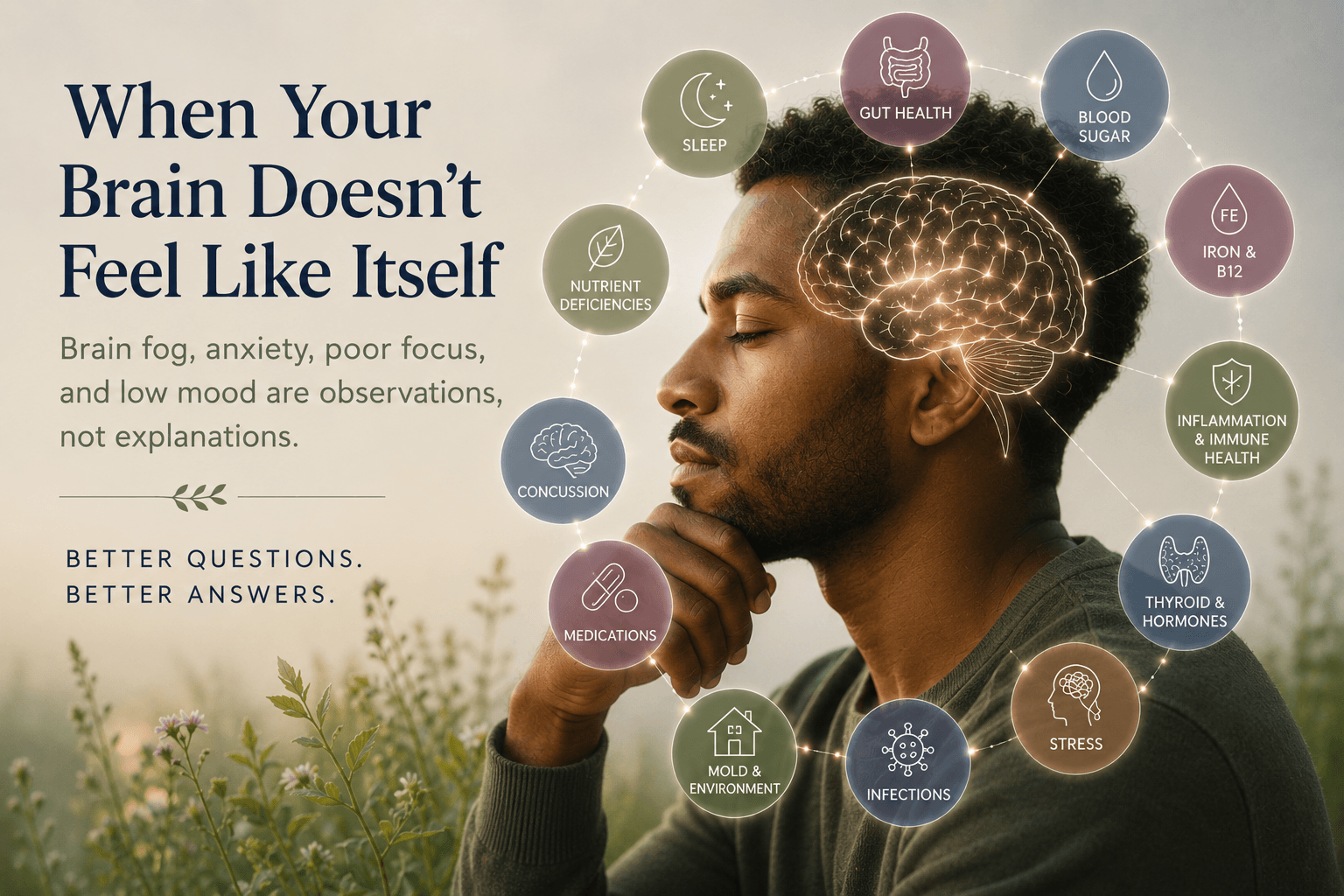
When the Conversation Changes: What Brain Fog, Anxiety, Poor Focus, and Low Mood May Be Trying to Tell You

Over the past two weeks we’ve spent quite a bit of time talking about communication. First, we explored the remarkable conversation taking place between the gut and the brain, and then we looked at the language that allows billions of neurons to exchange information every second of every day. We followed electrical impulses as they became chemical messengers, we met neurotransmitters like serotonin, dopamine, GABA, and glutamate, and we discovered that healthy brain chemistry depends on healthy brain biology.
This week I’d like to shift the conversation ever so slightly.
Instead of asking how the brain communicates, I’d like us to consider what happens when that communication begins to change.
Not stop.
Not fail.
Simply change.
One of the most common phrases I hear in my office is surprisingly difficult to measure with a laboratory test, and yet I would argue it contains an incredible amount of clinical information.
“I just don’t feel like myself anymore.”
Sometimes those words are followed by descriptions of brain fog or difficulty concentrating. Sometimes people tell me they’re forgetting names they would normally remember, struggling to find words in the middle of conversations, feeling emotionally flat, becoming anxious over situations that never used to bother them, or walking into a room only to stand there wondering why they came in. New parents laugh because they’re convinced sleep deprivation has permanently erased half their vocabulary. College students assume they’re just stressed. Busy professionals chalk it up to getting older. Cancer survivors often wonder whether they’ll ever feel mentally sharp again. I have these conversations with people in every season of life.
The interesting thing is that while those experiences can sound remarkably similar, the biology underneath them is often very different.
That’s one of the reasons I become cautious when I hear statements like, “Brain fog is caused by…” or “Anxiety means…” or “Low motivation is always…” The body has never been particularly interested in giving us simple, one-size-fits-all explanations. It prefers nuance, and while I realize nuance doesn’t make for flashy social media headlines, it usually makes for much better medicine.
One of the greatest privileges of my job is that people trust me with stories they haven’t shared with many others. They tell me about feeling disconnected from themselves, frustrated that their memory isn’t what it used to be, discouraged that their motivation seems to have disappeared, or worried that they’re somehow becoming a different person. Those conversations are rarely just about symptoms. They’re about identity. They remember what it felt like to think clearly, to enjoy reading, to stay focused through an afternoon meeting, or to feel emotionally resilient, and they’re grieving the fact that something feels different even if they can’t quite explain what that difference is.
I think that’s an important distinction because symptoms don’t happen in a vacuum. They affect relationships, careers, confidence, and the way people move through the world. They change whether someone volunteers for the presentation at work, feels comfortable driving across town, enjoys dinner with friends, or has enough mental energy left to read a bedtime story without rereading the same page three times. Our brains shape so much of our daily experience that even subtle changes can feel deeply personal.
Perhaps that’s why I dislike the phrase “it’s just brain fog.”
If you’ve ever experienced it, you know there’s nothing “just” about it.
Symptoms Are Observations, Not Explanations
One of the most valuable lessons medicine has taught me is that symptoms are observations.
They are not explanations.
That may sound like semantics, but I think it’s one of the most important shifts we can make in healthcare.
Let’s say someone comes into the clinic complaining of fatigue. Fatigue is real. It deserves to be taken seriously. But fatigue itself doesn’t tell us why it’s happening. The list of possibilities is remarkably long. Sleep deprivation, iron deficiency, thyroid dysfunction, blood sugar instability, chronic infections, autoimmune disease, medication side effects, depression, nutrient deficiencies, overtraining, under-eating, pregnancy, cancer treatment, and dozens of other situations can all leave someone feeling exhausted. The symptom is genuine. The biology behind it varies enormously.
The same thing is true for brain fog.
The same thing is true for anxiety.
The same thing is true for poor focus, memory concerns, low motivation, irritability, or feeling emotionally “off.”
Those experiences are observations. They’re the body’s way of saying, “Something about the current environment has changed.” They don’t immediately tell us what that something is.
I sometimes compare this to the check engine light in your car, although I realize that analogy has been borrowed by about half the healthcare profession at this point, so perhaps it’s due for retirement. Still, it illustrates an important principle. A check engine light tells you to pay attention. It doesn’t tell you whether the problem is a loose gas cap, a faulty oxygen sensor, or something far more significant. The warning isn’t the diagnosis. It’s the invitation to investigate.
Our bodies operate much the same way.
The challenge, of course, is that unlike a car, the human body is constantly adapting. If the brain senses that sleep has been inadequate for weeks, it adjusts. If blood sugar has become erratic, it adjusts. If inflammation increases, it adjusts. If nutrients become scarce, it adjusts. If chronic stress convinces the nervous system that the world has become a less predictable place, it adjusts.
That’s what healthy physiology does.
It adapts.
Sometimes those adaptations are exactly what keep us alive.
Sometimes they become the very symptoms that eventually bring someone into my office.
The Brain Is Constantly Prioritizing
One of the ideas I hope has become clear throughout this month’s series is that the brain isn’t simply reacting. It’s constantly making decisions.
Should we stay alert or relax?
Should we store energy or spend it?
Should we devote resources toward digestion, reproduction, tissue repair, learning, memory, immune function, or immediate survival?
The remarkable thing is that these decisions aren’t made consciously. They’re occurring quietly in the background based on the information the brain has available.
That’s one of the reasons I return so often to the phrase, “The body is trying to survive before it’s trying to thrive.”
People sometimes hear that sentence and assume I’m talking only about stress, but I mean something much broader. Survival, from the brain’s perspective, is about resource management. It’s constantly evaluating where energy should be invested, and because we’ve already established that the brain is one of the most metabolically demanding organs in the body, those decisions matter.
If you’ve ever stayed awake with a sick child, prepared for a major exam, recovered from surgery, cared for an aging parent, navigated months of grief, or simply lived through a season where life asked more of you than you thought you had to give, you’ve probably experienced this in one way or another. During those seasons, the brain often becomes remarkably efficient at focusing on what it believes is most important. Creativity may feel harder. Memory may become less reliable. Patience may wear thinner than usual. None of those changes necessarily mean something is permanently wrong. Often they reflect a brain that’s reallocating resources in response to the environment it believes it’s living in.
Personally, I find that perspective far more compassionate than assuming the brain has simply stopped working well.
Because if symptoms can represent adaptation, they also become opportunities to ask better questions.
And in my experience, good medicine almost always begins with good questions.
The question isn’t simply, “How do we make this symptom go away?”
It’s, “Why might the brain have chosen this response in the first place?”
That’s where our curiosity begins, and it’s where we’ll spend the rest of this week’s conversation.
One Symptom, Many Possible Stories
One of the reasons I enjoy practicing medicine is that it reminds me, almost daily, how humbling the human body can be.
Early in our education, there’s a natural tendency to associate symptoms with diagnoses. If someone has a cough, we begin thinking about pneumonia, asthma, allergies, reflux, or a viral infection. If someone has joint pain, we consider arthritis, an injury, autoimmune disease, or perhaps something metabolic. That’s an important part of learning medicine, but over time you also begin to appreciate something equally important: symptoms are shared by an astonishing number of different conditions, and the art of good clinical care often lies in asking questions that help distinguish one story from another.
Brain health is no different.
Let’s take brain fog, since it has become one of those phrases that almost everyone recognizes, even if no two people seem to mean quite the same thing by it. For one person, brain fog means difficulty concentrating during afternoon meetings. Someone else describes it as feeling like they’re moving through wet cement all day. Another person tells me they can remember conversations from twenty years ago but can’t recall why they opened the refrigerator five minutes earlier. I’ve had patients describe it as feeling disconnected from the world around them, while others say they simply don’t have the same mental stamina they once did. They can still think clearly for an hour or two, but by mid-afternoon it’s as though someone quietly dimmed the lights.
Those are all legitimate experiences.
They’re also not necessarily the same experience biologically.
One person may have been sleeping five interrupted hours each night for the past year because of a newborn. Another may be struggling with blood sugar that rises and crashes throughout the day. Someone else may have an iron deficiency that’s quietly limiting oxygen delivery to tissues, while another is recovering from a concussion, navigating menopause, living with an autoimmune condition, or still healing from a viral illness that changed the way their immune system communicates with the nervous system. Yet another person may simply be trying to function on coffee, skipped meals, and determination, which, despite what many healthcare providers would have you believe, is not actually a recognized food group.
From the outside, they all describe “brain fog.”
Underneath the surface, they may be living very different biological stories.
That’s why I become a little uncomfortable when I hear blanket statements like, “Brain fog is caused by inflammation,” or “Brain fog is always your gut,” or “Brain fog means your hormones are off.” Could any of those be contributing? Absolutely. I’ve seen every one of them. But I’ve also seen enough patients over the years to know that confidence should never replace curiosity.
The same symptom can arise from dozens of different pathways.
That’s why asking better questions matters.
The Body Rarely Sends One Message at a Time
Another thing I’ve noticed over the years is that symptoms have a tendency to travel in groups.
Someone may come in because they’re concerned about their concentration, but somewhere during the conversation they mention that their digestion has changed, they’re waking up at three in the morning, they’ve become unusually sensitive to stress, and they’ve started relying on three cups of coffee just to make it through the morning. Another patient schedules an appointment for anxiety, but as we continue talking we discover that they’re also experiencing hair loss, heavy menstrual cycles, restless legs at night, and persistent fatigue. Someone else wants to discuss memory concerns, and eventually we uncover a long history of gastrointestinal symptoms, food intolerances, nutrient deficiencies, and chronic inflammation.
I don’t share those examples because I expect every symptom to be connected. Sometimes they aren’t.
I share them because I think the body has a remarkable way of revealing patterns when we’re willing to slow down and listen.
It’s one of the reasons I enjoy the detective work of medicine. Every conversation provides another piece of the puzzle. Laboratory testing may provide another. Physical examination adds still more information. By themselves, none of those pieces usually tells the whole story, but together they often begin forming a picture that makes far more sense than any individual symptom ever could.
Patients occasionally apologize for “going off on tangents” during appointments because they aren’t sure whether a digestive symptom, an old concussion, their stressful job, or the migraines they experienced in college could possibly have anything to do with the reason they scheduled the visit.
More often than not, I tell them to keep talking.
Those tangents frequently end up being some of the most valuable parts of the visit.
Your Brain Lives in an Environment
One of the ideas we’ve returned to throughout this series is that the brain doesn’t exist in isolation.
It lives inside a body.
That may sound almost too obvious to mention, but I think it’s surprisingly easy to forget. We often talk about the brain as though it’s floating independently inside the skull, making decisions without much regard for what the rest of the body is doing. In reality, every neuron is living within an environment that’s constantly changing, and those changes influence how effectively the brain is able to communicate.
Take sleep, for example.
We all know we feel mentally slower after a poor night’s sleep, but the effects go far beyond simply feeling tired. Sleep is when the brain consolidates memories, clears metabolic waste, recalibrates neurotransmitter systems, and performs many of the restorative processes that prepare us for the next day. After enough nights of inadequate sleep, it isn’t surprising that concentration becomes more difficult, emotional resilience declines, or the little frustrations of everyday life suddenly feel much bigger than they did a week earlier. The brain isn’t being lazy. It’s trying to function with fewer resources.
Then there’s blood sugar, one of my favorite examples because the brain is such an energy-demanding organ. Unlike many other tissues, it has very little capacity to store fuel for later. It depends on a relatively steady supply of glucose, which means dramatic swings in blood sugar can influence attention, mood, memory, decision-making, and energy surprisingly quickly. I can’t tell you how many times someone has come into my office convinced they have a neurotransmitter problem, only to discover they’re eating once at noon, grabbing a pastry at three, and wondering why they can’t concentrate by four o’clock.
Nutrition extends well beyond calories.
The brain relies on iron to transport oxygen and support numerous enzymatic reactions. Vitamin B₁₂ plays an essential role in nerve health, myelin formation, and DNA synthesis. Folate, vitamin B₆, magnesium, zinc, vitamin D, choline, omega-3 fatty acids, amino acids from dietary protein, and countless other nutrients quietly participate in the chemistry we’ve been discussing over the last several weeks. When one or more of those building blocks becomes limited, the nervous system often adapts as best it can, but sometimes those adaptations are exactly what we experience as mental fatigue, poor concentration, or changes in mood.
Inflammation deserves its own conversation because it changes far more than sore joints or swollen tissues. The immune system and nervous system communicate constantly, and inflammatory signaling can alter neurotransmitter metabolism, energy production, sleep quality, and the way the brain processes information. This is one of the reasons people often describe feeling mentally “foggy” during an infection. The brain hasn’t suddenly forgotten how to think. It’s responding to an immune system that’s asking it to redirect resources toward recovery.
Hormones can have equally profound effects.
Thyroid hormones help regulate the metabolic pace of nearly every cell in the body, including neurons. When thyroid function changes, people frequently describe slower thinking, fatigue, memory concerns, or difficulty concentrating. Sex hormones influence neurotransmitter systems throughout the lifespan, which helps explain why puberty, pregnancy, postpartum recovery, perimenopause, and menopause can all bring noticeable changes in mood, cognition, or emotional resilience. Later this fall we’ll spend an entire month discussing the relationship between stress, cortisol, and thyroid function because it’s one of the most fascinating examples of how interconnected these systems truly are.
Then we have stress itself.
I realize stress has become something of a catch-all explanation in healthcare, and I try not to blame everything on it because life is rarely that simple. At the same time, chronic stress changes biology in measurable ways. It influences cortisol rhythms, sleep architecture, blood sugar regulation, immune activity, digestion, neurotransmitter metabolism, and even the structure and function of certain areas of the brain over time. When I say the body is trying to survive before it’s trying to thrive, this is exactly what I’m talking about. The brain adapts to the environment it believes it’s living in.
There are plenty of other contributors that deserve consideration as well. Environmental exposures such as mold can influence inflammation and immune signaling in susceptible individuals. Viral illnesses and other infections may leave lingering effects on the nervous system long after the acute illness has resolved. Certain medications, while absolutely necessary and life-changing for many people, can also influence cognition, nutrient status, or neurotransmitter activity as an unintended consequence. Previous concussions may alter brain function for months or even years depending on the injury and the individual. Even something as seemingly straightforward as dehydration can make concentration noticeably more difficult.
When you begin looking at brain health through that lens, it’s almost impossible to reduce symptoms to a single explanation.
And honestly, I find that encouraging.
It means that when someone tells me they don’t feel like themselves anymore, my job isn’t to force every patient into the same diagnostic box. My job is to become curious enough to understand your story, because the biology behind one person’s brain fog may look very different from the biology behind someone else’s.
The Brain’s Environment
If that environment changes, the brain changes with it.
That doesn’t mean every symptom originates outside the brain, nor does it mean every neurological concern can be solved by improving gut health or correcting a nutrient deficiency. Medicine is rarely that simple, and I think it’s important to acknowledge that. The brain has its own diseases, its own injuries, its own developmental differences, and its own remarkable complexities.
At the same time, we shouldn’t overlook the fact that the brain is one of the most resource-dependent organs in the body.
It needs fuel.
It needs oxygen.
It needs nutrients.
It needs restorative sleep.
It needs healthy communication with the immune system and the gut.
It needs opportunities to recover from stress rather than remaining in a constant state of adaptation.
When I step back and think about all of those requirements, I find myself becoming less surprised that so many different factors can influence how we think, feel, remember, and focus.
In fact, I think the opposite would be far more surprising.
Curiosity Almost Always Asks Better Questions Than Assumption
One of my favorite parts of practicing naturopathic medicine is that it gives me permission to stay curious.
Curiosity doesn’t mean uncertainty or indecision. It means remaining open to the possibility that the first explanation isn’t always the complete explanation.
If someone develops anxiety after years of feeling emotionally steady, I’m certainly interested in their neurotransmitters. I’m also wondering whether they’ve recently experienced a significant life stressor, whether they’re sleeping well, whether they’re nourishing themselves consistently, whether there have been hormonal changes, whether inflammation has increased, whether their thyroid is functioning optimally, whether medications have changed, or whether something happening in the gut might be influencing the nervous system in ways that aren’t immediately obvious.
Likewise, if someone is struggling with attention or motivation, I don’t automatically assume dopamine is the entire story.
Sometimes it plays a role.
Sometimes it doesn’t.
Sometimes dopamine is only one chapter in a much longer book.
I’ve found that patients are often relieved to hear that because it replaces the pressure of finding one perfect answer with the possibility of discovering several meaningful ones. Biology is wonderfully interconnected, and while that interconnectedness can occasionally feel overwhelming, it also gives us multiple opportunities to support healing.
To me, that’s one of the most hopeful messages in all of medicine.
Because if there are many pathways that can contribute to symptoms, there are often many pathways that can contribute to feeling well again.
Connecting the Dots
If you’ve made it this far, you may be having one of two reactions.
The first is, “Wow…the brain is even more complicated than I thought.”
The second is, “Then how do you ever figure out what’s actually going on?”
The honest answer is that we usually don’t discover it by looking at one symptom, one neurotransmitter, or one laboratory value in isolation. We discover it by stepping back far enough to appreciate the entire landscape.
One of the things I enjoy most about practicing naturopathic medicine is that it allows me to approach patients much the way I approach a good mystery novel. No single chapter tells the entire story, and if you skip ahead to the last page too quickly, you miss all of the clues that make the ending meaningful. Every conversation with a patient adds another piece of information. Their health history tells me one story. Their symptoms tell another. Physical examination contributes still more, and thoughtfully chosen laboratory testing often helps illuminate parts of the picture that would otherwise remain hidden.
Notice I said thoughtfully chosen.
Just because we can measure something doesn’t always mean we should.
One of the questions I ask myself before ordering any laboratory test is, “Will the answer meaningfully change what we do next?” If the answer is no, then the test may not be necessary. But if it has the potential to explain why someone has been struggling, guide treatment decisions, or help us monitor progress over time, it can become an incredibly valuable tool.
That’s exactly how I think about neurotransmitter testing.
I don’t use it because I believe every symptom can be explained by dopamine, serotonin, or GABA. Quite the opposite, actually. I use it because neurotransmitters represent one important piece of a much larger biological conversation. They can help us understand how the nervous system may be responding, whether certain patterns deserve closer attention, and where additional support might be helpful. Like every other laboratory assessment I use, the results become far more meaningful when they’re interpreted alongside the person’s history, symptoms, physiology, and the broader context of their health.
One of my favorite examples of this is pairing neurotransmitter testing with gut testing.
If you’ve been following along over the past couple of months, you can probably see why those two fit together so naturally. Last month we spent four weeks talking about digestion, nutrient absorption, the microbiome, intestinal permeability, and the many ways gut health influences the rest of the body. This month we’ve explored how the brain depends on amino acids, micronutrients, healthy digestion, and balanced communication to build and regulate neurotransmitters. Those aren’t separate conversations. They’re different chapters of the same story.
Sometimes a patient’s neurotransmitter patterns raise questions that eventually lead us back to the gut.
Sometimes we begin with the gut and discover that improving digestion, reducing inflammation, or supporting nutrient status also improves cognitive function.
It’s rarely an either-or situation.
More often, it’s a both-and.
Another combination I find particularly valuable is neurotransmitter testing alongside genetic analysis. We’ll spend much more time talking about genetics later this year, but our genes can provide insight into how efficiently we produce certain enzymes, process nutrients, methylate, detoxify, and regulate many of the biochemical pathways involved in brain health. Genetics don’t determine your destiny, but they can help explain why two people exposed to similar circumstances sometimes respond very differently.
This is where I think functional (ah hem -* Naturopathic) medicine really shines.*
Rather than asking, “Which diagnosis fits this symptom?” we begin asking, “What biological factors may have contributed to this person’s experience?”
Those are very different questions.
And in my experience, they often lead to very different conversations.
Learning to Listen
When we began this month’s series, I suggested that your gut and brain have been carrying on a conversation your entire life. The following week we explored the language they use by looking at neurons and neurotransmitters, discovering that healthy brain chemistry depends on healthy brain biology.
This week we’ve shifted our attention once again.
We’ve learned that symptoms are not explanations. They’re observations. They’re clues that deserve thoughtful curiosity rather than quick assumptions, and while brain fog, anxiety, poor focus, low motivation, and memory concerns can certainly be frustrating, they also invite us to ask a deeper question.
What might my body be responding to?
I realize that question doesn’t provide the instant gratification of a simple diagnosis or a one-size-fits-all solution. In fact, it often leads to even more questions. But I’ve found that good medicine is remarkably comfortable with curiosity. It recognizes that the body is wonderfully interconnected, that biology rarely fits into neat little boxes, and that understanding the “why” behind a symptom is often just as important as finding ways to help someone feel better.
Every patient who walks into my office brings a different story. Some have struggled for months. Others have spent years searching for answers. Many have already been told that their laboratory work looks “normal,” yet they know something still feels different. They aren’t imagining their symptoms, and they certainly aren’t failing. More often than not, they’re living in a body that’s been adapting to its environment in ways that make perfect physiological sense, even if those adaptations have become uncomfortable.
Personally, I find that perspective incredibly hopeful.
Because if the body has the ability to adapt in response to illness, stress, inflammation, nutrient deficiencies, hormonal changes, or disrupted sleep, then it also has an extraordinary capacity to adapt when we begin improving those same environments.
That doesn’t mean healing always happens quickly, and it certainly doesn’t mean every symptom has a simple solution. Human biology has never been quite that predictable. But it does remind us that our bodies are dynamic. They’re learning, responding, compensating, repairing, and communicating every single day.
Which brings us to the final piece of this month’s conversation.
Over the past three weeks we’ve explored how the brain listens, how it communicates, and how those conversations can change. Next week we’ll turn our attention toward stewardship. We’ll talk about the daily habits, nutritional foundations, targeted supplementation, and practical strategies that help create an environment where the brain can do what it was beautifully designed to do.
After all, understanding the conversation is only the beginning.
Eventually, we have the opportunity to help shape it.
References
- Purves, D., Augustine, G. J., Fitzpatrick, D., Hall, W. C., LaMantia, A. S., McNamara, J. O., & White, L. E. (Eds.). (2018). Neuroscience (6th ed.). Oxford University Press.
- Cryan, J. F., O’Riordan, K. J., Cowan, C. S. M., Sandhu, K. V., Bastiaanssen, T. F. S., Boehme, M., … Dinan, T. G. (2019). The microbiota-gut-brain axis. Physiological Reviews, 99(4), 1877-2013.
- Mayer, E. A., Nance, K., & Chen, S. (2022). The gut-brain axis. Annual Review of Medicine, 73, 439-453.
- Kennedy, D. O. (2016). B vitamins and the brain: Mechanisms, dose and efficacy. Nutrients, 8(2), 68.
- Gómez-Pinilla, F. (2008). Brain foods: The effects of nutrients on brain function. Nature Reviews Neuroscience, 9(7), 568-578.
- Nuss, P. (2015). Anxiety disorders and GABA neurotransmission: A disturbance of modulation. Neuropsychiatric Disease and Treatment, 11, 165-175.
- Samuels, M. H., & Bernstein, L. J. (2022). Brain fog in hypothyroidism: What is it, how is it measured, and what can be done about it? Thyroid, 32(7), 752-763.
- Zeisel, S. H., & da Costa, K. A. (2009). Choline: An essential nutrient for public health. Nutrition Reviews, 67(11), 615-623.
- Fernstrom, J. D. (2013). Large neutral amino acids: Dietary effects on brain neurochemistry and function. Amino Acids, 45(3), 419-430.
- Foster, J. A., Rinaman, L., & Cryan, J. F. (2017). Stress and the gut-brain axis: Regulation by the microbiome. Neurobiology of Stress, 7, 124-136.
- Mittal, R., Debs, L. H., Patel, A. P., Nguyen, D., Patel, K., O’Connor, G., … Grati, M. (2017). Neurotransmitters: The critical modulators regulating the gut-brain axis. Journal of Cellular Physiology, 232(9), 2359-2372.
- Sarris, J., Logan, A. C., Akbaraly, T. N., Amminger, G. P., Balanzá-Martínez, V., Freeman, M. P., … Jacka, F. N. (2015). Nutritional medicine as mainstream in psychiatry. The Lancet Psychiatry, 2(3), 271-274.
- Martin, J. V., & Sarkar, P. K. (2023). Nongenomic roles of thyroid hormones and their derivatives in adult brain: Are these compounds putative neurotransmitters? Frontiers in Endocrinology, 14.
- Bottiglieri, T. (2005). Homocysteine and folate metabolism in depression. Progress in Neuro-Psychopharmacology & Biological Psychiatry, 29(7), 1103-1112.