
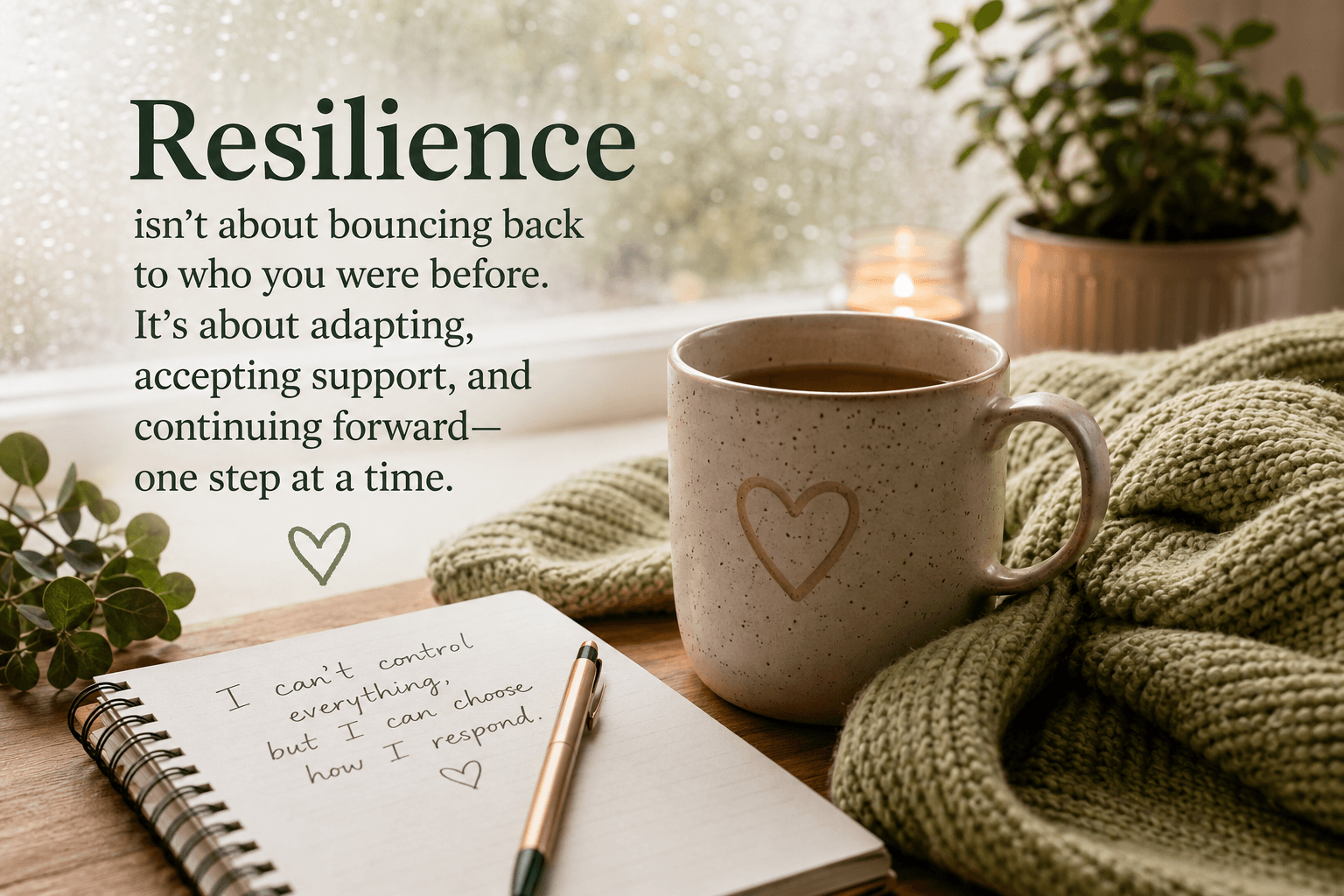
Emotional Resilience: Staying Flexible When Life Doesn’t Go According to Plan

Resilience Is Not the Same Thing as Being Unaffected
I have mixed feelings about the word resilience. I love what it is supposed to represent: our remarkable human capacity to adapt when circumstances change, recover after difficulty, learn from experience, and continue moving forward when life looks nothing like the version we had planned. Somewhere along the way, though, resilience became tangled up with toughness. We praise people for being resilient when they keep working through enormous stress, remain composed during terrible circumstances, take care of everyone else while their own world is falling apart, and somehow manage to make the whole thing look relatively graceful from the outside. There is almost an implied standard attached to the word now. If you are really resilient, perhaps you shouldn’t struggle very much. You shouldn’t need too much help, stay upset for too long, or allow the experience to interfere with your productivity. You should “bounce back,” preferably with a newfound appreciation for life and an inspirational quote ready for Instagram.
Human beings are considerably messier than that, and thankfully, the science of resilience is too. Psychological resilience is better understood not as a fixed personality trait that some fortunate people possess, but as a dynamic process of adapting in the context of adversity.¹˒² It changes across time and circumstances and emerges from interactions among our biology, psychological resources, relationships, environment, previous experiences, access to resources, and the nature of the challenge itself. Someone may demonstrate extraordinary resilience during one period of life and feel completely overwhelmed during another. That doesn’t necessarily mean they became weaker. The load may have changed. Their resources may have changed. Usually, some combination of the two has changed, because life has an annoying habit of introducing several variables at once rather than allowing us to conduct our stressful experiences under tidy laboratory conditions.
I think this distinction matters enormously because resilience should never become another way of asking people to tolerate more than is reasonable. We spent last week talking about burnout and the difference between capacity and sustainability, and emotional resilience belongs in that same conversation. Being capable of surviving something does not automatically mean the experience is harmless. Continuing to function does not prove that the circumstances are sustainable, and getting through something does not mean we should have been expected to endure it without support. Sometimes resilience means continuing, but sometimes it means stopping. It can mean asking for help, changing the plan, leaving something behind, grieving what didn’t happen, accepting that our capacity is temporarily smaller than we want it to be, or admitting that the way we have been doing things simply no longer works. That is a much more interesting version of resilience to me because it leaves room for adaptation rather than glorifying endurance for endurance’s sake.
The Problem With “Bouncing Back”
One of the metaphors we often use for resilience is bouncing back, and I understand why it has stuck around. It captures the reassuring idea that adversity doesn’t have to permanently incapacitate us. What I don’t particularly like about it is the suggestion that recovery means returning to exactly who we were before something happened, as though the ideal outcome after a major experience is to erase its impact and restore the factory settings. Often, we don’t go back. Some experiences change us, and that isn’t necessarily evidence that recovery failed.
Loss changes us. Parenthood changes us. Illness changes us. Relationships, failure, success, caregiving, financial uncertainty, professional transitions, trauma, and long periods of stress can alter our priorities, our expectations, our sense of safety, and the amount of energy we have available for things that once felt easy. Sometimes those changes are painful, sometimes they eventually become useful, and often they are a mixture of both. The goal of resilience is not necessarily to eliminate those effects. Research has increasingly moved away from simplistic notions of resilience as invulnerability and toward models that recognize adaptation as dynamic, multidimensional, and highly dependent on context.³ There is no single universal trajectory after adversity. Some people maintain relatively stable functioning, some struggle initially and gradually recover, some experience difficulties later, and some continue struggling for extended periods.⁴ Even within the same person, functioning can vary enormously across different parts of life.
That last point is especially important because outward functioning is a remarkably imperfect measure of internal well-being. Someone may perform beautifully at work while barely holding things together at home, maintain strong relationships while struggling profoundly with sleep and anxiety, or continue accomplishing everything expected of them while the amount of effort required to do it has quietly doubled. I think high-functioning people are particularly vulnerable to having distress overlooked for exactly this reason. Competence is reassuring to everyone around us. If you are still getting things done, answering emails, caring for your family, showing up professionally, remembering to buy groceries, and generally preventing the wheels from falling off, people assume you must be okay. Sometimes we assume we must be okay because the wheels are technically still attached.
But resilience cannot simply mean maintaining output. If it did, we would be measuring productivity rather than adaptation, and those are not remotely the same thing.
Your Capacity Is Not a Constant
One of the most useful things we can understand about emotional resilience is that capacity changes, sometimes dramatically, even within the same person. Consider a relatively ordinary stressor: someone sends you a frustrating email. On a well-rested Tuesday morning after breakfast, when life is generally stable and you have fifteen minutes before your next obligation, the email may be irritating but manageable. You read it, roll your eyes, decide whether it actually deserves a response, and continue with your day. Now let the exact same email arrive after three nights of terrible sleep while your child is sick, you’re worried about money, you haven’t eaten since breakfast, your hormones are shifting, your relationship feels strained, and something important at work has just gone sideways. Suddenly that email has acquired the emotional weight of a congressional investigation.
The email didn’t change. The nervous system receiving it did.
This is why the dishwasher is sometimes genuinely not about the dishwasher. We touched on this last week when we talked about sleep and burnout, but it becomes even more important in the context of emotional resilience because our emotional responses do not occur independently from our physiology. Sleep deprivation can increase emotional reactivity and alter communication between brain regions involved in emotional processing and regulation.⁵ Chronic stress can influence cognitive and emotional functioning, while pain, illness, hormonal fluctuations, metabolic state, inflammation, medications, substance use, and countless other physiological factors can affect how much regulatory capacity we have available at a given moment. None of this means every difficult emotion requires a biological explanation. Sometimes you’re angry because something genuinely infuriating happened, and no amount of magnesium is going to make the situation less annoying. Understanding that emotional capacity is partly state-dependent simply gives us a more useful way to interpret why something that felt manageable last month suddenly feels enormous today.
Instead of immediately asking ourselves, “Why am I suddenly so bad at handling things?”, we can become curious about what else we’re carrying. Maybe the stressor itself is relatively small but it arrived on top of five larger ones. Maybe we’re sleep deprived. Maybe we’ve been caregiving for months without meaningful recovery. Maybe we’re lonely, physically depleted, grieving, financially stressed, or trying to navigate uncertainty in another area of life. When we look at the whole load rather than judging ourselves solely by our response to the final straw, emotional reactions often make considerably more sense.
Stress Is Not Automatically the Enemy
This is also a good place to rescue stress from the terrible reputation it has acquired in wellness culture. Just as we talked earlier this month about sympathetic nervous system activation not being inherently bad, stress itself is not automatically harmful. Humans are built to respond to challenges. A deadline can sharpen attention. Exercise deliberately creates physiological stress that stimulates adaptation. Learning something difficult requires effort and frustration. Parenting is stressful even when it is deeply wanted and profoundly meaningful. Starting a business, falling in love, traveling somewhere unfamiliar, competing, performing, speaking publicly, and pursuing almost any worthwhile goal can activate our stress-response systems. A completely stress-free life would not necessarily be a healthy life, and I suspect it would also be incredibly boring.
What matters is the relationship between demand and resources. Research on stress and resilience recognizes that our responses depend not simply on whether a stressor exists, but on its intensity, duration, controllability, predictability, meaning, and the resources available to meet it.⁶ A challenging experience that is time-limited, meaningful, and accompanied by adequate support can affect us very differently from chronic, uncontrollable stress with no clear endpoint. This helps explain why we can sometimes tolerate an objectively enormous amount of stress surprisingly well when we understand why we’re doing it, have chosen some part of it, believe we are capable of responding, and can see an end somewhere on the horizon.
Graduate school is a good example. So is caring for a newborn, preparing for an athletic event, launching a business, completing a major project, or moving across the country. These seasons can demand tremendous amounts of energy, and no one experiencing them would necessarily describe them as relaxing, but meaning and a visible endpoint can change the way the stress is experienced. Chronic uncertainty is different. The nervous system likes information. It likes knowing whether the threat has passed, whether resources are available, and whether our actions have some influence over what happens next. Unpredictable and uncontrollable stressors can therefore be particularly difficult because they remove much of that information.⁷
I think this is why some of the hardest seasons of life aren’t necessarily the ones in which something terrible happens and then ends. Sometimes the hardest seasons are the ones in which the situation keeps changing, the finish line keeps moving, and you can’t make a plan because you don’t yet have enough information to know what the plan should be. You keep adapting, but before you have completely found your footing, something shifts again. Emotional resilience in those seasons looks very different from recovering after a single discrete event because there isn’t yet a clear “after.” You are adapting while the story is still being written.
Resilience Has More to Do With Flexibility Than Strength
When I think about emotional resilience now, I think less about strength and much more about flexibility. Strength is certainly useful, but rigidity has limits. A system can tolerate tremendous force in exactly the direction it was designed to handle and still break when pressure arrives from somewhere unexpected. Flexibility gives us another option: we can adjust our response when circumstances change instead of continuing to apply the same strategy simply because it worked before.
Psychological flexibility has been studied extensively and generally describes the capacity to remain in contact with present experience while adapting our behavior according to circumstances and personally meaningful values. Greater psychological flexibility has been associated with better mental health and adaptive functioning, while psychological inflexibility is associated with a range of psychological difficulties.⁸ I like this framework because it does not require us to feel good about everything that happens. Flexibility is not passive resignation, nor is it convincing ourselves that a painful situation is secretly wonderful. It means being able to recognize when the old strategy is no longer serving us and having enough psychological room to choose another one.
Maybe you planned to push through something and discover that you need rest. Maybe you expected to handle a situation independently and realize that you need help. Maybe you intended to stay in a job, relationship, or role and eventually understand that leaving is healthier. Maybe you expected yourself to “be over it” by now and have to stop placing an arbitrary deadline on grief. Sometimes the goal itself changes because the person pursuing it has changed. There is enormous resilience in being able to look at reality and say, This isn’t working anymore. What would work better now?
High achievers can struggle with this because persistence has served us extraordinarily well. We learn early that when something is difficult, the answer is usually to work harder, prepare more, become more disciplined, troubleshoot the problem, and try again. Often, that is exactly the right answer, which is why the strategy becomes so deeply reinforced. The challenge comes when a situation requires adaptation rather than persistence. Continuing to push harder can look like resilience from the outside while actually becoming rigidity. Knowing when to persevere and when to change course is considerably more sophisticated than simply being able to endure.
Being Emotional Does Not Mean You Are Dysregulated
I also want to separate emotional resilience from emotional calm because those ideas get blurred together constantly. Resilient people still get angry. They grieve. They become frightened, overwhelmed, disappointed, embarrassed, jealous, lonely, and occasionally irrationally furious at an inanimate household object that has chosen exactly the wrong moment to stop working. Emotions are not evidence that regulation has failed. They are part of the system we’re trying to regulate.
Fear can orient us toward potential danger. Anger can alert us to a perceived violation or injustice. Sadness can accompany loss and draw us toward reflection or support. Guilt may tell us that our behavior conflicted with our values. Even anxiety, as we discussed earlier this month, can sometimes increase vigilance and preparation. Problems arise when emotions become so intense, persistent, or disconnected from context that they significantly impair our ability to function, or when the strategies we use to escape uncomfortable emotions create additional problems. The goal of emotional resilience, however, should not be to flatten the emotional landscape until we are pleasantly neutral about everything.
Research on emotion regulation suggests that flexibility in regulatory strategies matters. No single strategy is universally adaptive in every circumstance. Cognitive reappraisal, acceptance, problem-solving, distraction, emotional expression, and even temporary suppression may each be useful depending on the situation, the intensity of the emotion, the timing, and how much control we actually have over what is happening.⁹ This is wonderfully freeing because it means there is no gold medal for processing every emotion perfectly in real time. Sometimes you need to take a walk before responding. Sometimes you need to cry. Sometimes you need to talk about something immediately, while another time you may need to set it aside long enough to get through a meeting and come back to it later. Sometimes you need to journal about your feelings, and sometimes you need to stop analyzing your feelings and go make dinner.
Emotional resilience includes having enough options that one strategy does not have to solve every problem. Someone who can only suppress may eventually struggle under the weight of everything they are containing, but someone who believes every emotion must be immediately expressed and thoroughly processed may also have difficulty functioning when circumstances require temporary containment. Flexibility means we can respond to the needs of the moment without confusing a temporary strategy with a permanent way of living.
Suppression Is Not the Same Thing as Regulation
This is where our cultural idea of “being strong” can become particularly unhelpful. Many of us learned, explicitly or implicitly, that emotional control means not showing emotion. Keep it together. Don’t cry. Don’t get angry. Don’t let them know you’re scared. Be the strong one. There are absolutely moments when temporarily containing an emotional response is appropriate. If something difficult happens five minutes before I walk into a professional responsibility, I may need to set that experience aside temporarily so I can do what needs to be done and return to it later. That is a very different process from deciding that the emotion itself is unacceptable or that acknowledging it somehow makes me less capable.
Habitual expressive suppression has been associated with less positive emotion, poorer interpersonal functioning, and, in some research, worse psychological outcomes, while more flexible approaches to emotion regulation appear to be more adaptive.¹⁰ That doesn’t mean everyone needs to narrate every internal experience to everyone around them. Personality, culture, context, and individual processing styles matter tremendously. Some people genuinely process more internally, while others understand what they feel through conversation. The distinction I care about is whether we are choosing how to respond to an emotion or spending enormous amounts of energy pretending it isn’t there.
There is something deeply freeing about being able to acknowledge that an experience is hard while also recognizing that we are handling it. Those statements do not contradict each other. You can be grateful and exhausted, hopeful and scared, strong and in need of help, confident about a decision and sad about what it cost, excited about the future and grieving what you left behind. Human emotions are remarkably unconcerned with our preference for tidy categories, and emotional resilience allows more than one thing to be true at the same time.
You Don’t Have to Earn the Word “Resilient”
There is another reason I want to redefine resilience this way: calling someone resilient can accidentally become permission to keep giving them more. We do this particularly with competent people. She’ll handle it. He’s been through worse. They’re so strong. Maybe they will handle it, but strong people still have limits. The person who usually manages everything is allowed to reach capacity, and someone who has survived enormous adversity does not owe the world continued proof that they can survive more. Previous hardship is not a lifetime subscription to additional hardship.
Prior adversity can influence future stress responses in complicated ways. Some experiences may contribute to greater confidence, coping skills, perspective, or a stronger belief in our ability to survive difficult circumstances, while severe or cumulative adversity can also increase vulnerability to later mental and physical health difficulties.¹¹ There is no reliable equation in which suffering automatically produces strength. Sometimes hardship teaches us that we can survive difficult things. Sometimes it teaches us that we never want to live that way again, which can be just as valuable. Sometimes it changes what we are willing to tolerate, clarifies what matters, or makes us more willing to ask for help earlier the next time.
And sometimes there is no beautiful lesson at all. Something awful happened, we wish it hadn’t, and eventually we figured out how to continue living. I think we need to leave room for that version too. Not every painful experience needs to become a gift, and insisting that people extract meaning from suffering before they are ready can become its own form of emotional pressure. Resilience does not require us to be grateful for everything that shaped us.
Resilience Happens in Context
Perhaps the biggest problem with treating resilience as an individual personality trait is that it places nearly all responsibility on the person experiencing adversity. One person recovers, so we call them resilient. Another struggles, and the implication is that something inside them was insufficient. That interpretation ignores almost everything surrounding them. Contemporary resilience research emphasizes the importance of systems and resources beyond the individual, including family relationships, social support, economic stability, community, culture, healthcare, education, and the broader environment in which adversity occurs.¹² We adapt through the resources available to us, not through willpower alone.
It is considerably easier to “bounce back” when you can take time away from work without losing your housing. It is easier to seek therapy when therapy is affordable and available. It is easier to rest when someone else can watch the children, easier to recover from illness when food and healthcare are accessible, and easier to navigate a crisis when friends, family, coworkers, or community members show up. Acknowledging those realities does not diminish individual strength. It gives us a more accurate picture of where strength actually comes from.
Often, resilience is distributed across a network. There are seasons when someone else lends us some of their capacity because ours is low, and later, when we have more to give, perhaps we do the same for them. A partner takes over bedtime because you have nothing left. A friend listens to the same story for the fourth time because apparently you still need to tell it. A coworker covers something you normally handle. Someone brings dinner. Someone watches the dog, picks up the child, answers the phone, makes you laugh at exactly the right moment, or simply sits beside you while there is nothing useful to say. These are not side notes to resilience. They are often part of the mechanism through which resilience happens.
Maybe We Were Never Supposed to Do This Alone
Modern wellness culture can make resilience feel like another individual optimization project. Regulate your nervous system, perfect your morning routine, meditate, exercise, journal, practice gratitude, take the supplements, develop better coping skills, and perhaps become so emotionally optimized that nothing life throws at you can penetrate your carefully constructed bubble of regulation. Many of those practices are genuinely useful, and we’ve spent this entire month talking about several of them. The problem is not the tools. It is the assumption that the responsibility for adapting to every difficult circumstance lives entirely inside the individual.
Humans are profoundly social organisms, and our emotional regulation develops and continues to operate in relationship with other people. Social support is consistently associated with better psychological outcomes following adversity, and interpersonal connection can influence both physiological stress responses and our subjective experience of threat and safety.¹³ Sometimes resilience does look like having excellent coping skills, knowing how to regulate our breathing, understanding our triggers, protecting sleep, moving our bodies, and having practices that help us return to ourselves. Other times, resilience looks remarkably less impressive. It looks like knowing who to call.
I think that is where the next part of this conversation needs to go, because once we stop treating resilience as a test of individual toughness, relationships become central to the story. We can begin talking about co-regulation and the biology of connection, why meaning and purpose can change the way we experience adversity, and why positive thinking can sometimes help while at other times becoming a way of avoiding emotions that genuinely need space. We can also explore what it means to build resilience intentionally without turning it into another demand to be endlessly adaptable to circumstances that perhaps should change.
Because I don’t think emotional resilience is the ability to remain unchanged while life happens around us. Life will change us. People will change us. Love will change us. Loss will change us. Parenthood, work, illness, uncertainty, disappointment, joy, and the accumulation of years will all leave something behind. I don’t want resilience to mean becoming so hard that none of those experiences can reach us.
I would rather become flexible enough to be affected by life without being permanently defined by every difficult thing that happens.
That feels much more human.
We Were Never Meant to Be Resilient Alone
If resilience is not simply a matter of becoming tougher, then we have to broaden the conversation beyond what happens inside one person’s mind. This is where I think a lot of popular advice about emotional health gets things backward. We are told to regulate ourselves, manage our stress, change our mindset, develop better coping skills, protect our peace, and become more comfortable with discomfort. Much of that is useful, and I certainly spend plenty of time talking about those things with patients. But human beings did not evolve as emotionally self-sufficient little islands. We are social organisms, and from the beginning of life, our nervous systems develop in relationship with other nervous systems. A baby does not arrive with a fully developed ability to recognize distress, understand what it means, and calmly breathe through it. Regulation initially happens through caregivers who feed, hold, rock, soothe, speak, make eye contact, and repeatedly provide the experience that distress can occur and eventually resolve.¹⁴
We become more capable of self-regulation as we develop, but we never completely outgrow the influence other people have on our emotional and physiological state. Adults regulate one another too, although it usually looks less like swaddling and considerably more like calling someone after a terrible day, sitting beside a partner when something frightening has happened, laughing with a friend when everything has become absurd, or hearing someone we trust say, “We’ll figure this out,” and noticing that our shoulders drop a little. Social connection can influence stress physiology, perceived threat, emotional processing, and our ability to cope with adversity. Research on social buffering has demonstrated that supportive relationships can attenuate aspects of the physiological stress response, although the effects depend on the relationship, context, and individual involved.¹⁵˒¹⁶
I think most of us intuitively know this long before we know any of the neuroscience. There are people whose presence makes us feel more settled and people whose name appearing on our phone produces the opposite effect. There are conversations after which a problem feels more manageable even though absolutely nothing about the actual problem has changed. Sometimes what changed was simply the experience of carrying it alone.
Co-Regulation Isn’t Just for Children
The term co-regulation has become popular enough that it occasionally gets used rather loosely, but the underlying idea is important: emotional regulation occurs partly through interactions with other people. In childhood, supportive caregivers help scaffold the development of self-regulation. In adulthood, relationships can continue to influence how we interpret and respond to stress.¹⁷ The goal is not to become dependent on another person to regulate every uncomfortable feeling. Healthy self-regulation matters. But independence and connection are not opposites, and being emotionally healthy does not require us to become so self-contained that we no longer need anyone.
This distinction matters because some people are extremely good at appearing independent precisely because they learned very early not to expect help. They handle things themselves. They don’t want to burden anyone. They are often the person everyone else calls during a crisis because they are competent, calm, and reliable, and there can be genuine strength in those qualities. But sometimes underneath that competence is a belief that needing other people is dangerous, inconvenient, or somehow evidence of failure. That belief can make adversity considerably lonelier than it needs to be.
Healthy resilience includes knowing how to draw on relationships without expecting another person to fix what we feel. A partner cannot remove grief, a friend cannot eliminate uncertainty, and a therapist cannot make difficult circumstances disappear. What another person can sometimes provide is enough safety, perspective, practical help, humor, or companionship that we have more capacity to meet the experience ourselves. There is a tremendous difference between someone needs to make this feeling go away for me and I don’t have to experience this feeling entirely alone.
That difference is part of emotional maturity, not evidence that we have somehow failed to become independent enough.
The People Around Us Change the Load
Social support is one of the most consistently identified protective factors in resilience research, but even the phrase social support can sound a little clinical compared with what it looks like in actual life. Sometimes support is emotional: someone listens, validates, encourages, or reminds us of a perspective we temporarily cannot access ourselves. Sometimes it is practical: someone brings dinner, covers an appointment, watches a child, helps with paperwork, drives us somewhere, or takes one task off an already ridiculous list. Sometimes support is informational, such as helping us understand a problem or connect with resources. The form matters less than the fact that support can change the relationship between the demand and the resources available to meet it.¹⁸
This is important because we often talk about resilience as though the resilient person somehow developed a larger internal container for stress. Sometimes that is true. People develop coping skills, confidence, perspective, and emotional regulation through experience. But sometimes resilience occurs because the load itself becomes lighter when it is distributed. If I am carrying ten things and someone takes two of them, I have not magically become stronger. I simply have more capacity available for the remaining eight.
That may sound obvious, but it changes the way we think about asking for help. Asking for help is often framed as something we do only after we have exhausted our own resources, almost like breaking the glass on an emergency box. We try everything ourselves first, become completely overwhelmed, and then reluctantly admit that perhaps another human being could participate. A more resilient system uses support earlier. It recognizes that distributing resources is not cheating. It is good design.
There is also an important difference between the number of people around us and the quality of those relationships. Loneliness can occur in a crowded room, in a marriage, in a large family, or in a workplace full of people. What seems to matter is not simply social contact but whether we experience relationships as supportive, responsive, and safe enough for genuine connection. Perceived social support has been associated with better mental health and adaptation across a variety of stressful circumstances, while loneliness and social isolation are associated with poorer physical and psychological outcomes.¹⁹
This is one reason I hesitate when wellness advice treats relationships as an optional bonus after we’ve perfected diet, exercise, sleep, and supplements. Connection is not frosting on the health cake. Apparently I have now turned social neuroscience into baking, but we’re going with it. Relationships are part of the environment in which our nervous systems function.
Not Every Relationship Is Regulating
Of course, simply being around other people does not automatically make us more resilient. Relationships can be among our greatest sources of safety and among our greatest sources of stress. A chronically critical partner, unpredictable family member, hostile workplace, emotionally unsafe friendship, or relationship in which someone constantly has to monitor another person’s mood can increase rather than decrease physiological and psychological load. Social connection is protective when the connection itself is supportive.
This is where boundaries return to our October conversation, but in a slightly different way than they did last week. We talked about boundaries in burnout as a way of protecting finite resources. Emotional resilience also requires boundaries because connection without differentiation can become another form of depletion. Being supportive does not mean becoming responsible for every emotion experienced by everyone we love, and empathy does not require absorbing another person’s distress until we are equally dysregulated.
For people in helping professions, caregiving roles, or families where they have historically been “the strong one,” this distinction can take some practice. We can care deeply about what someone is experiencing without assuming we must solve it. We can listen without taking ownership. We can remain compassionate while acknowledging that we do not have unlimited capacity. In fact, boundaries often preserve relationships because they reduce the resentment that develops when care repeatedly requires self-abandonment.
The goal, then, isn’t simply more connection. It is healthy connection, the kind that allows people to remain distinct while still supporting one another. Sometimes resilience involves leaning in toward relationships, and sometimes it requires enough self-trust to step away from relationships that repeatedly destabilize us. Again, flexibility matters more than a universal rule.
Emotional Flexibility Means Letting the Emotion Fit the Situation
Relationships help us regulate, but resilience also depends on how much room we allow for our own emotional experience. This is where I want to talk about emotional flexibility, because we have a cultural tendency to divide emotions into two categories: the ones we want and the ones we’d like to return for store credit.
Joy, gratitude, excitement, confidence, and contentment are welcome. Anxiety, anger, grief, jealousy, shame, frustration, and disappointment tend to get labeled as negative, and once we call them negative, we naturally assume the goal is to get rid of them. This has created an enormous market for strategies designed to make us feel better as quickly as possible, which is understandable because uncomfortable emotions are, by definition, uncomfortable. But an emotionally resilient life cannot depend on feeling good most of the time.
Sometimes feeling terrible is an appropriate response to what has happened.
If someone you love dies, grief is not dysregulation. If someone violates an important boundary, anger may be appropriate. If you are facing genuine uncertainty, anxiety may make sense. If something you worked very hard for falls apart, disappointment is not a mindset problem. Our emotional responses contain information about what we value, what we fear, what we have lost, and what may need our attention.
Emotional flexibility means allowing the emotional response to fit the situation while retaining some choice about what we do next. Research on regulatory flexibility suggests that adaptive emotion regulation depends partly on sensitivity to context and the ability to select and modify strategies according to what the situation requires.²⁰ Sometimes changing our interpretation of an event is useful. Sometimes the interpretation is perfectly accurate and the situation itself needs to change. Sometimes distraction is healthy because we need a break from something we cannot solve. Sometimes distraction becomes avoidance because we never return to what needs attention. Even a generally useful strategy can become unhelpful when it is applied rigidly.
This is why I am wary of declaring one emotional regulation technique universally superior to another. Human beings are not IKEA furniture. There is no single instruction manual where step four is “apply cognitive reappraisal” and suddenly the emotional bookshelf stands upright.
We need options.
Acceptance Is Not Approval
One of those options is acceptance, another word that is frequently misunderstood. Accepting an experience does not mean approving of it, liking it, agreeing that it should have happened, or abandoning efforts to change what can be changed. Psychological acceptance is closer to acknowledging what is already present without spending additional energy insisting that reality should currently be different. Acceptance-based approaches, including Acceptance and Commitment Therapy, emphasize making room for internal experiences while continuing to act in ways that align with personally meaningful values.²¹
This can sound almost annoyingly simple until you notice how much energy we spend arguing with experiences that have already occurred. This shouldn’t be happening. I shouldn’t feel this way. I should be over this. They shouldn’t have done that. This isn’t how this year was supposed to go. Some of those statements may be completely correct. It shouldn’t have happened. They shouldn’t have done it. You deserved something different.
And it still happened.
Acceptance begins there.
Once we stop requiring reality to retroactively cooperate, we have more energy available to decide what happens next. That may mean taking action, setting a boundary, grieving, seeking treatment, changing course, repairing something, or simply allowing time to pass. Acceptance does not remove agency. Often, it gives agency somewhere useful to go.
I think this becomes especially important during periods of uncertainty because there may not yet be a problem we can fully solve. Sometimes we have done everything currently available to us and are waiting for information, another person’s decision, a medical result, an insurance process, a job opportunity, or circumstances outside our control. That waiting can be maddening for people who are accustomed to solving problems through action. Acceptance in those moments may simply mean recognizing the boundary between what we can influence today and what has not yet become ours to decide.
When Positivity Becomes Another Form of Avoidance
This brings me to positive thinking, which I want to defend and criticize at the same time.
Optimism can absolutely be protective. Positive expectations, hope, meaning, and the belief that we have some ability to cope with future challenges are associated with better psychological adjustment in many contexts.²² Gratitude practices can be helpful. Reframing can be helpful. Looking for what remains good during a difficult period can be enormously stabilizing.
I do this myself. I also think positivity becomes harmful when it is used to invalidate reality.
This is sometimes called toxic positivity, although that phrase is used more colloquially than clinically. The basic problem occurs when positive framing becomes an expectation that uncomfortable emotions should be quickly replaced with gratitude, optimism, or a lesson. Someone loses something important and hears, “Everything happens for a reason.” Someone is overwhelmed and is told to focus on what they have. Someone is frightened and hears that they need to think positively.
Often the person saying these things is trying to help. Difficult emotions make observers uncomfortable too, and offering a bright side can feel like giving someone a way out. But sometimes what a person needs is not a way out of the emotion. They need someone willing to sit beside them while it exists. There is an enormous difference between finding something good within a difficult experience and being required to call the difficult experience good.
We can be grateful for the people who showed up after a crisis without being grateful that the crisis happened. We can discover strength we did not know we had and still wish we had never needed it. We can appreciate what an experience taught us while acknowledging that the tuition was absurdly expensive. That is emotional complexity, and I think resilience needs room for it.
Meaning Can Change the Experience of Stress
One of the reasons positive reframing can be useful when it is authentic is that meaning matters. Human beings seem to tolerate difficulty differently when we understand why we are enduring it or can connect our actions to something that matters deeply to us. Meaning does not necessarily reduce the objective demand, but it can change the relationship we have with that demand.
Research on meaning in life has linked a stronger sense of purpose and coherence with psychological well-being and, in some contexts, better adaptation to adversity.²³ Meaning can come from relationships, spirituality, work, caregiving, creativity, service, community, personal growth, or countless other sources. It does not have to be grand. Sometimes the reason we tolerate a difficult season is simply because someone we love needs us right now. Sometimes we continue a demanding project because we believe deeply in what it will create. Sometimes we endure uncertainty because the alternative would mean abandoning something that still matters.
But meaning is not the same as martyrdom. A meaningful job can still burn you out. Parenting can be the most meaningful role in someone’s life and still leave them desperate for a break. Caring for a sick family member can be an act of enormous love and still create exhaustion, grief, resentment, and frustration. The presence of meaning does not eliminate the need for recovery.
I think this is where last week’s conversation about burnout connects beautifully with resilience. Part of recovering from my own burnout involved reconnecting with why I wanted to practice medicine in the first place, but reconnecting with purpose alone would not have been enough. I also had to change the conditions under which I was doing the work. Meaning gave me a reason to rebuild the structure; it did not make the broken structure acceptable.
That is a distinction I return to frequently. Purpose can help us carry something difficult. It should not automatically convince us to carry something indefinitely.
Resilience Is Also Knowing Where Your Control Ends
A lot of emotional suffering lives in the space between what we wish we could control and what we actually can. This is not a new idea, but it remains frustratingly relevant. We can influence our choices, habits, communication, boundaries, preparation, and responses. We can sometimes influence other people and external systems, particularly when we have authority or resources. But we cannot control whether someone understands us, whether another person changes, whether every medical treatment works, whether a business succeeds, whether the weather cooperates, whether an insurance company behaves reasonably, or whether life respects the timeline we carefully constructed in our heads.
Uncertainty becomes especially exhausting when we repeatedly try to solve problems that have not yet become solvable. The brain keeps returning to them because unfinished problems naturally capture attention, and worry can create the sensation that we are doing something. If I think about this for another forty minutes at 2:00 a.m., perhaps I will finally identify the secret piece of information that does not currently exist.
I have personally conducted this experiment. The results are disappointing.
Resilience requires enough discernment to identify where action is useful and where continued mental effort is simply consuming resources. This does not mean we stop caring. It means we recognize that there are times when the most adaptive response is to gather the information we can, make the decision available to us today, and tolerate the fact that some portion of the future remains unresolved.
For people who are planners, perfectionists, or highly conscientious, that can be profoundly uncomfortable. Planning has probably protected us from many problems. Preparation often works. The trouble is that uncertainty occasionally presents a situation that cannot be prepared into submission.
Then resilience becomes the capacity to live while we wait.
Hope Doesn’t Require Certainty
I think hope belongs here because we sometimes treat hope as confidence that everything will work out exactly the way we want. That is a very fragile version of hope because life has never signed that contract.
A more durable hope sounds different.
It says, I don’t know exactly what happens next, but I trust that I will have options.
It says, If the plan changes, I can adapt.
It says, If I need help, I know who I can ask.
It says, I have survived uncertainty before, and I do not need to know the ending in order to continue participating in the middle.
Research on hope often conceptualizes it not merely as optimism but as the interaction between a sense of agency and the ability to identify pathways toward meaningful goals.²⁴ That definition feels much more useful to me because it leaves room for plans to change. If one pathway closes, hope does not require us to pretend it is still open. We look for another route.
Sometimes there isn’t another route yet. Then perhaps resilience is remaining open long enough for one to appear.
We Can Borrow Hope From Each Other
This is also where relationships return to the story. There are moments when our own perspective becomes very narrow under stress. We cannot see the options. We cannot imagine feeling differently. We cannot access the confidence we had six months ago because the present experience is too loud.
Sometimes another person can hold a wider perspective temporarily.
They remember who we are when we don’t particularly feel like ourselves. They remind us that we have solved difficult problems before. They notice options we cannot see. They don’t promise that everything will be fine, because sometimes neither of us knows that, but they help us tolerate not knowing.
That may be one of the most beautiful forms of co-regulation.
We borrow a little steadiness.
A little perspective.
A little hope.
Then eventually we have enough of our own again.
And perhaps later, when someone we love cannot see beyond whatever is happening to them, we return the favor.
This is why I increasingly think resilience is less like an individual reserve stored somewhere inside us and more like an ecosystem of resources. Some are internal: emotional regulation, physical health, coping skills, self-trust, perspective, flexibility, and experience. Others exist outside us: relationships, healthcare, money, time, community, meaningful work, safe housing, practical help, and opportunities. The health of the whole system influences how well we adapt when something changes. And something always changes.
You Do Not Have to Feel Ready to Keep Going
There is one final misconception I want to address before we move into the last part of this article: the idea that we need to feel confident, motivated, or emotionally resolved before we can take the next step. Sometimes we do. Often, we don’t.
We can make the phone call while anxious. We can set the boundary while feeling guilty. We can begin again while still disappointed that the first plan failed. We can show up for someone we love while grieving. We can take a small step toward the future without feeling remotely certain about where it leads.
Emotional resilience is not waiting until difficult emotions disappear before participating in life again. It is developing enough flexibility that those emotions can come with us without automatically being put in charge.
That is not the same as ignoring them. Sometimes the emotion changes the decision, and it should. Fear may reveal that something genuinely feels unsafe. Anger may clarify a boundary. Exhaustion may tell us that the pace is unsustainable. Grief may require more time than our schedule would prefer. Resilience means listening without surrendering all agency to whichever emotion happens to be loudest in the moment.
And this is where I think the final part of our October conversation needs to land. If resilience is dynamic, relational, flexible, and rooted partly in meaning, how do we actually cultivate more of it without turning resilience into one more thing we’re supposed to be good at? How do we build internal and external resources before the next difficult season arrives, recognize when coping has become avoidance, and support ourselves without pretending we can control every outcome?
Most importantly, how do we make room for the possibility that resilience does not always look like a triumphant return to normal? Sometimes there is no return to normal.
Sometimes the circumstances change, the plan changes, and we change too. We lean on people. We let go of things. We discover which parts of our lives were sturdier than we realized and which ones need rebuilding. We keep making the next decision available to us even when we cannot see very far beyond it. Maybe that isn’t bouncing back at all. Maybe it is learning how to move forward without requiring the future to look exactly like the past.
Building Resilience Without Becoming Harder
If resilience is dynamic rather than fixed, relational rather than purely individual, and more about flexibility than toughness, the obvious question becomes whether we can actually build more of it. I think the answer is yes, but perhaps not in the way resilience is usually marketed. We don’t become resilient by creating a life in which nothing bothers us, nor do we prepare for adversity by trying to become emotionally bulletproof. We build resilience by developing resources we can draw from when circumstances become difficult, and those resources exist both inside and outside us. Sleep matters. Physical health matters. Relationships matter. Financial and practical resources matter. Emotional regulation, self-trust, meaningful work, community, flexibility, and our ability to ask for help all matter. The more resources we have available, the less likely one difficult experience is to consume every ounce of capacity we possess.
This is one reason the previous weeks of October actually belong together more than they might initially appear. We began with anxiety and talked about the fact that activation is not inherently pathological. Then we explored nervous system regulation and the ability to move between activation and recovery rather than trying to remain permanently calm. Last week, we talked about sleep and burnout, and why recovery cannot simply be squeezed into whatever space remains after we’ve given everything else away. Emotional resilience sits on top of all of that. It is difficult to adapt flexibly when the nervous system is chronically activated, sleep deprived, physically depleted, socially isolated, and already operating at the edge of capacity. We sometimes ask people to develop better coping skills when what they desperately need is more capacity.
That doesn’t mean resilience is simply a matter of making life easier, because some aspects of life will never become easy. There will always be losses we cannot prevent, people we cannot control, bodies that change, relationships that disappoint us, plans that fail, and circumstances that refuse to consult our calendars before arriving. The goal is to build enough physiological, psychological, relational, and practical reserve that when something difficult happens, it does not immediately require every resource we have.
Build the Foundation Before You Need It
One of the least glamorous truths about resilience is that much of it is built during ordinary life. We tend to become interested in resilience once something has gone wrong, which makes sense, but many of the resources that help us through a crisis are developed long before we know we will need them. Regular physical activity, adequate sleep, supportive relationships, meaningful routines, time outside, nourishing food, financial buffers when they are possible, access to healthcare, and activities that give us a sense of competence or purpose all contribute to the broader system from which we respond to stress. Research examining protective factors for resilience consistently identifies a combination of individual capacities and environmental resources rather than one magical psychological characteristic.²⁵
This is not an argument for optimizing every part of your life in anticipation of disaster. I can already feel the perfectionists among us opening a new spreadsheet titled Resilience Protocol, and I am asking you lovingly to close it. The point is not to create a flawless foundation. It is to notice whether ordinary life contains enough things that replenish you to balance the things that consume you. If work is demanding, is there meaningful recovery outside of it? If you’re caregiving, who supports you? If you are going through a period of uncertainty, are there parts of your routine that still feel predictable? If your emotional reserves are low, are you also trying to function on five hours of sleep and coffee instead of lunch?
These questions are not glamorous, but they are often more useful than asking why we aren’t “handling stress better.” Resilience becomes much easier when the organism doing the handling has adequate resources.
Physical activity is a good example. Exercise is not simply useful because it changes cardiovascular fitness or body composition. Regular physical activity is associated with better mental health and can reduce symptoms of anxiety and depression while supporting sleep, cognition, and stress regulation.²⁶ The activity itself can also become a repeated experience of tolerating manageable stress and recovering from it. We deliberately ask the body to do something difficult, discover that we can, recover, and eventually adapt. I don’t think we need to turn every workout into a metaphor for personal growth, because sometimes a squat is allowed to just be a squat, but the broader principle is useful: resilience develops partly through experiencing manageable challenge in the presence of adequate recovery.
Resilience Is Not Avoiding Stress
This brings us to an important distinction. If chronic, overwhelming stress can harm us, it would be easy to conclude that the healthiest life is one in which we eliminate as much stress as possible. That isn’t the goal either. Avoiding every difficult experience can actually shrink our confidence in our ability to handle difficulty. We build self-trust partly through experience: something feels uncomfortable, we engage with it, we discover that we can tolerate the discomfort, and our brain acquires evidence that the next difficult thing may also be manageable.
This principle is especially obvious in anxiety treatment. Avoidance often provides immediate relief, which makes it incredibly reinforcing, but repeated avoidance can maintain anxiety by preventing us from learning that feared situations may be tolerable or that we can cope with discomfort if it occurs. Exposure-based approaches intentionally create opportunities for new learning rather than promising that anxiety must disappear before action becomes possible.²⁷ The lesson is not that we should force ourselves through every fear or remain in genuinely unsafe situations. It is that discomfort and danger are not always the same thing, and emotional resilience requires some ability to tell the difference.
That distinction becomes increasingly important in a culture where almost any unpleasant internal experience can be described as dysregulation. Sometimes your nervous system is telling you that something is genuinely unsafe or unsustainable, and we should listen. Other times your nervous system is reacting to novelty, uncertainty, embarrassment, conflict, effort, or the possibility of failure. Those experiences can feel terrible without necessarily being harmful. If we treat every uncomfortable sensation as evidence that we should stop, our world can gradually become smaller.
Resilience therefore requires two capacities that initially sound contradictory: the ability to honor our limits and the ability to stretch them. Wisdom lives in figuring out which one the moment requires.
Self-Trust Is Built Through Small Evidence
I think self-trust is one of the quieter foundations of emotional resilience. When something unexpected happens, we don’t necessarily need confidence that everything will work out exactly as planned. We need some confidence that we will be able to respond to whatever happens next. That confidence rarely appears because we repeated enough affirmations. It develops through evidence.
We make a difficult decision and survive the uncertainty afterward. We have a hard conversation and discover that conflict did not destroy us. We ask for help and learn that needing support did not make us incompetent. We set a boundary and tolerate someone else’s disappointment. We make a mistake, repair what we can, and continue. We experience grief and eventually notice that we can laugh again without betraying what we lost. We change a plan that we were deeply attached to and discover that another life existed on the other side of it.
None of those experiences feels particularly impressive while we’re inside it. Often, resilience is obvious only in retrospect. We look back and realize that the person who began the experience did not know how they were going to handle it, and yet somehow they kept making the next decision available to them.
This is one reason I don’t think resilience requires certainty. Certainty would certainly be nice, and if anyone knows where they are handing it out, please let me know. Most of the time, however, we don’t get enough information to know exactly how something will unfold. Self-trust fills some of that gap. Instead of I know what is going to happen, it becomes I trust myself to respond when I know more. That is a much more durable kind of confidence.
Give Your Nervous System Experiences of Completion
We have talked throughout October about nervous system activation and recovery, and one practical component of resilience is creating opportunities for stressful experiences to actually end. Chronic stress is particularly exhausting when there is no clear boundary between demand and recovery. Work follows us home through our phones. News follows us everywhere. Family responsibilities continue through weekends. Financial stress may remain present for months. Uncertainty doesn’t politely clock out at 5:00 p.m.
We cannot always eliminate those stressors, but we can sometimes create smaller experiences of completion within them. A workday can end even when the project isn’t finished. A difficult conversation can be followed by a walk. A period of intense concentration can be followed by movement, food, music, or connection. We can create rituals that mark transitions between roles rather than carrying every role simultaneously from morning until bedtime.
This is part of why routines can be stabilizing during uncertain periods. Predictable behaviors provide structure when the larger circumstances are unpredictable. Research on daily routines and rituals suggests that they can support a sense of control and reduce distress in some contexts, particularly during periods of uncertainty.²⁸ The ritual itself does not need to be elaborate. Making coffee in the same quiet kitchen every morning, walking the dog after work, calling someone on Sunday, exercising at a familiar time, or reading before bed can create small islands of predictability inside a life that otherwise feels unsettled.
The goal isn’t to pretend the larger problem has been solved. It is to remind the nervous system that not every moment belongs to the problem. I think that is a profoundly important distinction.
Know When Coping Has Become Avoidance
Coping strategies are useful precisely because difficult emotions can be exhausting. We need ways to give ourselves breaks. Watching something funny, exercising, cooking, spending time with friends, reading, gaming, traveling, or becoming absorbed in a hobby can all provide healthy psychological distance from stress. We are not required to stare directly at every difficult emotion until it confesses its deepest meaning.
But there is a difference between taking a break from an experience and building a life around never encountering it. Avoidance becomes a problem when the strategy that gives us short-term relief repeatedly prevents us from addressing something important. Alcohol can numb. Overworking can distract. Endless scrolling can occupy the mind. Even exercise, wellness routines, or constant productivity can become ways of avoiding emotions we don’t particularly want to meet.
This is where curiosity is much more useful than judgment. Instead of asking whether a coping strategy is “good” or “bad,” I think it is often better to ask what happens afterward. Does this help me return to the situation with more capacity, or does it keep me from returning at all? Does it restore me, or simply numb me? Is it expanding my life or gradually making my world smaller?
The answer may change depending on the day. Watching three episodes of something ridiculous after an awful week may be exactly what you need. Doing it every night because silence allows an uncomfortable thought to surface is a different pattern. Resilience doesn’t require us to eliminate avoidance completely. It asks us to notice when avoidance has quietly taken over the steering wheel.
Make Room for Joy Before Everything Is Fixed
One of the things I find most beautiful about human resilience is our ability to experience positive emotion while circumstances remain genuinely difficult. We often postpone joy until a problem has been resolved. I’ll relax when this project is over. I’ll enjoy myself once we know what happens. I’ll celebrate when everything settles down. Sometimes that makes sense, but if the uncertainty lasts six months, a year, or several years, we can accidentally place an enormous portion of life on hold.
Positive emotions do not erase adversity, but research associated with the broaden-and-build theory suggests that experiences such as joy, interest, contentment, and love may broaden attention and help build psychological and social resources over time.²⁹ I don’t interpret that to mean we should manufacture happiness in the middle of suffering. I think it gives us permission to notice when something good arrives without requiring the difficult thing to leave first.
You can laugh during grief.
You can enjoy dinner during a stressful month.
You can take a vacation while a problem remains unresolved.
You can be frightened about the future and have a wonderful afternoon.
Joy does not mean you weren’t really struggling.
There is sometimes guilt attached to this, especially when someone we love is suffering or when the larger situation remains serious. But allowing moments of pleasure is not a betrayal of the problem. It is part of remaining connected to a life that is larger than the problem.
This is also why play, hobbies, creativity, nature, movement, intimacy, humor, and community are not frivolous additions to emotional health. They remind us that our identity is bigger than whatever is currently demanding the most attention. During difficult seasons, that can be remarkably protective.
You Are Allowed to Change the Plan
Resilience is often celebrated when people persist, but I think we need to celebrate adaptation just as much. There is tremendous cultural admiration for people who refuse to give up, and persistence absolutely has value. Some worthwhile things require enormous patience and repeated effort. But persistence becomes less admirable when we continue pursuing something solely because we have already invested so much into it. Sometimes the resilient choice is to change the plan.
That might mean changing careers, ending a relationship, modifying a treatment strategy, asking for accommodations, reducing a workload, changing a goal, moving somewhere new, or accepting that the timeline we imagined is no longer realistic. None of those decisions necessarily means the original goal was wrong. Sometimes circumstances change. Sometimes we change.
Psychological flexibility involves adjusting behavior in response to changing situational demands while remaining connected to values, rather than rigidly pursuing one predetermined strategy.³⁰ That distinction is important because our values can remain stable even when the path changes. If the value is helping people, there may be many ways to build a career around that. If the value is family, the exact structure of family life may change. If the value is health, the strategy required at 25 may not be the strategy required at 45. A changed plan is not necessarily a failed plan. Sometimes it is evidence that we were paying attention.
Resilience Does Not Mean Doing It Alone
If I could change one thing about the way we talk about resilience, I might remove the image of the lone person standing triumphantly after a storm. It makes for a lovely photograph, but it isn’t how most human beings actually survive difficult things.
We survive through systems.
Families.
Friendships.
Communities.
Healthcare teams.
Coworkers.
Neighbors.
Sometimes complete strangers who show up at exactly the right moment.
Even the most independently capable person has been supported by structures they did not create alone. Someone taught them. Someone cared for them. Someone built the road, stocked the grocery store, answered the emergency call, watched the child, covered the shift, or sent the message that arrived on the right day. Recognizing that doesn’t make our accomplishments smaller. It makes our understanding of resilience more accurate.
There will be seasons when you are the person carrying more of the weight. There will also be seasons when someone needs to carry some of yours. Healthy relationships allow those roles to change over time. We do not need perfect reciprocity in every moment. We need enough trust that support can move in both directions across the life of the relationship. This is one of the reasons asking for help is not the opposite of resilience. Sometimes asking is the resilient response.
What Emotional Resilience Actually Looks Like
After spending this month talking about anxiety, nervous system regulation, sleep, burnout, and now resilience, I keep coming back to the same theme: mental and emotional health are not defined by the absence of difficult internal experiences.
A healthy nervous system becomes activated.
A healthy person experiences anxiety.
A healthy person sometimes sleeps badly.
A healthy person gets overwhelmed.
A resilient person can grieve, become angry, need help, lose confidence, change plans, and occasionally have absolutely no idea what they are doing next. What matters is what happens over time.
Can we return toward regulation after activation? Can we notice when anxiety is helping and when it is beginning to restrict our lives? Can we recognize when exhaustion needs sleep and when it is telling us something about the structure of our lives? Can we experience difficult emotions without assuming they must immediately disappear? Can we accept support? Can we adapt when the original plan is no longer available? That is a much more forgiving and more realistic definition of emotional health.
We Don’t Always Get the Neat Ending
I think there is a temptation when writing about resilience to end with the part where everything worked out. We love the retrospective story in which the hardship finally makes sense, the lesson becomes obvious, and the person can look back from the safety of the other side and explain why it was all worth it. Real life does not always cooperate with that narrative. Sometimes we are talking about resilience while the story is still happening. We don’t know what the outcome will be. We haven’t discovered the lesson yet. We may not even be certain there is one.
I think those periods teach us something important because they remove the possibility of basing our resilience on certainty. We cannot say, I know this will work out exactly the way I want, because we don’t know that. We cannot promise ourselves that every loss will be replaced with something better or that every difficult experience will eventually reveal a hidden purpose.
What we can say is that we will continue responding to the information available to us.
We will make the next decision.
We will ask for help when we need it.
We will rest when our capacity is low.
We will change direction when the evidence tells us the current direction no longer makes sense.
And while we’re waiting to know what comes next, we will continue participating in the parts of life that are happening now.
That is resilience too.
Maybe the Goal Isn’t to Bounce Back
At the beginning of this article, I said I have mixed feelings about the phrase “bounce back.” After spending all this time together, I think I know why.
I don’t necessarily want to bounce back. Back to what? Back to the exact person I was before I learned something difficult? Back to the priorities I had before life rearranged them? Back to the version of myself who had not yet loved, lost, struggled, failed, adapted, or discovered what I was capable of?
I don’t think resilience asks us to return unchanged. I think it asks us to remain flexible enough to continue. Sometimes we continue carrying something. Sometimes we put it down. Sometimes we repair what broke. Sometimes we build something different. Sometimes we lean heavily on other people until we can stand more steadily again, and later, when our capacity returns, perhaps we become part of someone else’s support system.
That is why I don’t want resilience to mean becoming harder. To become completely unaffected by loss, uncertainty, disappointment, or change would require us to become less attached to the very things that make life meaningful. Love makes us vulnerable to grief. Ambition makes us vulnerable to disappointment. Relationships make us vulnerable to rejection. Hope makes us vulnerable to uncertainty. Caring deeply about anything creates the possibility that losing or changing it will hurt. I would rather accept that bargain. I would rather be affected. I would rather care enough that some things have the power to hurt, while building enough flexibility, connection, and self-trust that hurt does not have to become the end of the story.
We grieve what was lost. We accept help. We change the plan. We rest when we need to. We laugh when something is finally funny again. We allow people to carry us for a while, and when our capacity returns, perhaps we carry someone else. We don’t necessarily bounce back into exactly who we were before.
We adapt.
And sometimes, while we’re still trying to figure out what comes next, we discover that we’re already doing it.
References
- Masten, A. S. (2001). Ordinary magic: Resilience processes in development. American Psychologist, 56(3), 227–238. https://doi.org/10.1037/0003-066X.56.3.227
- Southwick, S. M., Bonanno, G. A., Masten, A. S., Panter-Brick, C., & Yehuda, R. (2014). Resilience definitions, theory, and challenges: Interdisciplinary perspectives. European Journal of Psychotraumatology, 5(1), 25338. https://doi.org/10.3402/ejpt.v5.25338
- Kalisch, R., Baker, D. G., Basten, U., Boks, M. P., Bonanno, G. A., Brummelman, E., et al. (2017). The resilience framework as a strategy to combat stress-related disorders. Nature Human Behaviour, 1, 784–790. https://doi.org/10.1038/s41562-017-0200-8
- Bonanno, G. A., Westphal, M., & Mancini, A. D. (2011). Resilience to loss and potential trauma. Annual Review of Clinical Psychology, 7, 511–535. https://doi.org/10.1146/annurev-clinpsy-032210-104526
- Goldstein, A. N., & Walker, M. P. (2014). The role of sleep in emotional brain function. Annual Review of Clinical Psychology, 10, 679–708. https://doi.org/10.1146/annurev-clinpsy-032813-153716
- McEwen, B. S., & Akil, H. (2020). Revisiting the stress concept: Implications for affective disorders. Journal of Neuroscience, 40(1), 12–21. https://doi.org/10.1523/JNEUROSCI.0733-19.2019
- Peters, A., McEwen, B. S., & Friston, K. (2017). Uncertainty and stress: Why it causes diseases and how it is mastered by the brain. Progress in Neurobiology, 156, 164–188. https://doi.org/10.1016/j.pneurobio.2017.05.004
- Kashdan, T. B., & Rottenberg, J. (2010). Psychological flexibility as a fundamental aspect of health. Clinical Psychology Review, 30(7), 865–878. https://doi.org/10.1016/j.cpr.2010.03.001
- Bonanno, G. A., & Burton, C. L. (2013). Regulatory flexibility: An individual differences perspective on coping and emotion regulation. Perspectives on Psychological Science, 8(6), 591–612. https://doi.org/10.1177/1745691613504116
- Gross, J. J., & John, O. P. (2003). Individual differences in two emotion regulation processes: Implications for affect, relationships, and well-being. Journal of Personality and Social Psychology, 85(2), 348–362. https://doi.org/10.1037/0022-3514.85.2.348
- Seery, M. D., Holman, E. A., & Silver, R. C. (2010). Whatever does not kill us: Cumulative lifetime adversity, vulnerability, and resilience. Journal of Personality and Social Psychology, 99(6), 1025–1041. https://doi.org/10.1037/a0021344
- Masten, A. S., & Barnes, A. J. (2018). Resilience in children: Developmental perspectives. Children, 5(7), 98. https://doi.org/10.3390/children5070098
- Ozbay, F., Johnson, D. C., Dimoulas, E., Morgan, C. A., III, Charney, D., & Southwick, S. (2007). Social support and resilience to stress: From neurobiology to clinical practice. Psychiatry, 4(5), 35–40.
- Hostinar, C. E., Sullivan, R. M., & Gunnar, M. R. (2014). Psychobiological mechanisms underlying the social buffering of the hypothalamic-pituitary-adrenocortical axis: A review of animal models and human studies across development. Psychological Bulletin, 140(1), 256–282. https://doi.org/10.1037/a0032671
- Hostinar, C. E., & Gunnar, M. R. (2015). Social support can buffer against stress and shape brain activity. AJOB Neuroscience, 6(3), 34–42. https://doi.org/10.1080/21507740.2015.1047054
- Eisenberger, N. I. (2013). An empirical review of the neural underpinnings of receiving and giving social support: Implications for health. Psychosomatic Medicine, 75(6), 545–556. https://doi.org/10.1097/PSY.0b013e31829de2e7
- Murray, D. W., Rosanbalm, K., Christopoulos, C., & Hamoudi, A. (2015). Self-regulation and toxic stress report 1: Foundations for understanding self-regulation from an applied developmental perspective. Office of Planning, Research and Evaluation, Administration for Children and Families, U.S. Department of Health and Human Services.
- Cohen, S., & Wills, T. A. (1985). Stress, social support, and the buffering hypothesis. Psychological Bulletin, 98(2), 310–357. https://doi.org/10.1037/0033-2909.98.2.310
- Holt-Lunstad, J. (2018). Why social relationships are important for physical health: A systems approach to understanding and modifying risk and protection. Annual Review of Psychology, 69, 437–458. https://doi.org/10.1146/annurev-psych-122216-011902
- Bonanno, G. A., & Burton, C. L. (2013). Regulatory flexibility: An individual differences perspective on coping and emotion regulation. Perspectives on Psychological Science, 8(6), 591–612. https://doi.org/10.1177/1745691613504116
- Hayes, S. C., Luoma, J. B., Bond, F. W., Masuda, A., & Lillis, J. (2006). Acceptance and commitment therapy: Model, processes and outcomes. Behaviour Research and Therapy, 44(1), 1–25. https://doi.org/10.1016/j.brat.2005.06.006
- Carver, C. S., Scheier, M. F., & Segerstrom, S. C. (2010). Optimism. Clinical Psychology Review, 30(7), 879–889. https://doi.org/10.1016/j.cpr.2010.01.006
- Park, C. L. (2010). Making sense of the meaning literature: An integrative review of meaning making and its effects on adjustment to stressful life events. Psychological Bulletin, 136(2), 257–301. https://doi.org/10.1037/a0018301
- Snyder, C. R. (2002). Hope theory: Rainbows in the mind. Psychological Inquiry, 13(4), 249–275. https://doi.org/10.1207/S15327965PLI1304_01
- Masten, A. S. (2014). Ordinary magic: Resilience in development. Guilford Press.
- Singh, B., Olds, T., Curtis, R., Dumuid, D., Virgara, R., Watson, A., et al. (2023). Effectiveness of physical activity interventions for improving depression, anxiety and distress: An overview of systematic reviews. British Journal of Sports Medicine, 57(18), 1203–1209. https://doi.org/10.1136/bjsports-2022-106195
- Craske, M. G., Treanor, M., Conway, C. C., Zbozinek, T., & Vervliet, B. (2014). Maximizing exposure therapy: An inhibitory learning approach. Behaviour Research and Therapy, 58, 10–23. https://doi.org/10.1016/j.brat.2014.04.006
- Hobson, N. M., Schroeder, J., Risen, J. L., Xygalatas, D., & Inzlicht, M. (2018). The psychology of rituals: An integrative review and process-based framework. Personality and Social Psychology Review, 22(3), 260–284. https://doi.org/10.1177/1088868317734944
- Fredrickson, B. L. (2001). The role of positive emotions in positive psychology: The broaden-and-build theory of positive emotions. American Psychologist, 56(3), 218–226. https://doi.org/10.1037/0003-066X.56.3.218
- Kashdan, T. B., & Rottenberg, J. (2010). Psychological flexibility as a fundamental aspect of health. Clinical Psychology Review, 30(7), 865–878. https://doi.org/10.1016/j.cpr.2010.03.001