
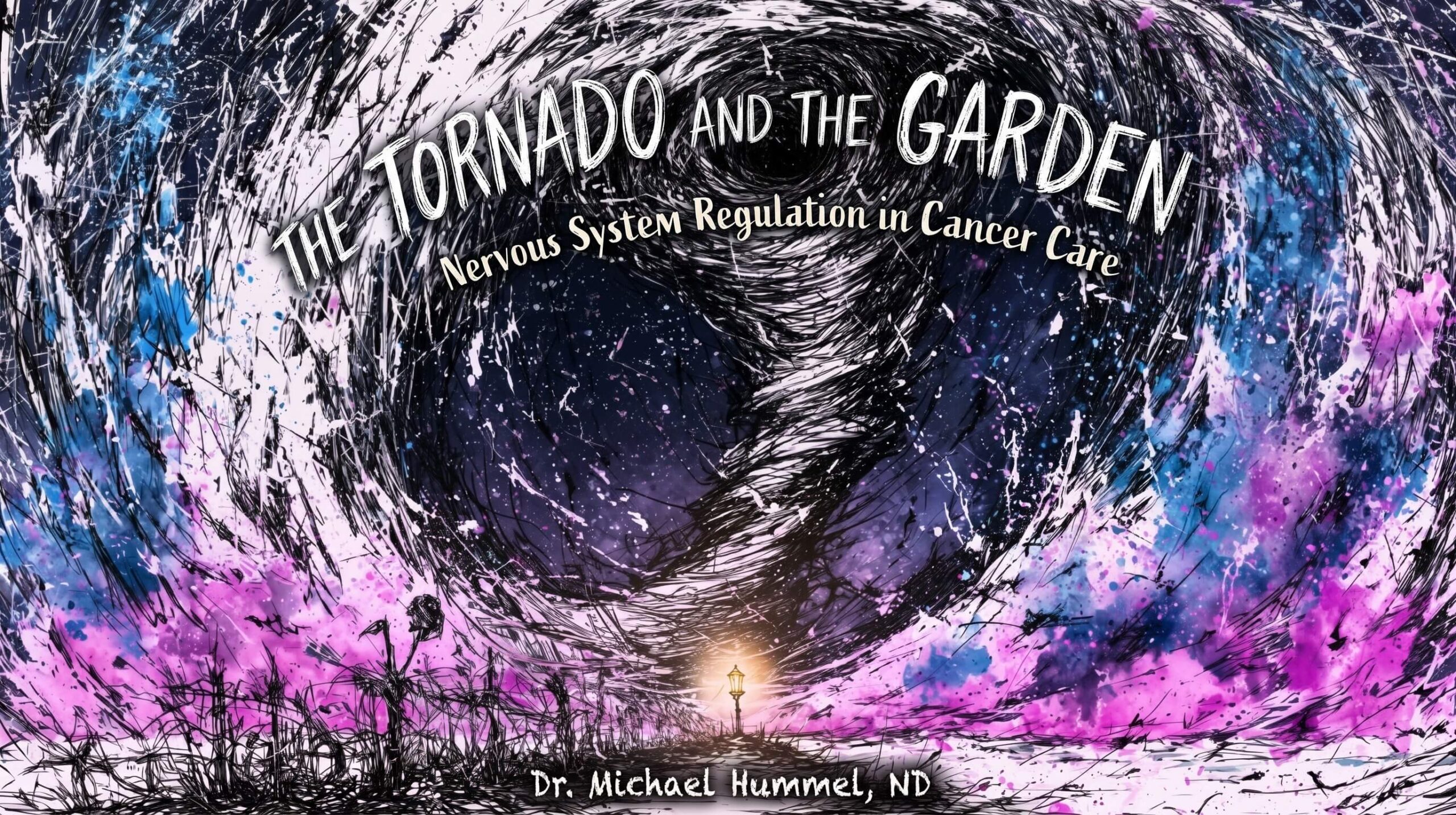
The Tornado and the Garden: Nervous System Regulation in Cancer Care

There is a particular silence that follows a cancer diagnosis. It carries the weight of a life reorganized around a word that used to belong to someone else. The phone call, the biopsy, the “we’ll have results soon.” The weeks after. I have referred to this in the past as the tornado that accompanies initial diagnosis. And like any tornado, it brings the pressure change, the darkening sky, the way the whole atmosphere of a household shifts and will not settle.
Many patients ask me what they can do in the first few weeks. And the answer is rarely the one they expect. They want a supplement, a protocol, a list of things to fight the cells. And those things matter. But the tornado is a nervous system in full alarm. And if we only treat the cells and leave the nervous system spinning, we are fighting one half of a two-person dance.
So let us talk about the other half. The one that is quietly, powerfully, biologically real.
The Nervous System Is a Player, Not a Bystander
For a long time, oncology treated the mind and the body as separate rooms. You could have a brilliant tumor board and a patient in the hallway whose heart rate would not come down. That separation served us for a while, but the rooms share a wall.
What we now know is that the nervous system is woven through the biology of cancer. This field is sometimes called cancer neuroscience, and it studies the conversation between nerves and tumors. The sympathetic branch of the autonomic nervous system, the one that drives fight or flight, releases catecholamines that can influence tumor growth, angiogenesis, and invasion. The hypothalamic-pituitary-adrenal axis releases cortisol. In the short term, that is survival. A threat appears, the body mobilizes, it handles the threat, it returns to baseline. The problem in cancer is that the threat does not leave. The diagnosis is a threat that, by its nature, lingers. And a stress response that never resets is a different animal than one that does.
A recent systematic review of the HPA axis in people with cancer found that dysfunction was common, and that the majority of studies reported an increased baseline cortisol and a heightened response to stimulation, across stages and treatments (Kanter et al., 2024). That is the tornado, written in cortisol.
And here is the part that I find genuinely thrilling, because it is the part that gives us something to work with. The autonomic nervous system has two branches, and they are in balance, like most things worth paying attention to. The sympathetic branch is the gas. The parasympathetic branch, the one carried largely by the vagus nerve, is the brake. It is the branch that says you are safe, you can digest, you can rest, you can let the immune system do its quiet work. A 2025 meta-analysis of heart rate variability, a window onto that vagal tone, found that higher vagal activity was associated with longer overall survival across multiple cancer types (Huang et al., 2025). Now, correlation is not a prescription, and I want to be honest about that. But the direction of the evidence is a gift. It tells us that the brake is part of the terrain.
Stress and the Immune System
The most studied connection between stress and cancer runs through the immune system, and it is the one I want to be careful with, because it is where both the promise and the peril live.
Chronic stress has been shown, in both human and animal work, to damp certain immune functions, including natural killer cell activity and T-cell response. That matters, because those are some of the cells that keep an eye on abnormal cells. A review by Antoni and Dhabhar laid out how chronic psychosocial stress can suppress these cellular immune responses, and how stress-management interventions can move them back toward baseline (Antoni & Dhabhar, 2019).
But I will say the caution plainly, because I do not believe in fear as medicine. This is evidence that a nervous system stuck in alarm, for long enough, can quietly weaken the very system we are asking to help. And the reverse is also true. Supportive relationships buffer the stress response. A 1998 review by Spiegel and colleagues proposed exactly this mechanism: that social support may protect survival by buffering the effect of stress on immunity (Spiegel et al., 1998). The body is a field that responds to the weather.
Even the newer tools in our oncology toolbox feel this. In a 2024 study of patients with advanced non-small-cell lung cancer treated with immune checkpoint inhibitors, those with significant baseline emotional distress had shorter progression-free survival and lower response rates, and the distress group showed elevated cortisol (Zeng et al., 2024). We are asking the immune system to do something extraordinary with these drugs. It helps if the nervous system is not simultaneously telling it to stand down.
The Space for Healing
So what do we actually do with a nervous system in a tornado?
I think about it in terms of space. The tornado does not stop because we argue with it. It passes, and the ground underneath stays intact, when we build the right conditions. That space is made of a few concrete things, and I will name them, because abstract comfort is not a treatment.
A caregiver, and care for the caregiver. Think of it as infrastructure. Caregivers carry a stress load that is, in some studies, higher than the load of the person they are caring for. That is a quietly dangerous thing. If the person holding the map is the most exhausted one in the room, the whole expedition suffers. So we make space for the caregiver too. They need rest, they need to be asked how they are doing, and they need permission to set the phone down for an evening. A caregiver who is regulated helps regulate the patient, because regulation is contagious in a way that anxiety also is. You cannot pour from a cup that is empty, and you cannot pour from a cup that is on fire.
Movement. This is where I get excited, because the evidence is strong and the medicine is free. A 2025 phase 3 trial in colon cancer, the CHALLENGE trial, found that a structured exercise program after chemotherapy was associated with longer disease-free survival and findings consistent with longer overall survival (Courneya et al., 2025). That is a meaningful number, and the study authors themselves noted the magnitude was comparable to some standard therapies. And beyond survival, movement reduces fatigue, improves mood, and quiets the nervous system in a way that is hard to replicate with anything else. You do not have to run a marathon. You have to move, at a level your body can tolerate, and let the body do what the body does, which is metabolize the stress it has been holding.
Stillness practices. Mindfulness-based stress reduction, an eight-week program developed by Jon Kabat-Zinn in the 1970s to bring active awareness into daily life, has a strong record in oncology. Randomized trials have shown it improves mood, quality of life, sleep, and anxiety in breast cancer patients, with benefits that persist (Hoffman et al., 2012; Lengacher et al., 2009). And in a large 2019 trial, MBSR was associated with reduced salivary cortisol and interleukin-6, the objective markers we have been talking about (Lengacher et al., 2019). I love that the subjective and the objective finally agree. The patient feels calmer, and the blood confirms it.
Connection. This is the one that is hardest to schedule and most likely to be skipped, so I will press on it. The epidemiology of social support and survival is consistent and large. In the Nurses’ Health Study, women who were socially isolated before diagnosis had meaningfully higher mortality after breast cancer (Kroenke et al., 2006). A much larger pooled analysis of nearly ten thousand women found that larger social networks after diagnosis were associated with better breast-cancer-specific and overall survival (Kroenke et al., 2017). I want to be careful, because these are associations, and a person who is isolated may be isolated for reasons that are also driving the risk. But the clinical message is clear enough. Belonging is a biological input. Loneliness is a stressor. And a nervous system that knows it is not alone is a nervous system that can, more easily, come out of the alarm state.
A Note on Balance
I want to land this honestly, because I do not practice a medicine of absolutes.
Regulating the nervous system will not cure cancer. I would never tell you that, and you should be wary of anyone who does. What I will tell you is this. The nervous system is a co-author in your care. And the tornado will pass, or it will not, and we cannot control which. But we can control whether the ground underneath is firm. We can build the space. We can bring in the caregiver, the movement, the stillness, the connection. We can tend the garden while the wind blows.
That is the whole person. The cells, yes. But also the breath, the relationship, the quiet hour, the hand on the shoulder. Healing is something you and your body do together, in the space you are given.
Vis medicatrix naturae. The healing power of nature. And the nervous system is one of nature’s most ancient and reliable instruments. We just have to remember how to play it.
If you are in the tornado right now, or you are the one holding the map for someone who is, we are here. You do not have to do this in the dark, and you do not have to do it alone.
With care,
Dr. Michael Hummel, ND
Denver Naturopathic Clinic
References
1.Antoni MH, Dhabhar FS. The impact of psychosocial stress and stress management on immune responses in patients with cancer. Cancer. 2019 May 1;125(9):1417-1431. doi:10.1002/cncr.31943. PMID: 30768779.
2.Kanter NG, Cohen-Woods S, Balfour DA, Burt MG, Waterman AL, Koczwara B. Hypothalamic-pituitary-adrenal axis dysfunction in people with cancer: a systematic review. Cancer Med. 2024 Nov;13(22):e70366. doi:10.1002/cam4.70366. PMID: 39569439.
3.Huang WB, Lai HZ, Long J, Ma Q, Fu X, You FM, Xiao C. Vagal nerve activity and cancer prognosis: a systematic review and meta-analysis. BMC Cancer. 2025 Mar 31;25(1):579. doi:10.1186/s12885-025-13956-w. PMID: 40165090.
4.Spiegel D, Sephton SE, Terr AI, Stites DP. Effects of psychosocial treatment in prolonging cancer survival may be mediated by neuroimmune pathways. Ann N Y Acad Sci. 1998 May 1;840:674-683. doi:10.1111/j.1749-6632.1998.tb09606.x. PMID: 9629294.
5.Zeng Y, Hu CH, Li YZ, et al. Association between pretreatment emotional distress and immune checkpoint inhibitor response in non-small-cell lung cancer. Nat Med. 2024 Jun;30(6):1680-1688. doi:10.1038/s41591-024-02929-4. PMID: 38740994.
6.Courneya KS, Vardy JL, O’Callaghan CJ, et al; CHALLENGE Investigators. Structured exercise after adjuvant chemotherapy for colon cancer. N Engl J Med. 2025 Jul 3;393(1):13-25. doi:10.1056/NEJMoa2502760. PMID: 40450658.
7.Hoffman CJ, Ersser SJ, Hopkinson JB, Nicholls PG, Harrington JE, Thomas PW. Effectiveness of mindfulness-based stress reduction in mood, breast- and endocrine-related quality of life, and well-being in stage 0 to III breast cancer: a randomized, controlled trial. J Clin Oncol. 2012 Apr 20;30(12):1335-1342. doi:10.1200/JCO.2010.34.0331. PMID: 22430268.
8.Lengacher CA, Johnson-Mallard V, Post-White J, et al. Randomized controlled trial of mindfulness-based stress reduction (MBSR) for survivors of breast cancer. Psychooncology. 2009;18(11):1261-1272. doi:10.1002/pon.1529. PMID: 19235193.
9.Lengacher CA, Reich RR, Paterson CL, et al. A large randomized trial: effects of mindfulness-based stress reduction (MBSR) for breast cancer (BC) survivors on salivary cortisol and IL-6. Biol Res Nurs. 2019 Jan;21(1):39-49. doi:10.1177/1099800418789777. PMID: 30079756.
10.Kroenke CH, Kubzansky LD, Schernhammer ES, Holmes MD, Kawachi I. Social networks, social support, and survival after breast cancer diagnosis. J Clin Oncol. 2006 Mar 1;24(7):1105-1111. doi:10.1200/JCO.2005.04.2846. PMID: 16505430.
11.Kroenke CH, Michael YL, Poole EM, et al. Postdiagnosis social networks and breast cancer mortality in the After Breast Cancer Pooling Project (ABCPP). Cancer. 2017 Apr 1;123(7):1228-1237. doi:10.1002/cncr.30440. PMID: 27943274.