
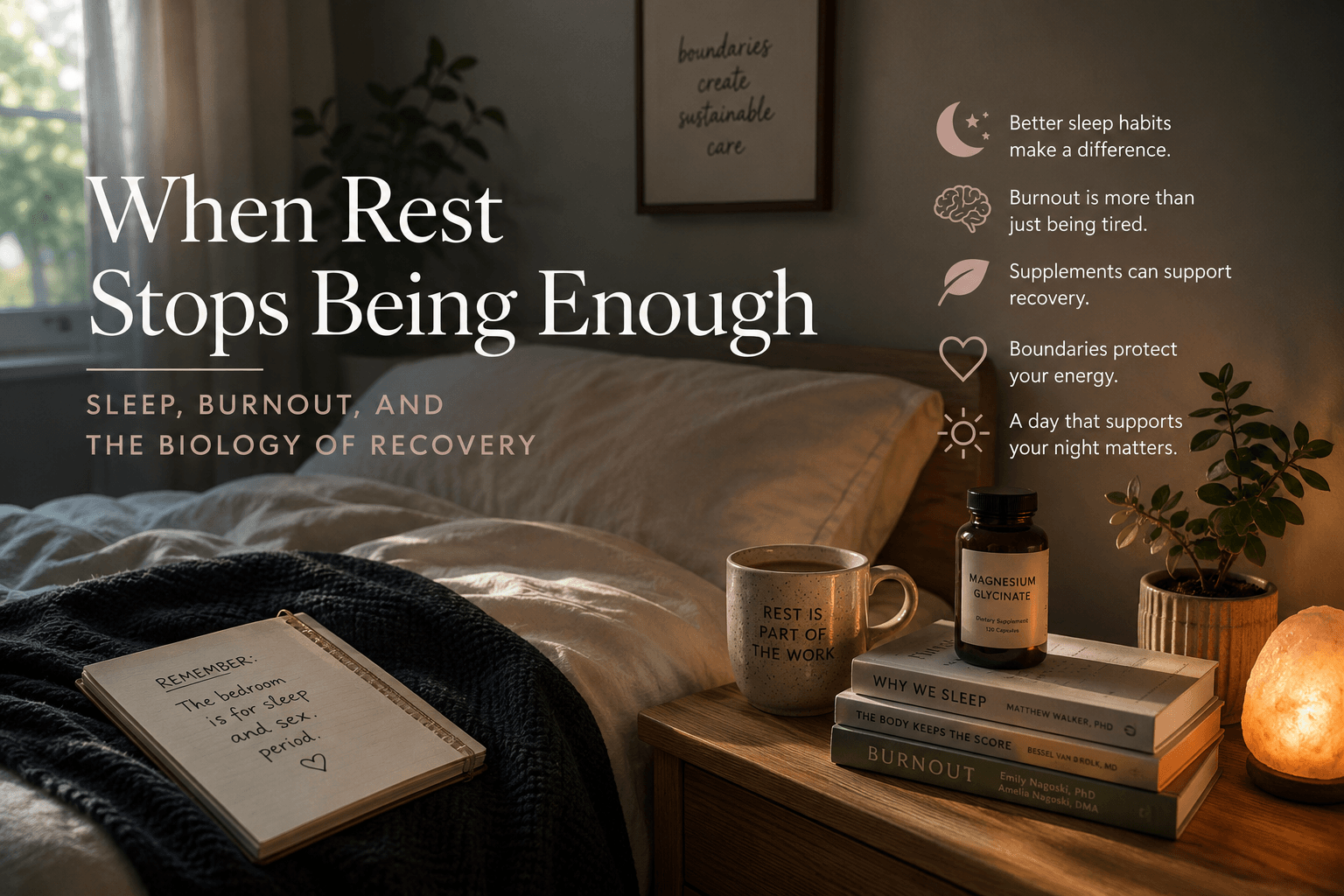
When Rest Stops Being Enough: Sleep, Burnout, and the Biology of Recovery

Sleep Is Not Just Time When You’re Not Doing Anything
There is a particular kind of exhaustion that sleep fixes. You stay up too late, the baby wakes up six times, you travel across several time zones, or you have one of those nights when your brain decides that 2:13 a.m. would be an excellent time to revisit something embarrassing you said in 2017. The next day you feel terrible, you eventually get a good night’s sleep, and the world begins looking considerably more reasonable again. Then there is another kind of exhaustion, the kind where you sleep but don’t really feel restored, the weekend arrives and somehow doesn’t seem long enough, and Sunday afternoon already feels slightly contaminated by Monday morning. Things that once excited you begin feeling like obligations. Your patience gets shorter. Your concentration becomes less reliable. You keep functioning because people are depending on you and you’re good at functioning, but somewhere along the way life starts requiring more energy than you seem capable of replacing.
That second experience brings us into the complicated territory of burnout, but I don’t think we can understand burnout without first understanding recovery. Last week, we talked about nervous system regulation as the ability to change gears. A healthy nervous system isn’t permanently calm; it mobilizes when circumstances require action and moves toward recovery when the demand has passed. Sleep is one of the most important biological periods in which that recovery occurs, but it isn’t simply eight hours during which consciousness has temporarily closed for business. Your brain is remarkably busy while you’re asleep. Memory is being processed and consolidated, emotional experiences are being integrated, metabolic and endocrine systems are shifting, immune processes are changing, and cardiovascular activity follows characteristic patterns across different sleep stages.¹ Sleep is not the absence of productivity. It is biological work, and the fact that we are unconscious for much of it is probably a good thing because if high achievers could supervise sleep, we would absolutely try to optimize that too. Somewhere there would be a spreadsheet.
What Actually Happens While You’re Sleeping?
Human sleep occurs in repeating cycles containing non-rapid eye movement (NREM) sleep and rapid eye movement (REM) sleep. NREM sleep itself progresses through stages ranging from lighter sleep into deeper slow-wave sleep, while REM sleep is characterized by a distinct pattern of brain activity and is strongly associated with vivid dreaming. Across a typical night, we cycle through these stages multiple times, and the composition of those cycles changes as the night progresses. Deep NREM sleep tends to be more prominent earlier in the night, while REM periods generally become longer toward morning.² This is one reason simply counting total hours doesn’t tell us everything about sleep quality. Someone may technically spend eight hours in bed while experiencing significant fragmentation from sleep-disordered breathing, pain, alcohol, hormonal changes, medications, environmental disturbances, or another underlying issue that changes the architecture and continuity of sleep.
Sleep also plays an important role in how we process emotion. Experimental sleep deprivation has been associated with increased emotional reactivity and altered communication between limbic areas such as the amygdala and prefrontal regions involved in higher-order emotional regulation.³ In much less scientific language, anyone who has ever become disproportionately upset by an objectively minor inconvenience after several terrible nights of sleep has probably conducted an informal version of this experiment. Your problems don’t necessarily become bigger when you’re tired; the brain meeting those problems has changed. That becomes particularly relevant when we talk about chronic stress and burnout because the relationship runs both ways. Stress can make it harder to fall asleep, stay asleep, or experience restorative sleep, while inadequate sleep can leave us more reactive and less resilient to whatever arrives the next day.⁴ It is a remarkably efficient feedback loop, unfortunately operating in exactly the wrong direction.
Your Brain Has a Clock and a Pressure Gauge
Two major biological processes help regulate when we sleep: the circadian system and sleep homeostasis. Sleep homeostasis is relatively intuitive. The longer you’ve been awake, the greater the biological pressure to sleep becomes. Adenosine accumulates during wakefulness and contributes to that increasing sleep pressure, while caffeine works largely by blocking adenosine receptors.⁵ This is why caffeine can make us feel less tired without actually eliminating the underlying biological need for sleep. It does not create rest; it temporarily interferes with our ability to hear how tired we are. I say this as someone who enjoys coffee and has absolutely no intention of turning this into an anti-caffeine manifesto, but there is a meaningful difference between using caffeine because you enjoy it and repeatedly using caffeine to compensate for a body that is begging for recovery.
The circadian system works differently. Rather than simply tracking how long we’ve been awake, it helps coordinate sleep and wakefulness with the roughly 24-hour light-dark cycle. The suprachiasmatic nucleus, a small region of the hypothalamus, functions as a central circadian pacemaker and receives information about environmental light through specialized retinal pathways.⁶ Light exposure, particularly its timing, helps synchronize rhythms involved in melatonin secretion, body temperature, alertness, hormone patterns, and sleep propensity. This is why morning light can be so useful for reinforcing the body’s daytime signal, and why bright light late at night can make the transition toward sleep more difficult.
Of course, humans spent most of our evolutionary history experiencing bright light during the day and relative darkness at night, whereas modern humans can sit under artificial lighting at 10:30 p.m. holding a brightly illuminated rectangle twelve inches from their faces while watching content specifically engineered to keep them engaged for another forty-five minutes. Screens aren’t uniquely evil, and blue light isn’t the only reason devices can interfere with sleep. The content matters too. Work emails are stimulating. Social media is stimulating. Video games are stimulating. News can be extremely stimulating. Even a really good television series has been intentionally designed to make you need to know what happens next, and your nervous system does not care that Netflix politely asked whether you’re still watching. It already knows.
Sleep Hygiene Is Not About Washing Your Sheets
This brings us to sleep hygiene, which is one of those medical terms that sounds considerably stranger than what it actually describes. Sleep hygiene refers to behavioral and environmental practices intended to support healthy sleep, including maintaining relatively consistent sleep and wake times, managing light exposure, limiting substances or activities that interfere with sleep, creating an environment conducive to rest, and being thoughtful about what activities we repeatedly associate with the bedroom.⁷
Sleep hygiene isn’t a cure for every sleep disorder, and I think that caveat matters because people with significant insomnia are sometimes handed a sheet of generic sleep-hygiene tips and left feeling as though they have failed because turning off their phone didn’t fix years of poor sleep. Someone with chronic insomnia may benefit from cognitive behavioral therapy for insomnia (CBT-I), which has strong evidence and is recommended as a first-line behavioral treatment.⁸ Someone with obstructive sleep apnea needs appropriate evaluation and treatment, not better blackout curtains. Restless legs syndrome, circadian rhythm disorders, chronic pain, reflux, thyroid dysfunction, menopausal vasomotor symptoms, medications, depression, anxiety, and other medical conditions can all interfere with sleep. Sleep hygiene provides a foundation; it shouldn’t become an excuse not to investigate why someone isn’t sleeping.
That said, the foundation really does matter, and I learned how memorable this can be through a student who took something I taught about sleep hygiene very seriously. We had been talking about the way the brain learns associations with environments and why, ideally, the bedroom should have a fairly limited job description. He went home and removed his television and his PlayStation from the bedroom. When I saw him later, he told me the change had completely transformed his relationship with his intimate partner. I remember thinking, Well, that was perhaps an even better outcome than I was aiming for, but his experience beautifully illustrates the larger point.
The bedroom is for sleep and sex. Period. That doesn’t mean you will spontaneously combust if you watch a movie in bed once on vacation, but as a general principle, the bedroom shouldn’t become another extension of daytime life. If we repeatedly work in bed, worry in bed, game in bed, scroll in bed, eat in bed, watch television in bed, and remain awake there for hours, the brain gets a fairly confusing collection of signals about what that environment is supposed to mean. Strengthening the association between the bed and sleep is actually a central principle of stimulus control, one of the behavioral components used in CBT-I.⁸ Apparently, removing the PlayStation may have additional relationship benefits as well. I cannot promise that particular outcome, but I am delighted to report the case study.
Make the Bedroom Boring, in the Best Possible Way
A good sleep environment doesn’t need to look like a luxury wellness retreat. It simply needs to communicate fairly consistently that the day is over. Darkness matters because light is a powerful circadian signal, so blackout curtains can be helpful when outdoor lighting enters the room, particularly for people living near streetlights or working schedules that require daytime sleep. Temperature matters too. Core body temperature normally declines as we approach and enter sleep, and overly warm environments can interfere with that process.⁹ There isn’t one magical bedroom temperature that works for every person because bedding, pajamas, hormones, age, and individual preference all affect thermal comfort, but most of us sleep better in a room that is comfortably cool rather than one that feels like a greenhouse.
Noise matters, although sudden and unpredictable sounds tend to be more disruptive than consistent background noise, which is why some people find fans, white noise, or earplugs useful. Then there is the phone, which may technically be serving as your alarm clock but is also your email, social media, news source, camera, calendar, shopping mall, work portal, entertainment center, and group chat. Perhaps that is a little too much responsibility for the object sitting six inches from your head while you are trying to sleep. For some people, charging the phone across the room creates enough friction to stop automatic scrolling. Others do better moving it out of the bedroom entirely and using an old-fashioned alarm clock. The goal isn’t technological purity. It is creating a boundary around wakefulness.
Consistency Without Turning Sleep Into Another Thing to Perfect
Maintaining a reasonably consistent sleep-wake schedule is another useful part of sleep hygiene, and I emphasize reasonably because wellness advice has a remarkable ability to turn healthy habits into rigid rules. If you normally go to bed at 10:00 and stay out until midnight at a friend’s wedding, you haven’t destroyed your circadian rhythm. You are allowed to have a life. What becomes more disruptive is repeatedly shifting sleep and wake times by several hours, particularly when weekends look dramatically different from weekdays. This discrepancy is sometimes called social jet lag because the circadian system is repeatedly being asked to adjust to schedules that resemble traveling between time zones.¹⁰
Wake time can be especially useful as an anchor. Getting up around the same time most days and then getting exposure to morning light provides a strong circadian cue, and outdoor light is generally much brighter than ordinary indoor lighting even on cloudy days. You don’t need to stare directly into the sun, despite what certain corners of the internet may suggest. Please don’t do that. The sun is perfectly capable of finding your retina without assistance.
The other part of consistency happens at night, and this is where I think many of us ask something slightly unreasonable of our brains. We work until 9:45, answer an email while brushing our teeth, check tomorrow’s schedule from bed, read three mildly alarming news stories, turn off the light at 10:00, and become annoyed because our brain is still active at 10:03. The nervous system is adaptable, but it is not psychic. It benefits from transition cues. A wind-down routine doesn’t need seventeen steps, herbal tea served in artisanal pottery, and a gratitude journal written by candlelight. It simply needs to reduce stimulation and become reasonably predictable. Maybe you dim the lights, stop working, shower, read, stretch, talk with your partner, or prepare what you need for tomorrow so your brain doesn’t feel obligated to rehearse it all night. The specific ritual matters less than the repeated message underneath it: nothing else is required of you today.
For some of us, that message is surprisingly difficult to accept, particularly when we are moving toward burnout.
When You’re Exhausted but Still Can’t Stop
One of the strange features of chronic stress is that exhaustion doesn’t always produce rest. Sometimes it produces a person who is deeply tired and still keeps going. You finally sit down and feel restless. You go on vacation and need three days before your brain stops thinking about work. You lie down at night and suddenly remember everything you didn’t finish. The body is tired, but the systems responsible for vigilance, productivity, and performance have become very practiced, and this is one reason I don’t think burnout can be adequately addressed by simply telling people to sleep more.
Sleep matters enormously, but burnout isn’t synonymous with sleep deprivation. The World Health Organization describes burnout as an occupational phenomenon resulting from chronic workplace stress that has not been successfully managed, characterized by exhaustion, increased mental distance or cynicism toward one’s job, and reduced professional efficacy.¹¹ That distinction is useful because we casually use “burned out” to mean really tired, when actual burnout often includes a deeper change in our relationship with the work itself. Things that once felt meaningful begin feeling heavy. People we genuinely want to help can start feeling like demands. Small administrative tasks become disproportionately irritating. Motivation becomes harder to access, and you may still care deeply about what you do while simultaneously feeling as though you have very little left to give it.
I know that experience because about three years into practice, I burned out. Looking back, I can see it much more clearly than I could while I was living through it. I had entered medicine with enormous enthusiasm and, like many new practitioners, I wanted to help everyone. I wanted to do excellent work. I wanted patients to feel cared for, I wanted the practice to succeed, and because I am me, “doing a good job” had a tendency to quietly expand into doing more, giving more, accommodating more, and expecting myself to remain endlessly available without acknowledging that my own time and energy had value.
For a while, I could do it, which was probably part of the problem. High-functioning people can often sustain an unsustainable situation for a surprisingly long time, and our continued ability to perform becomes evidence to ourselves and everyone else that everything must be fine. Eventually, though, I started losing some of the vitality and excitement I had always associated with practicing medicine. Work that had once energized me began consuming more than it returned, and I was tired in a way that wasn’t being fixed by a weekend. At some point I had to acknowledge that if I wanted to continue doing this work for decades, I couldn’t keep practicing the way I had been practicing.
I ended up working with a business coach, which at first glance might sound like a strange treatment for burnout. Why not take a vacation? Why not meditate more? Why not take something for “adrenal support”? The answer was that my problem wasn’t primarily a shortage of coping mechanisms. Some of the conditions of my work were unsustainable, and recovering meant looking honestly at how I was practicing, what I was giving away, where I wasn’t setting boundaries, what my expertise and time were actually worth, and what I needed in order to continue showing up for patients without slowly emptying myself in the process. I had to learn to honor my needs and my value, and I had to create boundaries that protected both. Doing that didn’t make me less devoted to my patients. It allowed me to enjoy being their doctor again.
That experience permanently changed the way I think about burnout because sometimes burnout is giving us accurate information. Sometimes the nervous system isn’t overreacting; sometimes the circumstances really are unsustainable. No breathing exercise can make an impossible workload reasonable. Magnesium cannot create boundaries for you. Meditation cannot indefinitely compensate for a workplace that expects constant availability, and a sleep supplement cannot fix a schedule that only leaves five hours available for sleep.
We absolutely need tools that help us tolerate the normal stresses of being human, but we also need the courage to recognize when the stress itself needs to change. That can be much more uncomfortable than adding another coping strategy because it may require saying no, charging appropriately, delegating, disappointing someone, asking for help, changing jobs, having a difficult conversation, or accepting that you cannot simultaneously meet every expectation placed upon you. For high-achieving people, this can be particularly hard because we are very good at finding ways to continue. We squeeze one more thing into the calendar, work a little later, answer one more message, and push through one more week, and eventually our ability to keep going becomes the reason everyone assumes we should.
But capacity is not the same thing as sustainability. You can carry something very heavy for a while without concluding that you should build your entire life around never putting it down. Sleep requires us to stop, and burnout often develops when we have forgotten how, or when the structure of our lives no longer gives us permission to do so.
Let’s look more deeply at what happens when chronic occupational stress becomes burnout, how burnout overlaps with but differs from depression, why perfectionism and helping professions can create particularly fertile ground for it, and why we sometimes reach a point where even rest doesn’t feel restorative. Once we understand that piece, we can finally talk about recovery, including sleep interventions, lifestyle changes, supplements, medical contributors, and the harder changes that can’t be purchased in a bottle.
When Exhaustion Becomes Burnout
Burnout is one of those words that has become so common that it can mean almost anything. We say we are burned out on cooking, burned out on social media, burned out on a project, burned out on the news. Sometimes what we really mean is bored, tired, irritated, overscheduled, or temporarily over it. Actual occupational burnout is more specific. It develops in the context of chronic workplace stress that has not been successfully managed and is characterized by exhaustion, growing mental distance or cynicism toward the work, and a reduced sense of professional effectiveness.¹² That combination matters because it captures something ordinary tiredness does not: burnout changes not only how much energy we have, but how we relate to the work that is consuming it.
That distinction helped me understand my own experience much more clearly in retrospect. I wasn’t simply tired after my third year in practice. I had worked hard before. I knew what it felt like to finish a demanding week and desperately want a quiet weekend. What changed was that the work itself began to feel different. The enthusiasm that had carried me through building a practice was starting to thin out, and things that once felt meaningful began requiring effort in a way they hadn’t before. I could still function, and I did, but the internal experience of functioning had changed. There was less curiosity, less vitality, less room. I wasn’t walking into each day thinking, I hate this. It was more subtle than that, which is probably why it took time to recognize. I still cared deeply about my patients and the medicine. I simply had less of myself available to give to either.
That subtlety is important because burnout does not always announce itself with a dramatic collapse. It can arrive as a series of small adaptations that initially look responsible. You stay later because someone needs you. You make an exception because this circumstance really is unusual. You take on one more responsibility because no one else is quite ready to handle it. You answer the email because it will only take two minutes. You squeeze in the appointment because the patient is struggling. You keep doing this because you are capable, and each individual decision seems perfectly defensible. The problem is not necessarily any one of them. The problem is the pattern they create when there is no equally strong pattern of protecting your own time, energy, and recovery.
Burnout and Depression Can Look Similar, but They Are Not Identical
One of the more complicated parts of burnout is that it can overlap substantially with depression. Both may involve fatigue, reduced motivation, difficulty concentrating, irritability, sleep disturbance, and a sense that things that once felt rewarding no longer do. Some researchers have questioned whether burnout and depression are truly distinct constructs or whether burnout, particularly severe burnout, may overlap heavily with depressive symptoms.¹³ Other work supports meaningful conceptual differences, especially the fact that burnout is defined in relation to chronic occupational stress, whereas depression is broader and can affect nearly every area of life.¹⁴
From a clinical perspective, I think the distinction is useful as long as we don’t force people into tidy categories. Someone can absolutely be burned out and depressed at the same time. Burnout can contribute to depressive symptoms, and preexisting depression can make occupational stress harder to tolerate. A person who says, “I don’t care about my work anymore,” may be describing burnout. A person who says, “I don’t care about anything anymore,” raises a different level of concern. That difference is not diagnostic by itself, of course, but it changes the questions I want to ask.
This is also why burnout should not become a fashionable label that allows us to minimize serious mental health symptoms. If someone is experiencing persistent hopelessness, significant loss of pleasure across life, marked changes in appetite or sleep, severe impairment, or thoughts of self-harm, that deserves appropriate mental health evaluation. “I’m just burned out” is not always a sufficient explanation. At the same time, I also don’t want to medicalize every season of occupational exhaustion into a psychiatric disorder when someone may be responding quite rationally to a work environment that has become unsustainable.
Sometimes the distinction becomes clearer when people step away. A burned-out clinician may take a meaningful break and rediscover warmth, curiosity, and interest outside of work fairly quickly, while the idea of returning to the same conditions still feels heavy. Someone experiencing major depression may find that the emotional flattening follows them everywhere. Again, these are not hard rules, but they illustrate why context matters. Burnout is not simply depression wearing business casual, and depression is not simply burnout that got worse.
Why Helping Professions Can Be Fertile Ground for Burnout
Healthcare is particularly vulnerable to burnout for reasons that are both obvious and strangely easy to normalize. The work matters. People need us. The stakes can be high. There are endless opportunities to do more, because there is almost always another patient, another message, another chart, another form, another lab result, another problem that would benefit from attention. The work also rewards conscientiousness, empathy, thoroughness, and a willingness to take responsibility, all of which are admirable traits and all of which can become expensive when there are no boundaries around them.
Burnout among physicians and other healthcare professionals has been linked to workload, administrative burden, lack of control, inefficiencies, moral distress, poor organizational support, and misalignment between personal values and workplace demands.¹⁵˒¹⁶ This matters because burnout is sometimes framed as an individual resilience problem, as though clinicians simply need more yoga, better coping skills, or stronger emotional armor. Personal resilience certainly matters, but organizational conditions matter too. If a healthcare system requires people to work in ways that are chronically misaligned with their values and human limits, asking them to become better at tolerating it is not a complete solution.
This was one of the lessons I had to learn in my own practice. I had tremendous autonomy compared with many employed physicians, so I couldn’t blame a hospital system or corporate administrator for every part of my workload. Some of the unsustainable conditions were ones I had helped create because I had not yet learned how to protect my own value and time. I was generous with availability, flexible with boundaries, and willing to absorb a great deal because I genuinely wanted people to feel cared for. The problem was that I had unconsciously built a version of care in which my own needs were always negotiable.
That works beautifully until you realize you are the infrastructure holding the entire system up.
And infrastructure requires maintenance.
Perfectionism Is Useful Until It Becomes a Tax
Perfectionism belongs in this conversation too, especially after the way we talked about anxiety earlier this month. Perfectionistic tendencies can support excellent work. They can encourage preparation, attention to detail, persistence, and high standards. But perfectionism can also increase burnout risk when “good work” becomes emotionally indistinguishable from “flawless work,” when mistakes feel intolerable, or when self-worth becomes tied too tightly to productivity and performance.¹⁷
The cost of perfectionism is often invisible because the finished product looks impressive. No one sees the extra two hours spent refining something that was already good. They don’t see the mental replay after a difficult interaction, the excessive preparation for an ordinary meeting, or the inability to disengage from work because there is always one more detail that could be improved. From the outside, this can look like dedication. Internally, it can become a tax on every task.
One of the harder realizations for high achievers is that many of our strengths are context-dependent. Conscientiousness is wonderful until it makes rest feel irresponsible. Empathy is beautiful until we absorb every problem as though it belongs entirely to us. High standards can drive excellent care until they become a refusal to acknowledge that some things must simply be good enough. The same trait can serve us beautifully at one intensity and quietly drain us at another.
This is part of why burnout recovery often requires more than reducing hours. If the underlying belief remains, My value comes from how much I can give, a lighter schedule may quickly fill itself again. If the deeper rule is, I should be able to handle this, we may keep tolerating conditions that no longer make sense simply because asking for help feels like failure. Burnout recovery sometimes asks us to rewrite not only the calendar, but the assumptions underneath it.
Burnout Changes Motivation Because the Brain Learns Cost
One of the most interesting parts of burnout is the way motivation changes. We often think motivation is a personality trait, something some people have and others don’t, but motivation is strongly influenced by perceived reward, effort, stress, and expectation. When work repeatedly demands high effort without sufficient recovery, autonomy, reward, or meaning, the brain begins to update its predictions about what that work costs. Researchers studying burnout have identified changes in cognitive control, attention, memory, emotional processing, and reward-related functioning, although the literature is still evolving and does not support one simple “burnout brain” profile.¹⁸
This helps explain why someone can care deeply about their profession and still find themselves procrastinating on tasks that once felt easy. The problem is not necessarily laziness or loss of character. The brain may have learned that engaging with work reliably predicts another drain on resources. Even opening the inbox can become aversive when the inbox has repeatedly delivered more demands than the person has capacity to meet.
I think this is especially relevant for people who blame themselves for losing motivation. They remember being energetic, driven, creative, and engaged, and now they feel flat or resistant, so they conclude that something is wrong with them. Sometimes there is a medical or psychiatric issue contributing, and that deserves investigation. But sometimes the change in motivation is an adaptive response to chronic overload. The brain is not refusing to work because it is defective. It may be trying to conserve resources after learning that work rarely ends in recovery.
That doesn’t mean avoidance is always healthy. Avoidance can reinforce anxiety and make difficult tasks harder over time. But burnout adds another layer. If every day has required sustained output without adequate replenishment, the nervous system has a perfectly understandable reason to hesitate before volunteering for more.
Why Rest May Stop Feeling Restorative
One of the most frustrating features of burnout is that people often know they need rest and then discover that rest does not immediately make them feel better. They sleep in on Saturday and still feel tired. They take a long weekend and spend much of it thinking about work. They go on vacation and notice that their body has arrived before their brain. Sometimes the first few days away are not blissful at all; they are restless, irritable, or strangely empty.
I think this is where people sometimes assume they are “bad at resting,” but that framing is not particularly useful. Recovery can lag behind demand. If you have spent months or years operating under chronic stress, a weekend is a small amount of recovery relative to the size of the accumulated load. It is similar to expecting one good meal to fully reverse months of undernutrition. The meal helps, but the system has more rebuilding to do.
There is also a psychological component. If productivity has become deeply tied to identity, stopping can create discomfort because it removes the very behavior that has been providing structure, validation, and a sense of usefulness. This is especially common among people who are rewarded for being dependable. When your role in a family, practice, company, or community is to be the person who handles things, doing nothing can feel almost disorienting.
Sometimes rest also exposes what busyness has been helping us avoid. When the calendar finally goes quiet, there is room to notice how unhappy we are, how disconnected we feel, or how much resentment has accumulated. Constant activity can be an excellent anesthetic. It is difficult to feel the full weight of dissatisfaction when you never stop moving.
This is why real recovery can initially feel worse before it feels better. The person is not deteriorating because they took time off. They are finally becoming aware of what had been muted by momentum.
Burnout Is Not an Adrenal Gland That Has Given Up
Because this is a naturopathic audience, I also want to address the language of “adrenal fatigue.” This phrase has been used for years to describe fatigue, poor stress tolerance, sleep problems, brain fog, and other symptoms attributed to adrenal glands becoming exhausted from chronic stress. The problem is that the concept of the adrenal glands progressively “burning out” in otherwise healthy people has not been supported by established endocrine physiology, and systematic reviews have not validated adrenal fatigue as a recognized medical diagnosis.¹⁹
That does not mean the symptoms people describe are imaginary.
They are often very real.
The mistake is assuming that because chronic stress affects the HPA axis, the adrenal glands themselves must eventually become unable to produce enough cortisol in the way the popular model suggests. Actual adrenal insufficiency is a serious medical condition with specific causes, laboratory findings, and treatment. Burnout and chronic stress can absolutely influence HPA-axis signaling, circadian cortisol patterns, autonomic activity, sleep, immune function, and metabolism, but the physiology is more complex than “the adrenals are tired.”
I actually think moving away from that model is helpful because it broadens the investigation. If someone is exhausted, we should think about sleep quality, anemia, iron status, thyroid function, B12 and folate, blood sugar regulation, infection, inflammation, medications, mood disorders, sleep apnea, hormonal transitions, nutrition, workload, caregiving, and the thousand other reasons a human being may feel depleted. A single adrenal explanation can become a convenient story that stops us from asking better questions.
And in burnout specifically, sometimes the most important laboratory value is the number of hours someone is trying to fit into a 24-hour day.
Unfortunately, Quest does not currently run that panel.
Sleep Problems Can Become Their Own Problem
Chronic stress frequently disrupts sleep, but after a while the sleep problem can develop a life of its own. A person initially lies awake because they are worried about work. Then they start worrying about not sleeping. Bedtime becomes associated with frustration, clock-watching, and mental effort. They may start going to bed earlier to “catch up,” spend more time awake in bed, sleep in whenever possible, nap extensively, and unintentionally weaken the very sleep pressure and bed-sleep association that support healthy sleep.
This is one reason CBT-I is so valuable for chronic insomnia. Its components commonly include stimulus control, sleep restriction or sleep-compression strategies, cognitive work around unhelpful beliefs about sleep, and attention to behaviors that maintain insomnia.²⁰ The treatment is much more sophisticated than generic sleep hygiene and has strong evidence across a variety of populations. In many cases, the goal is not to make someone try harder to sleep, but to reduce the amount of effort and anxiety surrounding sleep while rebuilding the physiological and behavioral conditions that make sleep more likely.
This can feel counterintuitive because tired people naturally want to spend more time in bed. But if much of that time is spent awake and frustrated, the brain becomes very good at learning that bed is a place where we think, worry, and attempt to force unconsciousness. Sleep is one of the few biological processes that often becomes more elusive the more aggressively we chase it.
Anyone who has ever looked at the clock and calculated, “If I fall asleep right now, I can still get six hours and forty-two minutes,” knows this particular form of madness.
The calculation never helps.
The Weekend Cannot Always Repair the Week
We also need to talk about the cultural idea that weekdays are for depletion and weekends are for repair. There is something deeply normalized about running ourselves into the ground Monday through Friday and then expecting two days to restore us sufficiently to repeat the cycle. Some people can tolerate periods of intense demand this way for a while, especially when the work is meaningful and the intense period has a clear endpoint. But chronic burnout tends to flourish when there is no endpoint. The temporary sprint quietly becomes the standard pace.
Recovery is more effective when it is built into the structure of ordinary life rather than reserved exclusively for vacations and weekends. That doesn’t mean every workday needs to be leisurely. It means there need to be actual moments when demand stops: meals away from work, evenings that are not simply unpaid extensions of the workday, sleep protected as a biological requirement rather than optional downtime, and some portion of life that is not evaluated according to productivity.
This was part of what I had to change. I needed to stop seeing boundaries as something I imposed on patients or work and begin understanding them as something that made sustainable care possible. If I wanted to show up attentive, curious, and genuinely excited about medicine, there had to be enough of me left to do that. A practice model that consistently required me to override my own needs was not evidence of commitment. It was a design flaw.
That distinction was transformative because it shifted burnout from a personal failure into a problem I could actually address. Instead of asking, Why can’t I handle this better? I could ask, What about this system needs to change so that I can keep doing good work without destroying my relationship with it?
That question led to changes in how I valued my time, how I structured the practice, what I was willing to give away, and how I thought about accessibility and boundaries. Not every decision was comfortable. Boundaries rarely feel generous to everyone in the moment, particularly if people were benefiting from your lack of them. But I learned that saying yes to everyone else indefinitely was ultimately a way of saying no to myself, and eventually it was also going to compromise what I could give professionally.
Recovery Is Not Laziness. It Is Part of the Work.
One of the cultural problems underneath burnout is that we tend to treat recovery as the opposite of productivity rather than as one of its biological requirements. We understand this perfectly in athletics. No competent strength coach would recommend training the same muscle group at maximal intensity every day while progressively reducing sleep and food. We know adaptation requires a stressor followed by recovery. Yet professionally, we often celebrate the equivalent of overtraining.
Work harder.
Stay later.
Be available.
Push through.
Keep scaling.
Answer faster.
Then, when motivation and health begin to unravel, we prescribe self-care around the edges of the same schedule.
The body is less impressed by this arrangement than LinkedIn is.
Recovery is not wasted time between productive periods. It is what allows productive periods to continue without progressively eroding the person performing them. Sleep is part of that recovery, but so are psychological detachment from work, social connection, physical activity, adequate nutrition, enjoyable experiences, and periods in which we are not being evaluated or required to produce. Research on recovery from work stress suggests that detachment from work, relaxation, mastery experiences, and a sense of control during nonwork time can all contribute to improved well-being and reduced strain.²¹
The interesting part is that recovery does not have to mean lying perfectly still. For some people, gardening is more restorative than sitting on the couch. A difficult hike may feel more replenishing than television because the activity is chosen, enjoyable, physically embodied, and completely unrelated to professional demands. Recovery is partly about reducing physiological load, but it is also about changing the type of demand and restoring a sense of autonomy.
This is another reason burnout can make even enjoyable things feel like chores if they become mandatory. “You should exercise because it helps stress” is technically reasonable, but if someone already has no time and now feels guilty for not completing a workout, we have turned recovery into another performance requirement. A restorative activity needs enough freedom in it to actually feel restorative.
Sometimes We Need to Grieve the Version of Ourselves Who Could Do More
There is another part of burnout recovery that we don’t talk about much: sometimes we have to accept that our capacity has changed, at least for a while. High-functioning people can become attached to an earlier version of themselves who could work longer, sleep less, say yes more often, and apparently recover without consequence. When that stops working, the instinct is often to figure out how to get back to that version as quickly as possible.
I understand that impulse.
But perhaps the earlier version was not necessarily healthier. Perhaps they simply had fewer responsibilities, more physiological reserve, more novelty in the work, or less accumulated stress. Maybe life has changed. Maybe parenthood, caregiving, illness, aging, hormonal shifts, grief, or simply years of carrying responsibility have altered what is sustainable. Capacity is dynamic, and insisting that it remain identical throughout adulthood is another form of ignoring reality.
Honoring current capacity does not mean surrendering ambition.
It means allocating resources intelligently.
There are seasons for expansion and seasons for consolidation. There are years when we can take on something enormous and others when maintaining what already exists is enough. Burnout recovery often requires allowing the current body and current life to set the pace rather than forcing them to meet a standard established under entirely different conditions.
That can feel humbling.
It can also be incredibly freeing.
Sleep Is the Beginning of Recovery, Not the Entire Plan
By now, I hope it is clear why sleep and burnout belong in the same conversation but are not interchangeable. Sleep is one of the foundational biological processes that supports recovery, emotional regulation, cognition, and resilience. Chronic sleep disruption can increase vulnerability to stress and make burnout harder to recover from. But someone can optimize every element of sleep hygiene and still remain burned out if they wake up each morning and return to circumstances that consistently exceed their capacity.
The bedroom matters.
The morning light matters.
The caffeine timing matters.
The temperature and the phone and the routine all matter.
And none of them can compensate indefinitely for a life in which there is no meaningful boundary between demand and recovery.
This is why I want to be practical without becoming simplistic. In a moment, I’ll discuss sleep-supportive nutrients and supplements, because there are useful tools outside of lifestyle and I use them clinically. We’ll discuss magnesium, glycine, L-theanine, melatonin, and several herbal options, including what the evidence actually suggests and where I think they fit. We’ll also talk about when persistent fatigue or poor sleep warrants medical evaluation, because supplements should never become a substitute for investigating sleep apnea, iron deficiency, thyroid dysfunction, restless legs, mood disorders, or other underlying contributors.
But I also want to return to the lesson burnout taught me personally: sometimes the intervention that changes everything is not the one that helps you tolerate the existing system.
Sometimes it is the one that helps you finally change it.
Rebuilding Recovery
By the time someone reaches the point of significant burnout, they usually already know they are tired. They may also know, intellectually, that they should sleep more, take breaks, stop checking email at night, get outside, exercise, eat consistently, and probably spend less time staring at a screen. The problem is that knowing these things does not automatically create the conditions required to do them, and that is where recovery becomes much more interesting than a checklist. For some people, the first step really is sleep, but not “perfect sleep” and not an elaborate evening ritual with six products lined up on the nightstand. It may simply mean creating a schedule that makes adequate sleep biologically possible. If someone has only five hours available because work, parenting, late-night obligations, and poor boundaries have crowded out the night, no amount of magnesium is going to turn five hours into eight. That sounds obvious, but wellness culture can become oddly magical around sleep supplements, as though the right combination of capsules will somehow compensate for a life that leaves no room for recovery.
At the same time, some people do make space for sleep and still cannot sleep well. That is where I want us to stop assuming the answer is simply “better sleep hygiene” and start asking better questions. Persistent sleep problems deserve thoughtful evaluation, particularly when someone snores loudly, wakes choking or gasping, experiences significant daytime sleepiness, has morning headaches, feels compelled to move their legs at night, wakes with a racing heart, or has insomnia that continues despite reasonable habits. Obstructive sleep apnea, restless legs syndrome, periodic limb movement disorder, circadian rhythm disorders, reflux, pain, medications, thyroid dysfunction, iron deficiency, menopausal vasomotor symptoms, depression, anxiety, and other conditions can all interfere with sleep quality.²² This matters because many of these problems are treatable, but only if we identify them. Someone with untreated sleep apnea may technically spend eight hours in bed and still wake feeling unrefreshed because sleep architecture is repeatedly disrupted by respiratory events, while someone with iron deficiency and restless legs may describe “insomnia” when the actual issue is a neurologic urge to move. I am all for supportive nutrients and herbs, but I do not want supplements to become a way of bypassing appropriate evaluation. They should support the clinical picture, not replace it.
Where Supplements Can Be Helpful
Magnesium is probably the first supplement most people think of for sleep, and there is some rationale for that. Magnesium participates in hundreds of enzymatic reactions and plays important roles in neuromuscular function, neurotransmission, and cellular energy metabolism. Low magnesium status has been associated with sleep disturbances in some observational work, and small clinical trials have suggested potential benefit in certain populations, although the evidence is still mixed and not nearly as definitive as social media would have us believe.²³ In practice, I may think about magnesium when sleep problems occur alongside muscle tension, restless sleep, constipation, or low dietary intake, but I do not assume that every person with insomnia is magnesium deficient. The form can matter for tolerability, too. Magnesium glycinate is popular because it tends to be gentler on the gastrointestinal tract, while magnesium citrate may make more sense for someone who is also constipated. I care less about finding the mythical “best form for sleep” and more about whether it is appropriate for the person, whether the dose is sensible, whether kidney function and medications have been considered, and whether there is an actual reason to use it.
Glycine is another option I sometimes find interesting because the evidence, while limited, is biologically plausible. Glycine functions as an inhibitory neurotransmitter in parts of the central nervous system and also participates in thermoregulation and a number of metabolic processes. Small human studies have suggested that taking glycine before bed may improve subjective sleep quality and next-day fatigue in some people, potentially in part through effects on body temperature and sleep architecture.²⁴ I like glycine most when the goal is not simply “knock me out,” but rather to gently support the physiology of sleep and recovery. The limitation is that the studies are small, so I would never present it as something everyone with poor sleep needs indefinitely. This is an important theme with sleep supplements in general: promising does not automatically mean universal.
L-theanine falls into a similar category. It is an amino acid found naturally in tea leaves and is often used for stress, cognitive tension, and sleep. Rather than functioning like a conventional sedative, it appears to influence several neurotransmitter systems and may promote a calmer state without necessarily causing heavy drowsiness. Some studies suggest potential benefit for stress and aspects of sleep quality, although the evidence base remains modest.²⁵ Clinically, I tend to think of L-theanine more as a tool for people whose bodies are tired but whose minds remain very active. They lie down and immediately start planning tomorrow, replaying today, solving problems that are not solvable at 11:30 p.m., or mentally rehearsing conversations that have already happened. In that situation, taking some of the edge off cognitive hyperarousal may be more helpful than simply adding something more sedating. Of course, if someone takes L-theanine while continuing to answer work messages until fifteen minutes before bed, we are asking one small intervention to compete with the actual source of stimulation, and that is not a particularly fair fight.
Melatonin deserves even more nuance because it is probably one of the most misunderstood sleep aids in the United States. Melatonin is a hormone produced primarily by the pineal gland in response to darkness, and its major role is as a circadian signal. It helps tell the body that biological night is occurring. Exogenous melatonin can be useful for certain circadian rhythm problems, jet lag, delayed sleep timing, and some forms of insomnia, but more is not necessarily better.²⁶ Over-the-counter products frequently contain doses far above normal physiologic nighttime levels, and people often take 5, 10, or even 20 milligrams because they assume a larger dose should make them sleep harder. That is not really how melatonin works. Higher doses may increase the likelihood of vivid dreams, morning grogginess, or headaches without necessarily improving sleep architecture or addressing the reason the sleep problem exists in the first place. Timing matters tremendously, too, because melatonin is a clock-setting signal as much as a sleep aid. In the right situation, it can be excellent. In the wrong situation, it becomes one more product being used to compensate for a problem that really lives elsewhere.
Herbal medicine offers a number of additional options, including passionflower, valerian, lemon balm, hops, chamomile, and lavender, and each of these has its own personality, pharmacology, and evidence base. Some studies suggest modest benefits for anxiety or sleep, while others are inconsistent, and the quality of evidence varies considerably depending on the herb, preparation, dose, and outcome being measured.²⁷ Passionflower may be a nice fit when mental overactivity or anxious rumination is part of the picture, while valerian is more traditionally sedating and may help some people with sleep onset, although the smell alone is enough to make others reconsider their commitment to botanical medicine. Lemon balm can be gentler and may make sense when nervous tension and digestive symptoms travel together, while chamomile has a long history of use and modest evidence for supporting relaxation. What I do not want is for people to assume that “natural” means inert. Herbs can interact with medications and alcohol, and pregnancy, breastfeeding, liver disease, seizure disorders, and other clinical contexts can change what is appropriate. A sleep stack borrowed from someone else’s social media post is not individualized medicine.
Phosphatidylserine is another supplement that comes up often, particularly in people who describe themselves as “wired and tired” or who have been told they have high nighttime cortisol. There is some research suggesting that phosphatidylserine may influence HPA-axis responses to acute stress, but the evidence is limited and does not support the idea that it is a universal treatment for elevated evening cortisol.²⁸ Cortisol is one of the most overworked explanatory molecules in the wellness world, and I am reluctant to blame every 2:00 a.m. awakening or evening energy surge on it without looking at the larger picture. Sleep timing, caffeine, alcohol, blood sugar, pain, medications, anxiety, menopause, light exposure, and ordinary circadian variation all matter. Phosphatidylserine can sometimes be a useful adjunct, but context remains more important than the supplement label.
The larger point is that supplements can support sleep, reduce tension, soften hyperarousal, or help with circadian timing, but they cannot make an unsustainable life sustainable. That is where I keep coming back to my own experience with burnout. What ultimately helped me recover was not finding a better supplement protocol. It was changing how I worked. I had to honor my time, my value, and the limits of my own capacity, and I had to redesign parts of the practice so I was not treating my own energy as an endlessly renewable resource. That was much less convenient than swallowing something at bedtime, but it was also much more powerful.
Sometimes the person asking for a sleep supplement does need magnesium, melatonin, or another supportive tool. Sometimes they need to stop answering email at night. Sometimes they need childcare, therapy, help with a parent, fewer appointments, or a different job. Sometimes they need to charge appropriately for the work they do so they can stop overbooking themselves to make the numbers work. Sometimes they need to acknowledge that their current schedule is incompatible with the life they say they want. No capsule can make that realization for us, which is why burnout recovery so often becomes an exercise in honesty.
Recovery Is Often a Structural Problem
One of the strongest themes in burnout research is the importance of autonomy and control. People generally tolerate demanding work better when they have meaningful influence over how the work is done, when expectations are clear, when resources are adequate, and when the work remains aligned with their values.²⁹ Burnout becomes more likely when high demand is paired with low control, inadequate reward, chronic interpersonal strain, or persistent conflict between what someone values and what the job requires. This was central to my own recovery because I had to stop thinking of boundaries as something I imposed on other people and start thinking of them as the structure that made sustainable care possible. Boundaries allowed me to show up with more attention and curiosity because I was no longer trying to be endlessly available.
That shift also changed the way I thought about work itself. Burnout can create a kind of mistrust of work because the nervous system learns that work predicts depletion. If opening the inbox repeatedly leads to more demands than you can meet, the inbox eventually starts to feel aversive before you even know what is in it. Rebuilding vitality means giving the brain repeated evidence that work can end, that rest is allowed, and that you have some influence over the boundary between the two. Maybe that means ending the workday at a consistent time, taking lunch away from the desk, not checking messages after a certain hour, scheduling fewer high-intensity tasks back-to-back, using vacation time before collapse, or delegating responsibilities that do not require your expertise. These choices can feel uncomfortable at first, especially for people who have built an identity around being generous, reliable, and endlessly capable, but the nervous system learns from repetition. Every time work ends and nothing catastrophic happens, the system receives new information.
Sleep hygiene works better when the day supports the night, and this is where the bigger picture matters again. Morning light helps anchor circadian timing. Physical activity supports sleep pressure and metabolic health. Caffeine timing matters because adenosine signaling matters. Alcohol matters because sedation is not the same thing as restorative sleep. Meals matter because reflux, late heavy eating, or long periods without food can all interfere with nighttime comfort and regulation. The night is partly the consequence of what happened before it. This is why the most effective sleep plan often feels less like “take this at bedtime” and more like “build a day that gives the body a clear contrast between activation and recovery.” The circadian system loves contrast: brighter days and darker nights, activity followed by rest, work followed by stopping. Modern life blurs all of those boundaries, and one of the goals of sleep hygiene is simply to make them more visible again.
That is also why I keep thinking about my student who removed the television and PlayStation from his bedroom. It sounds almost comically simple, but the effect was profound because he changed what the bedroom represented. It was no longer a second entertainment room, gaming room, and extension of daytime life. It became a place associated more strongly with rest and intimacy, and apparently that shift had benefits well beyond sleep. I still come back to the same simple rule: the bedroom is for sleep and sex. Period. That does not mean no one can ever watch a movie in bed again, but it does mean it is worth asking what the bedroom currently teaches your nervous system to expect. If the answer is work, stimulation, scrolling, gaming, and worry, the brain is receiving a very mixed message.
Recovery itself does not always mean doing nothing, either. Sometimes lying on the couch is exactly what the body needs, but restorative experiences can also be active. Hiking, gardening, strength training, cooking, intimacy, creative work, dancing, traveling, or spending time with people we love can all be deeply replenishing when they restore more than they deplete. The common denominator is not inactivity. It is that the experience is chosen, meaningful, and not another performance demand. Burned-out people often lose touch with pleasure because every activity becomes instrumental. Exercise becomes a metric. Reading becomes professional development. Cooking becomes meal prep. Even rest starts needing to justify itself by improving productivity later. Sometimes recovery means doing something inefficient, enjoyable, and completely useless from a productivity standpoint, which can be surprisingly difficult for high-achieving people and surprisingly good for us.
Burnout Is Often About Values, Not Just Energy
At its deepest level, burnout is not always just about being tired. Sometimes it is about living too far away from what matters to us. Maybe someone entered healthcare because they wanted to help people but spends most of the day doing administrative work. Maybe they value family but have built a career that consumes every evening. Maybe autonomy matters deeply to them but their work allows almost none. Maybe they value excellence, but the workload makes good work nearly impossible. Burnout research repeatedly points to workload, control, reward, community, fairness, and values as important dimensions of the work environment.³⁰ When those areas are chronically misaligned, no amount of resilience training is going to fully solve the problem.
That is why one of the most useful questions in burnout recovery can also be one of the most uncomfortable: What am I continuing to tolerate that no longer matches the life I say I value? That question changed my practice because it forced me to look beyond fatigue and ask what had become structurally incompatible with the kind of doctor, business owner, and human being I wanted to be. The answer was not to become less ambitious. It was to stop confusing ambition with endless availability and stop treating depletion as evidence of dedication.
High-achieving people often struggle with this because we tend to evaluate ourselves according to how much we can carry. If we can keep going, we assume we should. If we can squeeze something else into the calendar, we do. If we can push through one more week, we convince ourselves the current pace is still workable. The problem is that capacity and sustainability are not the same thing. You can carry something very heavy for quite a long time without concluding that you should build your entire life around never putting it down.
Sleep is such a powerful symbol of that because sleep requires us to stop, and stopping is exactly what burnout often teaches us to resist. At some point every day, physiology asks us to stop producing, stop answering, stop solving, stop performing, and simply let the body do the work of recovery. Burnout often develops when we override similar signals all day long. We ignore hunger, resentment, fatigue, boredom, grief, irritability, and the quiet sense that something no longer feels right because we are still technically capable of continuing.
I would much rather we learn to listen before the body has to make the message louder.
So protect the bedroom. Protect the night. Use supplements when they are appropriate, but do not ask them to compensate for a life that never allows recovery. Investigate persistent sleep problems instead of assuming every case is simply stress. Treat medical contributors when they are present. Honor the amount of capacity you have in this season rather than the amount you had five years ago. And pay attention when the things you once loved begin to feel heavy, because sometimes that is not a sign that you need to push harder. Sometimes it is information.
I am grateful I learned that lesson when I did, because recovering from burnout did not make me less driven or less committed to my work. It allowed me to reconnect with why I wanted to do the work in the first place. Once I stopped trying to prove that I could carry everything, I had room for curiosity and excitement to return, and that was the part of recovery I had not realized I was missing.
Burnout had taken more than my energy.
Recovery gave me my vitality back.
References
- Zielinski, M. R., McKenna, J. T., & McCarley, R. W. (2016). Functions and mechanisms of sleep. AIMS Neuroscience, 3(1), 67–104.
- Carskadon, M. A., & Dement, W. C. (2011). Normal human sleep: An overview. In M. H. Kryger, T. Roth, & W. C. Dement (Eds.), Principles and practice of sleep medicine (5th ed., pp. 16–26). Elsevier Saunders.
- Goldstein, A. N., & Walker, M. P. (2014). The role of sleep in emotional brain function. Annual Review of Clinical Psychology, 10, 679–708.
- Kalmbach, D. A., Anderson, J. R., & Drake, C. L. (2018). The impact of stress on sleep: Pathogenic sleep reactivity as a vulnerability to insomnia and circadian disorders. Journal of Sleep Research, 27(6), e12710.
- Fredholm, B. B., Bättig, K., Holmén, J., Nehlig, A., & Zvartau, E. E. (1999). Actions of caffeine in the brain with special reference to factors that contribute to its widespread use. Pharmacological Reviews, 51(1), 83–133.
- Hastings, M. H., Maywood, E. S., & Brancaccio, M. (2018). Generation of circadian rhythms in the suprachiasmatic nucleus. Nature Reviews Neuroscience, 19(8), 453–469.
- Irish, L. A., Kline, C. E., Gunn, H. E., Buysse, D. J., & Hall, M. H. (2015). The role of sleep hygiene in promoting public health: A review of empirical evidence. Sleep Medicine Reviews, 22, 23–36.
- Edinger, J. D., Arnedt, J. T., Bertisch, S. M., Carney, C. E., Harrington, J. J., Lichstein, K. L., et al. (2021). Behavioral and psychological treatments for chronic insomnia disorder in adults: An American Academy of Sleep Medicine clinical practice guideline. Journal of Clinical Sleep Medicine, 17(2), 255–262.
- Harding, E. C., Franks, N. P., & Wisden, W. (2019). The temperature dependence of sleep. Frontiers in Neuroscience, 13, 336.
- Wittmann, M., Dinich, J., Merrow, M., & Roenneberg, T. (2006). Social jetlag: Misalignment of biological and social time. Chronobiology International, 23(1–2), 497–509.
- World Health Organization. (2019). Burn-out an “occupational phenomenon”: International Classification of Diseases. World Health Organization.
- Maslach, C., & Leiter, M. P. (2016). Understanding the burnout experience: Recent research and its implications for psychiatry. World Psychiatry, 15(2), 103–111. https://doi.org/10.1002/wps.20311
- Bianchi, R., Schonfeld, I. S., & Laurent, E. (2015). Burnout-depression overlap: A review. Clinical Psychology Review, 36, 28–41. https://doi.org/10.1016/j.cpr.2015.01.004
- Koutsimani, P., Montgomery, A., & Georganta, K. (2019). The relationship between burnout, depression, and anxiety: A systematic review and meta-analysis. Frontiers in Psychology, 10, 284. https://doi.org/10.3389/fpsyg.2019.00284
- National Academies of Sciences, Engineering, and Medicine. (2019). Taking action against clinician burnout: A systems approach to professional well-being. The National Academies Press. https://doi.org/10.17226/25521
- West, C. P., Dyrbye, L. N., & Shanafelt, T. D. (2018). Physician burnout: Contributors, consequences and solutions. Journal of Internal Medicine, 283(6), 516–529. https://doi.org/10.1111/joim.12752
- Hill, A. P., & Curran, T. (2016). Multidimensional perfectionism and burnout: A meta-analysis. Personality and Social Psychology Review, 20(3), 269–288. https://doi.org/10.1177/1088868315596286
- Deligkaris, P., Panagopoulou, E., Montgomery, A. J., & Masoura, E. (2014). Job burnout and cognitive functioning: A systematic review. Work & Stress, 28(2), 107–123. https://doi.org/10.1080/02678373.2014.909545
- Cadegiani, F. A., & Kater, C. E. (2016). Adrenal fatigue does not exist: A systematic review. BMC Endocrine Disorders, 16, 48. https://doi.org/10.1186/s12902-016-0128-4
- Edinger, J. D., Arnedt, J. T., Bertisch, S. M., Carney, C. E., Harrington, J. J., Lichstein, K. L., et al. (2021). Behavioral and psychological treatments for chronic insomnia disorder in adults: An American Academy of Sleep Medicine clinical practice guideline. Journal of Clinical Sleep Medicine, 17(2), 255–262. https://doi.org/10.5664/jcsm.8986
- Sonnentag, S., & Fritz, C. (2007). The Recovery Experience Questionnaire: Development and validation of a measure for assessing recuperation and unwinding from work. Journal of Occupational Health Psychology, 12(3), 204–221. https://doi.org/10.1037/1076-8998.12.3.204
- Sateia, M. J. (2014). International classification of sleep disorders-third edition: Highlights and modifications. Chest, 146(5), 1387–1394. https://doi.org/10.1378/chest.14-0970
- Abbasi, B., Kimiagar, M., Sadeghniiat, K., Shirazi, M. M., Hedayati, M., & Rashidkhani, B. (2012). The effect of magnesium supplementation on primary insomnia in elderly: A double-blind placebo-controlled clinical trial. Journal of Research in Medical Sciences, 17(12), 1161–1169.
- Bannai, M., & Kawai, N. (2012). New therapeutic strategy for amino acid medicine: Glycine improves the quality of sleep. Journal of Pharmacological Sciences, 118(2), 145–148. https://doi.org/10.1254/jphs.11R04FM
- Hidese, S., Ota, M., Wakabayashi, C., Noda, T., Ozawa, H., Okubo, T., & Kunugi, H. (2019). Effects of chronic L-theanine administration in patients with major depressive disorder: An open-label study. Acta Neuropsychiatrica, 31(3), 169–174. https://doi.org/10.1017/neu.2018.32
- Ferracioli-Oda, E., Qawasmi, A., & Bloch, M. H. (2013). Meta-analysis: Melatonin for the treatment of primary sleep disorders. PLoS ONE, 8(5), e63773. https://doi.org/10.1371/journal.pone.0063773
- Sarris, J., Byrne, G. J., Cribb, L., Oliver, G., Murphy, J., Macdonald, P., et al. (2019). L-theanine in the adjunctive treatment of generalized anxiety disorder: A double-blind, randomised, placebo-controlled trial. Journal of Psychiatric Research, 110, 31–37. https://doi.org/10.1016/j.jpsychires.2018.12.014
- Starks, M. A., Starks, S. L., Kingsley, M., Purpura, M., & Jäger, R. (2008). The effects of phosphatidylserine on endocrine response to moderate intensity exercise. Journal of the International Society of Sports Nutrition, 5, 11. https://doi.org/10.1186/1550-2783-5-11
- Bakker, A. B., & Demerouti, E. (2007). The Job Demands-Resources model: State of the art. Journal of Managerial Psychology, 22(3), 309–328. https://doi.org/10.1108/02683940710733115
- Maslach, C., & Leiter, M. P. (2016). Understanding the burnout experience: Recent research and its implications for psychiatry. World Psychiatry, 15(2), 103–111. https://doi.org/10.1002/wps.20311